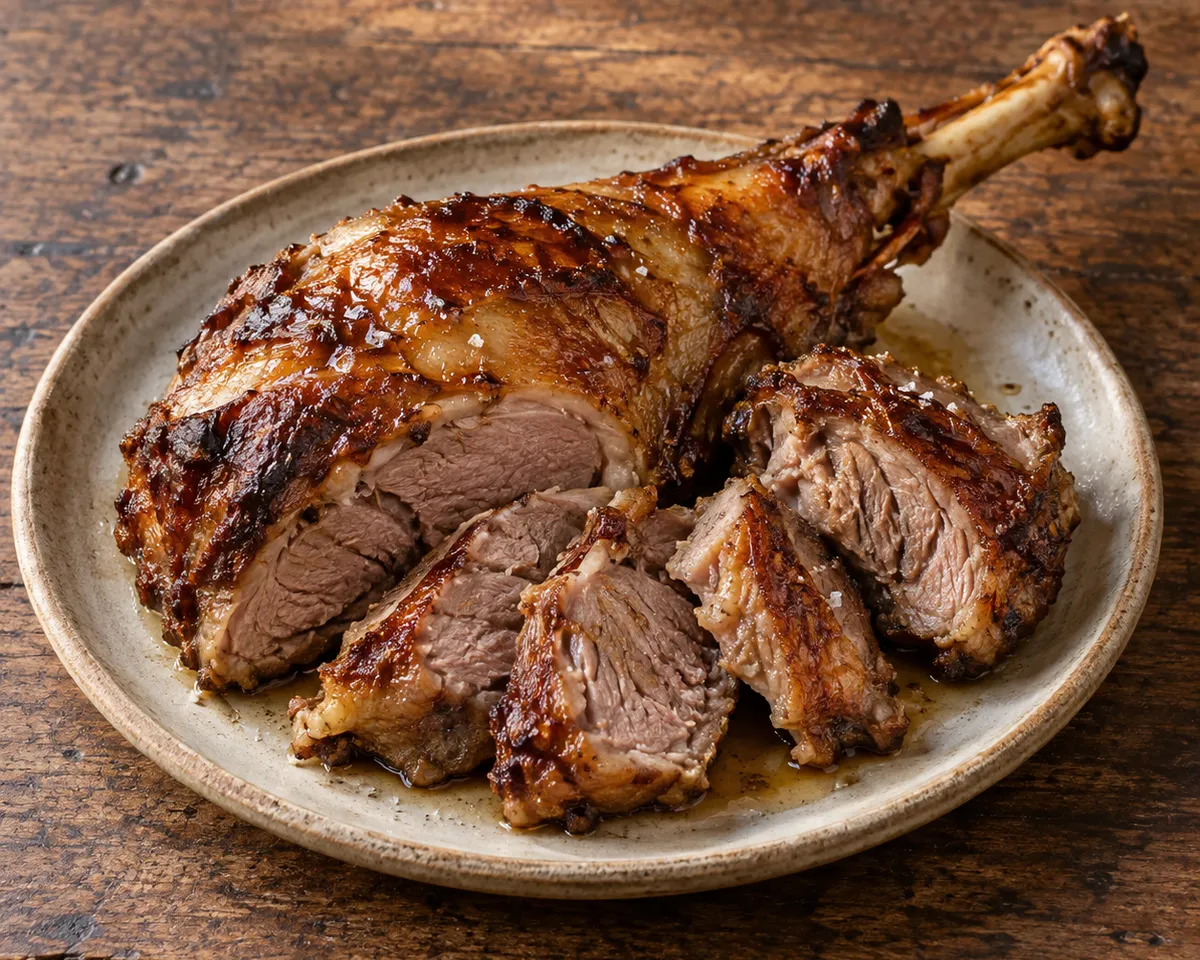
Agnello allo spiedo con miele di corbezzolo
Spit-roast lamb with bitter arbutus honey
At village scale, a whole young lamb turns slowly beside hardwood embers in a Sardinian spit roast. Its fat melts as the surface becomes crisp and bronzed, with salt added near the end. The bitter honey finish here is an adaptation that brings together two Sardinian specialties.
Miele di corbezzolo changes the usual promise of honey. Made from the autumn flowers of the strawberry tree, it is rare, pungent, and distinctly bitter, with none of acacia honey's easy sweetness. Brushed thinly onto the lamb after roasting, it adds a dark, bitter seasoning to the browned meat.
A bone-in leg on a domestic rotisserie is a smaller, quicker roast than the whole lamb. It browns evenly as it turns, leaving a savory surface for the thin honey finish.
Ingredients
For the lamb
- 1.8–2.3 kg(4–5 lb)bone-in leg of lamb, preferably from a young lamb, tied securely if needed (see note)
- 10 gfine sea salt
- 15 g(1 tbsp)fresh pork lard or rendered lamb fat, only if the surface needs basting
To finish
- 35–45 g(about 2 tbsp)Sardinian miele di corbezzolo (bitter arbutus honey; see note)
Kitchen notes
- Bone-in leg of lamb
- Use a bone-in leg that can be balanced securely on the rotisserie; a boneless rolled roast turns and bastes differently. Ask a butcher to tie loose meat firmly to the bone so it will not slip on the spit.
- Miele di corbezzolo
- This is monofloral strawberry-tree (Arbutus unedo) honey, a scarce Sardinian honey with a pungent aroma and a pronounced, persistent bitterness. It is not honey made from the tree's red fruit and it is not ordinary wildflower honey. Seek it from a specialist Italian-food or honey supplier; do not replace it with a mild honey, which would change the dish's purpose. If it cannot be found, serve the roast without honey.
- Lard or rendered lamb fat
- The traditional roast is simply salted, with hot lard dripped over it near the end only if the surface looks dry. Use plain lard or rendered lamb fat, not smoked bacon fat or butter.
Method
Set up a restrained rotisserie fire
- Take the lamb from the refrigerator 45 minutes before cooking and pat it very dry; do not rinse it. Fit it securely on a rotisserie spit, balancing it as evenly as you can. Prepare a covered charcoal or gas grill for indirect heat at 325–350°F (165–175°C), with a drip pan under the lamb and no fire directly beneath it. A charcoal fire should be a compact bed of glowing embers, not active flames.
Turn until deeply bronzed
- Set the spit turning, close the lid, and cook until the exterior is a rich, even brown and the thickest part of the leg, away from the bone, reaches 145°F (63°C), usually 1½–2 hours. Check after 75 minutes and move coals or adjust burners if one side colors faster. Rotate continuously or as often as your rotisserie allows. If a lean patch begins to look dry before the meat is done, melt the lard or rendered lamb fat and let just a little drip over it; do not baste it with a sweet sauce.
Salt late and rest
- In the last 10 minutes, season the browning surface with the salt. Once the thickest part has reached 145°F (63°C), transfer the lamb to a warm board and rest it, loosely tented, for 15 minutes before carving. The meat should be rosy but not raw at the bone.
Apply the bitter finish and carve
- Warm the corbezzolo honey only enough to make it brushable if it has crystallized. Brush a very thin film over the rested lamb, then carve into generous slices or pieces and serve at once. Do not cook the honey over direct flame or apply a thick coating: its rare bitter character is the point, and a dark, sticky crust is not.