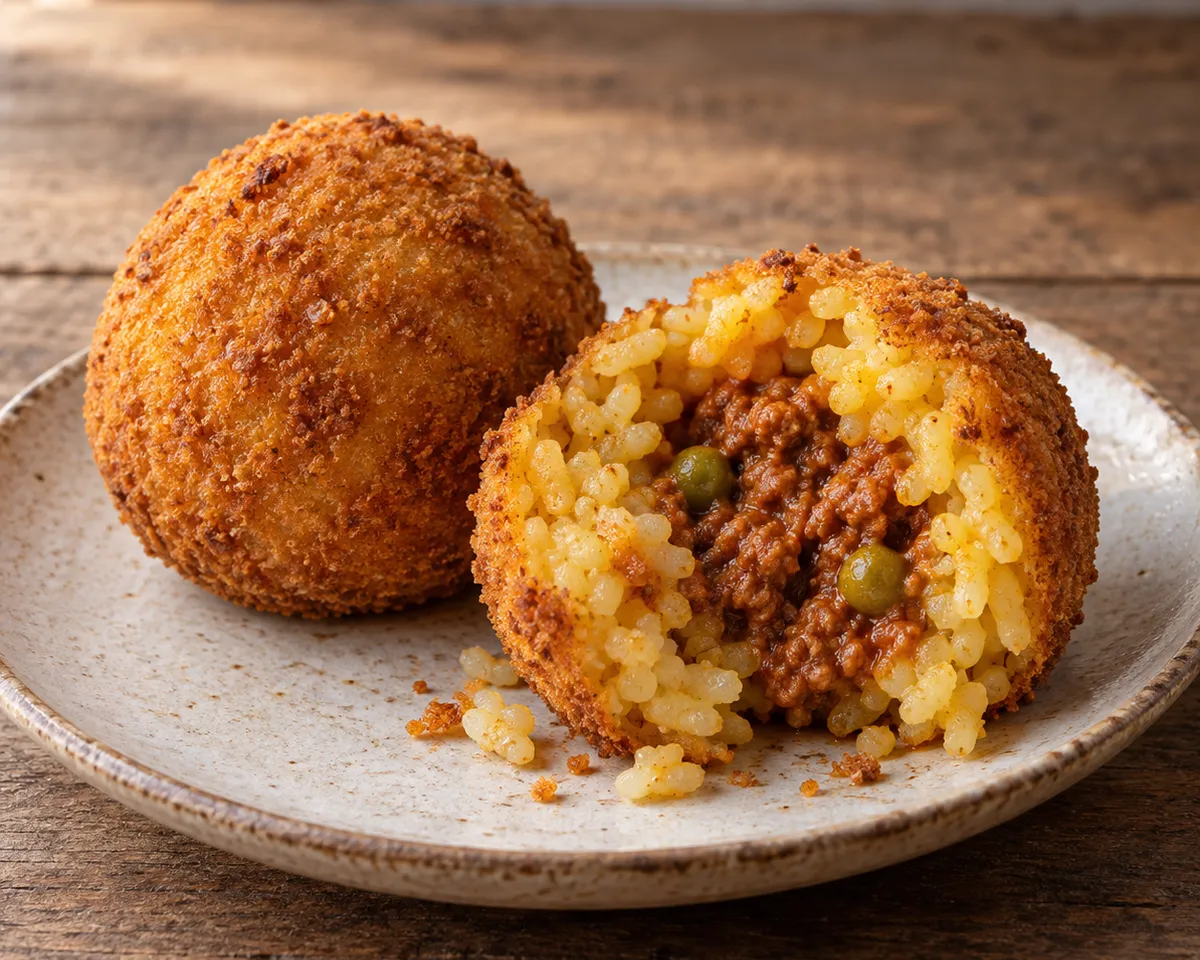
Arancina palermitana
Palermo saffron rice ball with ragù and peas
At a Palermo counter, an arancina is a gold, crisp sphere that takes its feminine name and shape from an orange. This western Sicilian street food is made with saffron in the rice and a compact center of ragù and peas.
The filling has to be thick enough to stay put. Veal, tomato and peas cook down until they are spoonable rather than saucy; the rice is tender, dry enough to handle, and perfumed with saffron. Rice and filling meet inside a thin, continuous crust.
There are other legitimate Palermo fillings, notably the buttery combination of ham and cheese. This is the classic carne version, made as a small batch for the table or a party.
Ingredients
Saffron rice
- 400 gItalian medium-grain rice, ideally Originario or another semifino rice (see note)
- 1 liter(about 4¼ cups)lightly salted beef broth
- 0.2 gsaffron threads, crushed (see note)
- 50 gunsalted butter
- 60 gParmigiano Reggiano, finely grated
- 2large eggs, lightly beaten
- fine salt
Veal ragù filling
- 30 ml(2 tbsp)extra-virgin olive oil
- 100 gyellow onion, very finely chopped
- 250 gground veal
- 150 gpassata di pomodoro
- 150 gfresh or frozen peas
- fine salt
- freshly ground black pepper
Coating and frying
- 100 gall-purpose flour
- 3large eggs, beaten
- 200 gfine, unseasoned dry breadcrumbs (see note)
- about 1.5 liters(6 1/3 cups)olive oil, or enough for deep frying
Kitchen notes
- Italian medium-grain rice
- Look for Originario or another Italian semifino rice at a specialty Italian market. Its short, starchy grain packs into a firm shell once cooled. Do not use parboiled rice or a long-grain variety; the grains will not bind in the same way.
- Saffron
- Use pure saffron threads, not a yellow rice-seasoning mix. This small quantity should scent and color the rice rather than turn it aggressively yellow.
- Passata di pomodoro
- Passata is smooth, strained tomato purée sold in bottles or jars; it is not sweetened American pasta sauce. Its job is to bind the meat and peas into a dry filling, so cook it down fully.
- Fine dry breadcrumbs
- Use finely ground, unseasoned breadcrumbs, not coarse panko. The close, even crumb makes the thin, continuous crust that keeps the rice sphere intact in the oil.
Method
Cook and cool the ragù
- Warm the olive oil in a wide skillet over medium-low heat. Cook the onion with a pinch of salt until soft and translucent, about 8 minutes, without browning it. Add the veal and cook, breaking it into very small pieces, until no pink remains. Stir in the passata and peas, season lightly with pepper, and simmer uncovered for 20–25 minutes, until the tomato clings to the meat and there is no loose liquid at the edge of the pan. Taste for salt. Spread the ragù on a plate and cool completely.
Cook the saffron rice
- Bring the broth to a lively simmer in a medium saucepan. Add the rice and cook, stirring often, until it is just al dente, about 14 minutes. Drain it thoroughly; the grains should be tender at the edge but retain a firm center, and the rice should not be soupy. Return it to the warm pot off the heat and stir in the saffron, butter, Parmigiano, and the 2 beaten eggs. Spread the rice on a large tray in a layer no deeper than 2.5 cm (1 in) and cool completely, then refrigerate until firm, at least 1 hour.
Shape the arancine
- With damp hands, take about 65 g of cold rice and press it into a 9 cm (3½ in) round in one palm. Put about 35–40 g (2 scant tbsp) of cold ragù in the center, then cover it with about 35 g more rice. Press the seam closed and roll gently into a compact sphere about the size of a small orange. Set it on a tray and repeat, dividing all the ragù among the 12 arancine; if a filling shows through, patch it with a little rice before coating.
Coat and fry
- Set out the flour, 3 beaten eggs, and breadcrumbs in three shallow dishes. Roll each arancina lightly in flour, dip it completely in egg, then coat it evenly in breadcrumbs, pressing only enough to make them adhere. Heat the oil in a deep, heavy pot to 320°F (160°C). Fry a few at a time, turning gently, until evenly golden and hot at the center, about 5–7 minutes; cut the first one open to confirm the ragù is steaming. Hold the oil near 320°F (160°C) between batches. Drain briefly on a rack or paper, salt lightly if needed, and serve hot.