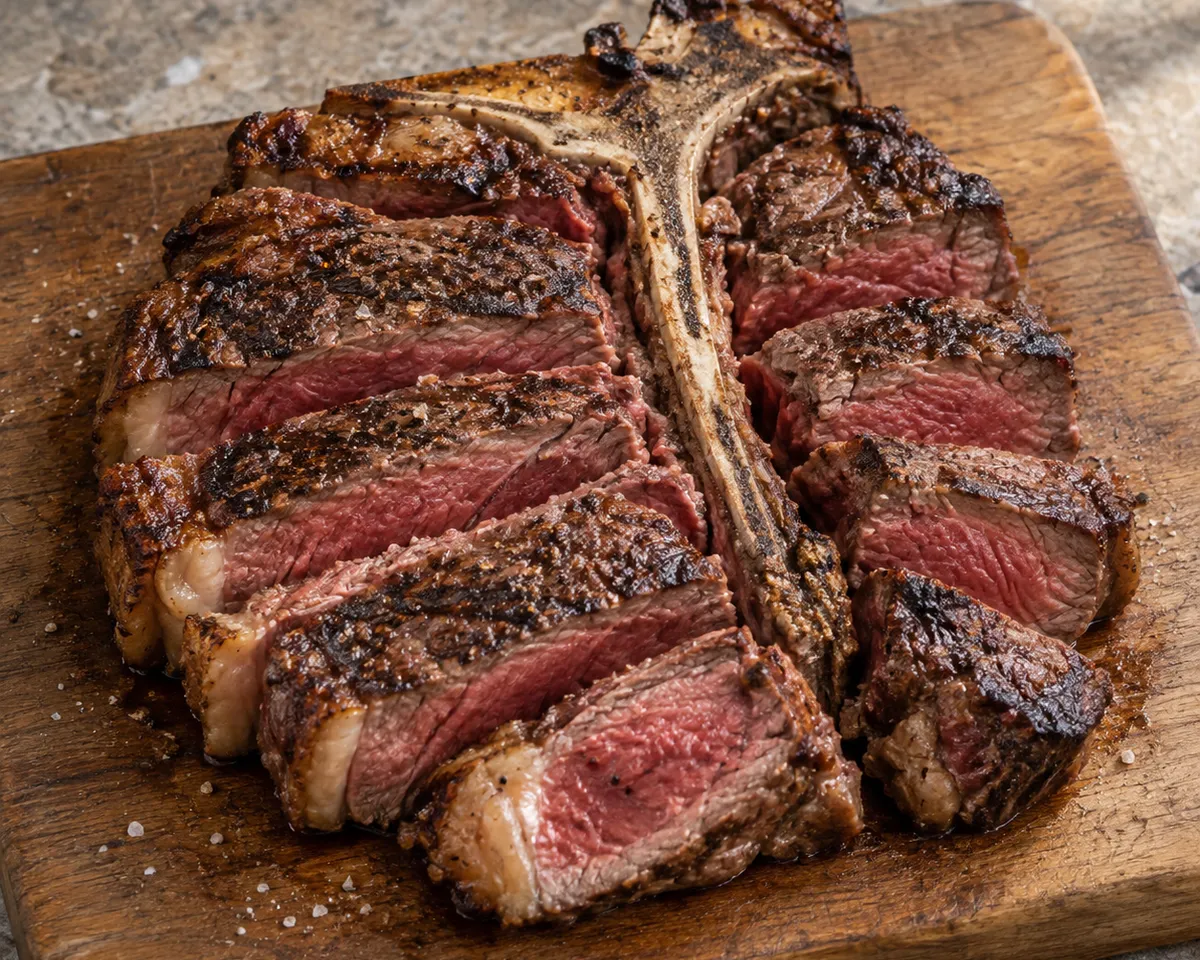
Bistecca alla fiorentina
Florentine T-bone steak
The bone sets the terms. A bistecca alla fiorentina is cut across the loin in one monumental slice, its T dividing tenderloin from strip and its thickness protecting a warm, red center while the two broad faces meet the hard heat of the coals. In Firenze, this is a steak for the table rather than the individual.
Chianina is the celebrated name, but breed alone does not guarantee a great bistecca. The animal, the care taken in raising it, and proper aging all register in a dish with nowhere to hide. Look for deep-red, well-matured beef with a clean cover of fat and a cut at least four centimeters thick; a thin steak cannot build the same dark crust and remain rare within.
The steak goes onto the grate bare. Hardwood charcoal supplies the perfume, salt and pepper arrive only after the heat, and the meat rests just long enough for its temperature to settle. The tenderloin and strip are carved away from the bone and shared while warm.
Ingredients
For the bistecca
- 1, weighing 1–1.2 kg (2¼–2⅔ lb) and 4–5 cm (1½–2 inches) thickproperly aged bone-in porterhouse or T-bone steak, with tenderloin and strip loin on opposite sides of the T-shaped bone (see note)
- fine sea salt
- black peppercorns, for grinding
Kitchen notes
- Porterhouse or T-bone
- The cut is a thick slice from the loin with tenderloin and strip loin divided by a T-shaped bone. In U.S. butcher language, a porterhouse comes from the tenderloin-rich end of the short loin; a T-bone has a smaller tenderloin. Ask for a porterhouse when possible to get the generous, nearly balanced tenderloin-and-strip profile of a Florentine bistecca. A bone-in rib steak or tomahawk is a different cut.
- Breed and aging
- Chianina is the historic showpiece, but breed alone does not determine the quality. Buy excellent, traceable beef from a butcher who can confirm that the loin was properly aged; two to four weeks of maturation is common guidance. “Aged” here describes the maturation of the beef and does not require the aggressively funky flavor of long U.S. dry-aging.
- Rare doneness
- A red, warm center around 122–125°F (50–52°C) is defining for the traditional dish. This is below the U.S. government recommendation of 145°F (63°C) followed by a 3-minute rest for whole beef steaks. People at higher risk from foodborne illness should follow that safety guidance; at that temperature, however, the result will no longer have the characteristic Florentine doneness.
- The fire
- Hardwood charcoal—traditionally oak or holm oak—gives fierce, clean heat without resinous smoke. A gas grill can reproduce the sear and rare center, but not the charcoal aroma.
Method
Temper the steak
- Take the steak from the refrigerator 1½–2 hours before cooking, unwrap it, and set it on a rack over a tray. Pat it thoroughly dry just before it goes to the grill. Do not salt it, oil it, or add a marinade. Do not leave the raw beef at room temperature for longer than 2 hours.
Prepare the charcoal
- Light enough natural hardwood lump charcoal to make a broad, even bed. When the coals are glowing fiercely under a light veil of ash and no flames remain, set a clean grate about 10–15 cm (4–6 inches) above them and let it become very hot. Keep a slightly cooler edge available by spreading the coals a little more thinly on one side; this is only for finishing the center after the crust has formed.
Grill the broad faces
- Lay the steak flat over the hottest coals. Grill without moving it until the first face has a dark brown crust, about 5–6 minutes. Turn it once with long tongs—never pierce it—and grill the second face for about 5 minutes. Control any flare-up by moving the steak briefly, not by dousing the coals. The surface should be deeply browned rather than sooty or burned.
Finish the center
- Insert an instant-read thermometer horizontally from the strip-loin side, aiming for the center and avoiding the bone. For the traditional rare result, remove the steak when the coolest central reading is 118–120°F (48–49°C). If both faces are well crusted before the center reaches that range, stand the steak on its bone over the cooler edge of the grill for a few minutes, checking every 1–2 minutes. Times vary with the fire, the exact thickness, and the starting temperature; let the thermometer and the crust decide.
Rest, season, and carve
- Set the steak on a warm board and rest it for 4–5 minutes; its center should settle around 122–125°F (50–52°C), warm and emphatically rare. Season both faces with fine salt and freshly ground black pepper. Cut the tenderloin and strip from the bone, slice them thickly across the grain, and arrange the slices around the bone. Serve immediately on warm plates.
Gas-grill fallback
- If charcoal is unavailable, preheat a gas grill with all burners on high for at least 15 minutes, then clean the grate. Just before cooking, turn one outside burner to low to create a gentler finishing area. Follow the same sear, temperature, rest, and carving instructions, moving the steak to the low burner only if the crust is ready before the center. The result is a sound home approximation, though it will not carry the aroma of hardwood charcoal.