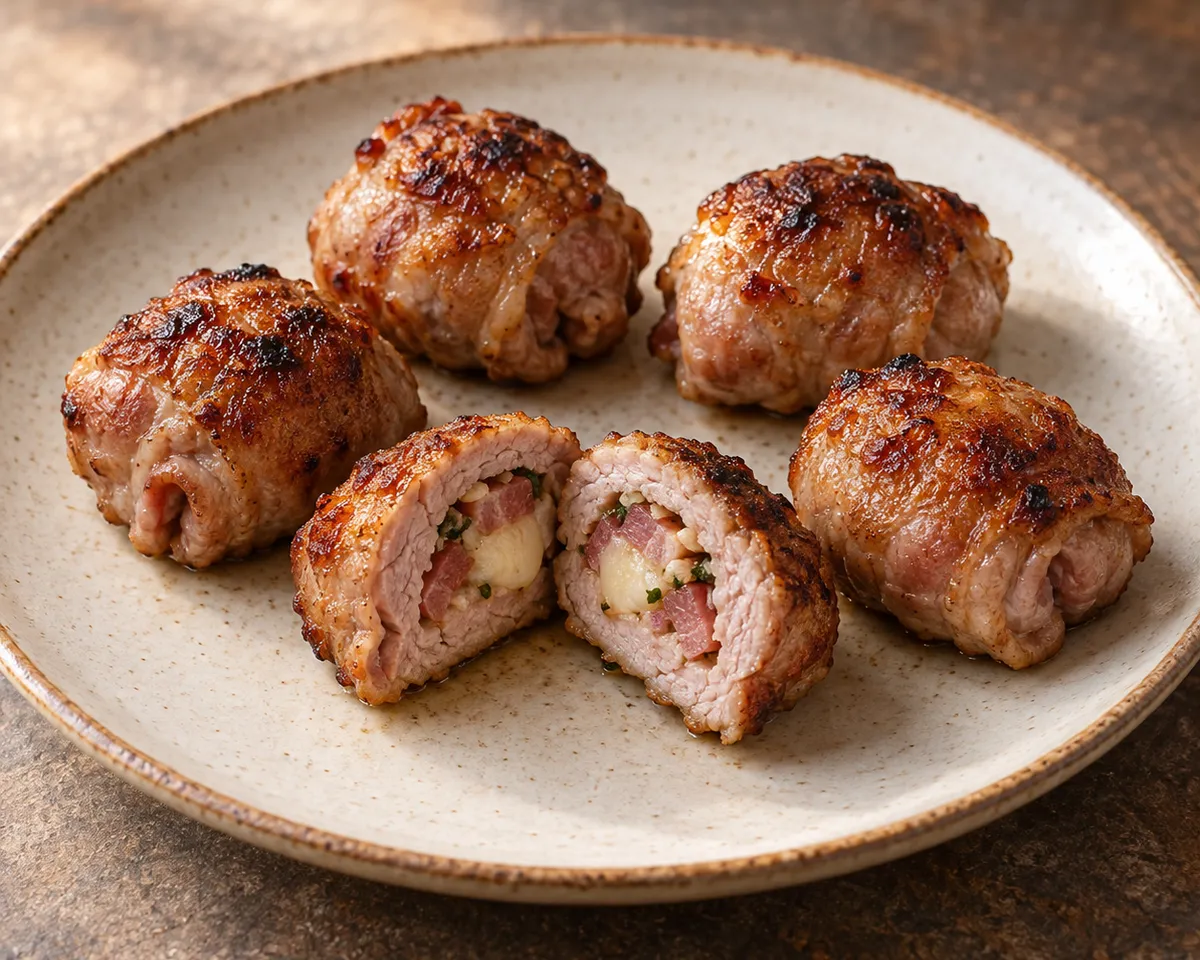
Bombette
Cisternino pork-collar rolls with caciocavallo
In Cisternino, evening often begins at the butcher's counter. Choose the meat, wait while it meets the heat of the fornello, then carry the small, hot rolls to a table outside. Bombette are designed for that immediate pleasure: pork with enough fat to stay juicy, a little melting cheese, and one or two bites before the next order arrives.
Fillings vary across the Valle d'Itria. Caciocavallo, Canestrato Pugliese, pancetta, herbs, cured pork and breadcrumbs all turn up from one shop to the next. Fresh pork collar wraps around pancetta, semi-aged caciocavallo, parsley and garlic in these Cisternino-style rolls, packed tightly enough that the cheese stays inside.
At a fornello pronto, vertical spits roast beside wood coals, catching the particular perfume of the butcher-grill. The wood heat browns the pork while the cheese melts inside.
Ingredients
For the bombette
- 600 g(about 1⅓ lb)fresh pork collar/neck (capocollo or coppa), cut into 12 thin slices (see note)
- 150 gsemi-aged caciocavallo, cut into 12 small batons (see note)
- 120 gthinly sliced pancetta tesa
- 10 g(about 3 tbsp)flat-leaf parsley, finely chopped
- 1small garlic clove, very finely chopped
- 3 g(about ½ tsp)fine sea salt
- 2 g(about 1 tsp)freshly ground black pepper
- 15 ml(1 tbsp)extra-virgin olive oil
Kitchen notes
- Fresh pork collar/neck (capocollo or coppa)
- This is the fresh, well-marbled pork cut from the neck/upper shoulder, not dry-cured capicola or capocollo from the deli case. Ask a butcher for fresh pork collar, coppa roast, or neck steak sliced thinly across the grain.
- Semi-aged caciocavallo
- Choose Italian caciocavallo that is firm enough to cut yet still melts readily. It is a pasta-filata cheese, not a generic shredded pizza blend. Its savory, elastic melt fills the center of the roll.
- Fornello pronto
- Cisternino's butcher-grills traditionally roast bombette on vertical spits in indirect wood heat. The rack-and-broiler method is the closest practical home treatment, though it cannot supply the original wood-fire aroma.
Method
Prepare the filling
- Heat the oven to 400°F (200°C). Set a wire rack over a rimmed baking sheet and brush the rack lightly with the olive oil. Mix the parsley and garlic together. If the pork slices are thicker than about 3 mm (⅛ inch), place them between sheets of parchment and pound them gently until even; they must be pliable but not torn.
Shape the rolls
- Season only the pork, and do so lightly, with the salt and pepper; the pancetta and caciocavallo will season the center. Lay one pancetta slice on each piece of pork. Put one caciocavallo baton and a pinch of the parsley-garlic mixture just below the center. Fold the nearer short end over the filling, then fold both long sides inward. Roll toward the remaining short end to make a compact parcel, and secure the seam with a toothpick. Do not overfill: the cheese should be enclosed by pork on every side.
Roast
- Arrange the bombette seam-side down on the rack, leaving space between them. Roast, turning once after about 14 minutes, until deeply browned in spots and the center of the cheese-and-pancetta filling reaches 165°F (74°C), usually 22–28 minutes. Begin checking at 20 minutes with a thin instant-read thermometer, inserting it through the side into the middle of the filling. If they need more color once the center is safe, move the tray under a hot broiler for 1–2 minutes, watching closely. Rest for 3 minutes so the cheese settles instead of spilling at the first cut.
Serve
- Remove the toothpicks and serve the bombette at once, while the caciocavallo is still fluid. They are substantial beside a simple salad or roasted vegetables, but their natural setting is more direct: hot from the fire, with good bread nearby.