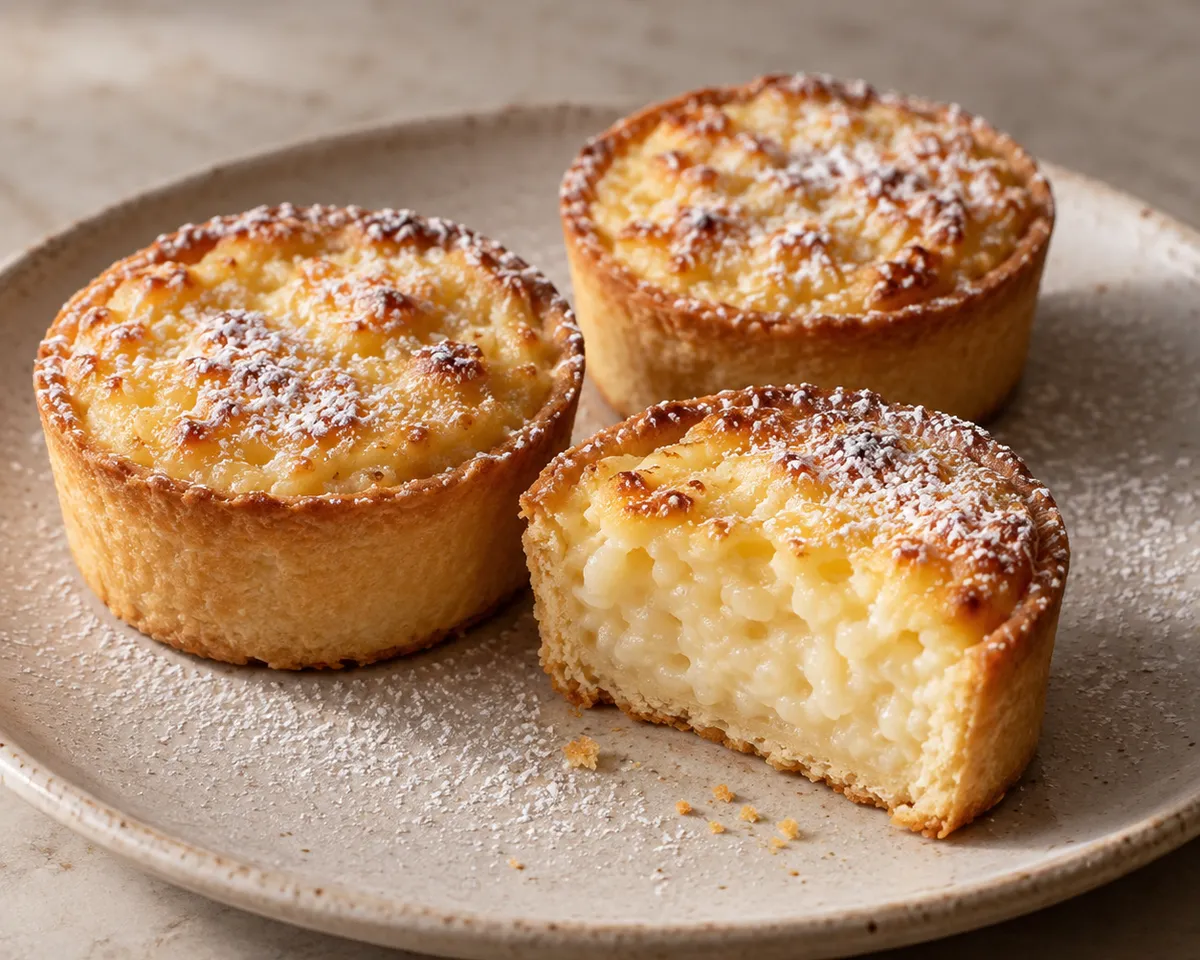
Budino di riso
Florentine rice-pudding tartlets
At a Florentine bar, the budino di riso has a shell of sweet shortcrust pastry, browned at its rim, holding rice that has gone soft and fragrant in milk. It is a breakfast pastry, but it behaves more like a proper little dessert than a hurried cornetto. The name is deceptive. There is no spoonable pudding here, only a crisp container and a filling just set enough to slice.
The rice is cooked slowly until the milk has nearly disappeared, then folded with pastry cream to make a soft, set filling. Orange, lemon, and vanilla are the traditional bright notes; their perfume runs through the milk-rich filling.
Shape, sweetness, and the balance of rice to cream vary across Florence's bakery cases. Eat one barely warm or at room temperature, when the shell still snaps and the center has settled.
Ingredients
For the pastry shells
- 300 gunbleached all-purpose flour (see note)
- 150 gunsalted butter, cool and cut into small pieces
- 85 gconfectioners' sugar
- 1large egg
- 2large egg yolks
- ½orange, finely grated zest only
- 1 gfine sea salt
For the rice filling
- 600 g(2½ cups)whole milk
- 150 gItalian Originario rice or Carnaroli rice (see note)
- 100 ggranulated sugar
- 1vanilla bean, split and scraped
- 1orange, finely grated zest only
- ½lemon, finely grated zest only
- 1 gfine sea salt
- 15 gunsalted butter
For the pastry cream and finish
- 350 g(1½ cups)whole milk
- 80 gconfectioners' sugar
- 35 gunbleached all-purpose flour
- 1large egg
- 1large egg yolk
- ½orange, finely grated zest only
- ½lemon, finely grated zest only
- confectioners' sugar, for dusting
Kitchen notes
- Rice
- Riso Originario is a small, round Italian rice that absorbs milk readily. Carnaroli is also used for Tuscan rice tartlets; either works here. Avoid long-grain rice, basmati, or parboiled rice, which do not give the same soft, cohesive filling.
- All-purpose flour
- Ordinary unbleached all-purpose flour works for this butter-rich, thin pastry; bread flour's extra strength is undesirable. Keep the dough cool and roll it thin.
- The filling
- Let both the cooked rice and pastry cream cool before folding them together; a warm filling softens the butter pastry.
Method
Make the frolla and let it rest
- Pulse or rub together the flour, butter, confectioners' sugar, salt, and orange zest until the butter is in fine, sandy pieces. Add the egg and yolks and bring the dough together quickly; press it into a flat disk without kneading it smooth. Wrap and refrigerate for at least 1 hour. The dough should be firm and cool when rolled, so the shells stay thin rather than slumping.
Cook the rice until it is creamy, not loose
- Put the 600 g milk, sugar, vanilla bean and seeds, orange zest, lemon zest, and salt in a heavy saucepan. Bring just to a simmer, add the rice, and cook over low heat for about 20 minutes, stirring often and scraping the bottom, until the grains are tender and the milk has been almost entirely absorbed. Remove the vanilla bean, stir in the butter, and spread the rice in a shallow bowl to cool completely. It should be glossy and thick enough to mound on a spoon, never soupy.
Make the pastry cream
- Whisk the confectioners' sugar and flour together in a heatproof bowl, then whisk in the egg and yolk until smooth. Heat the 350 g milk with the orange and lemon zest until steaming. Whisk a ladleful of hot milk into the egg mixture, then return everything to the saucepan. Cook over medium-low heat, whisking steadily, until the cream bubbles once or twice and has the thickness of soft mashed potatoes, about 1–2 minutes. Scrape into a shallow bowl, cover the surface, and cool completely. Fold the cooled cream into the cooled rice.
Line and fill the tins
- Heat the oven to 350°F (180°C). Butter a standard muffin tin; use two tins or bake in batches. Roll the chilled dough 2.5–3 mm (about ⅛ inch) thick. Cut about fifteen 12–12.5 cm (about 5-inch) rounds, rerolling scraps once, and ease them into the cups without stretching. Trim each rim level with the top of the cup. Divide the rice filling among the shells, leaving a little space at the top, then tap the tin once on the counter to level the tops. If baking in batches, keep the remaining dough and filling chilled.
Bake until the rims are golden and the centers are set
- Bake for 20 minutes, then lower the oven to 325°F (160°C) and bake 8–12 minutes more, until the pastry is golden at the edges and the filling looks set with only a slight wobble at its center. Cool in the tin for 15 minutes; run a thin knife around any stuck edge and lift out the tartlets. Dust lightly with confectioners' sugar once warm rather than hot.