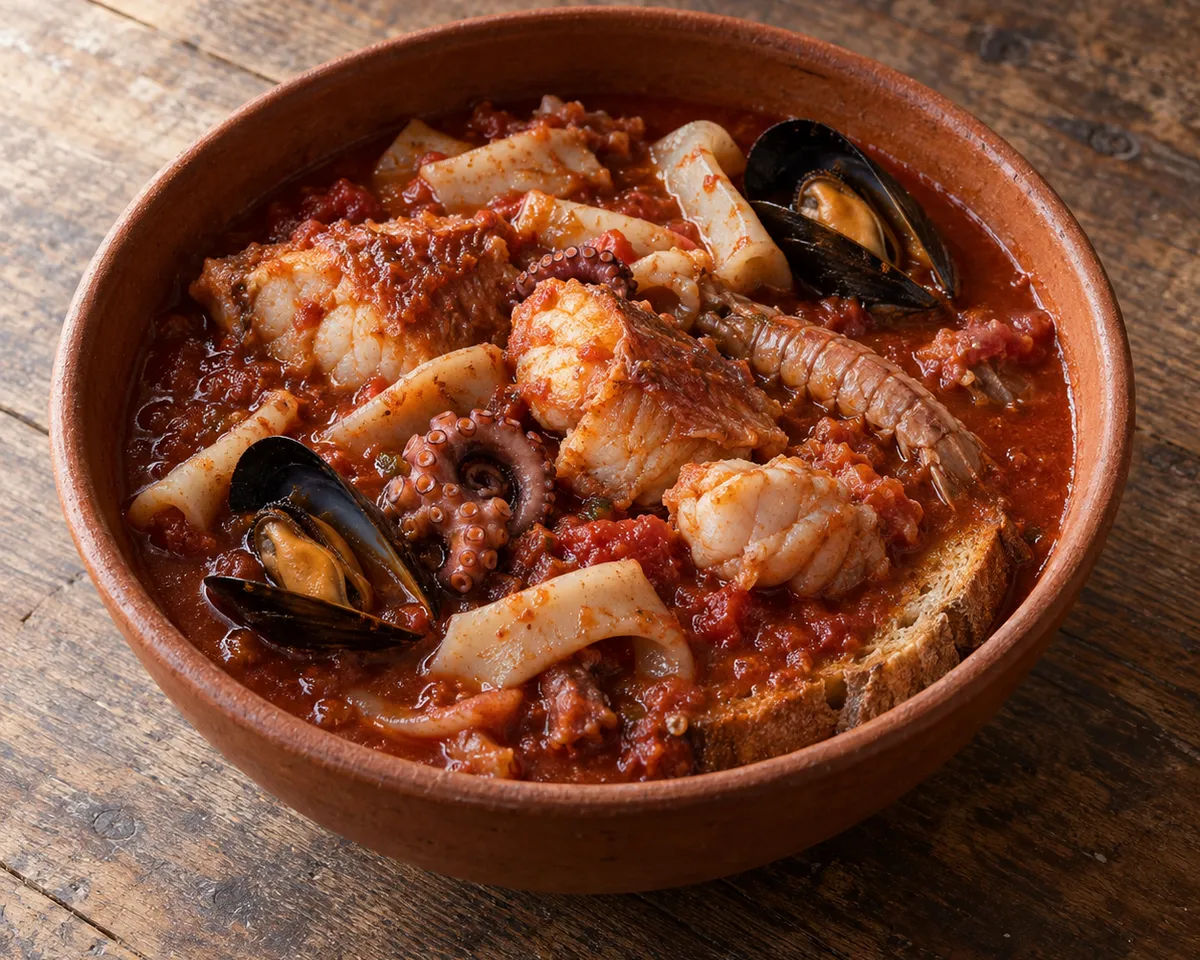
Cacciucco alla livornese
Livornese tomato and mixed-seafood stew
Cacciucco announces itself before the spoon reaches the bowl: dark tomato, garlic, chile, and the concentrated scent of the sea. In Livorno, this is a stew with edges. It should be thick enough to soak the bread, but loose enough that every fish, tentacle, and shellfish arrives in its own small pool of sauce.
The catch changes from day to day, but the stew combines several kinds of fish with octopus, cuttlefish, and shellfish. Bony soup fish give the broth body, while the cephalopods supply substantial pieces that hold their texture through the longer simmer.
Each kind of seafood has its own cooking time. Octopus and cuttlefish need time in the red base; tender fish, mussels, and crustaceans join late, after the base has cooked down. Toasted, garlic-rubbed bread is not an optional crouton. Put it in the bowl first and let it take on the broth at the table.
Ingredients
For the seafood and stock
- 900 g (about 2 lb) prepared weightmixed red gurnard (gallinella) and scorpionfish (scorfano), scaled and gutted, heads and trimmings removed for stock, remaining bone-in fish cut into serving pieces (see note)
- 350 g(about 12 oz)monkfish tail, trimmed and cut into 4 cm (1½-inch) pieces (see note)
- 650 g(about 1½ lb)cleaned octopus, cut into 3 cm (1¼-inch) pieces
- 300 g(about 10½ oz)cleaned cuttlefish, cut into wide strips
- 250 g(about 9 oz)mussels, scrubbed and debearded
- 250 g(about 9 oz)mantis shrimp (canocchie), rinsed (see note)
- 1.25 L(5¼ cups)cold water
For the tomato base
- 100 ml(scant ½ cup)extra-virgin olive oil, divided
- 1medium yellow or red onion, finely chopped
- 1small carrot, finely chopped
- 1celery rib, finely chopped
- 5garlic cloves, divided
- 8fresh sage leaves
- 1fresh red chile, split lengthwise, or dried chile to taste
- 150 ml(⅔ cup)dry Tuscan-style red wine
- 650 g(about 2¾ cups)tomato passata
- 45 g(3 tbsp)tomato paste
- fine salt and freshly ground black pepper
To serve
- 6 thick slices (about 360 g total)day-old naturally leavened country bread
- 1garlic clove, halved
- extra-virgin olive oil, for finishing
Kitchen notes
- The seafood selection
- Cacciucco is built from several categories of modest local catch, not a fixed list of five species. Italian pesci di scoglio is a culinary habitat category, not a synonym for a U.S. package labeled “rockfish,” which may be an unrelated Pacific species or striped bass. Ask a good fishmonger for red gurnard, scorpionfish, and monkfish; keep the bone-in gurnard and scorpionfish portions for the stew and use only the separated heads and trimmings for stock. Do not replace the mixture with a single expensive fish or with lobster.
- Mantis shrimp (canocchie)
- These slender crustaceans are characteristic of Livornese cacciucco. Buy them from a seafood market that can identify them as mantis shrimp or canocchie; they are not langoustines. Keep them in the shell so their delicate flesh does not disappear into the sauce.
- Monkfish (rana pescatrice)
- Rana pescatrice is monkfish, a firm-fleshed fish used alongside the bony soup fish. Its firm tail stays in large pieces through the short final simmer.
- Garlic bread
- The bread is part of the dish. Use a crusty, day-old naturally leavened loaf, toast it, and rub it with raw garlic while hot. It belongs under the stew or at the edge of the bowl, never as buttered garlic toast.
Method
Make a short fish stock
- Check that the fishmonger has removed the gills from the separated gurnard and scorpionfish heads. In a wide, heavy pot, warm 20 ml of the olive oil with 1 crushed garlic clove and 3 sage leaves over medium heat until fragrant, about 1 minute. Add the heads and trimmings and turn them for 3–4 minutes without browning the garlic. Pour in the cold water, bring just to a simmer, skim once, and cook quietly for 25 minutes. Strain into a clean bowl, pressing the solids gently; you need about 750 ml (3 cups). Keep it hot.
Build the red base and tenderize the cephalopods
- Wipe out the pot. Warm the remaining 80 ml olive oil over medium-low heat. Add the onion, carrot, celery, 4 finely sliced garlic cloves, remaining sage, and chile. Cook, stirring, until the vegetables are soft and sweet but not colored, 10–12 minutes. Add the octopus, raise the heat to medium, and turn it in the aromatics for 2 minutes. Add the red wine and let it reduce by about half. Stir in the passata, tomato paste, and 500 ml (2 cups) of the hot stock. Bring to a gentle simmer, cover partly, and cook 25 minutes. Add the cuttlefish and continue gently until the octopus yields easily to a skewer and the cuttlefish is tender, usually another 15–20 minutes. Start checking 15 minutes after adding the cuttlefish, and wait until both it and the octopus are tender before adding the fish; add a splash more stock if the sauce tightens too much.
Add the fish in stages
- Taste the sauce and season lightly; the mussels will add their own salinity. Lay in the monkfish and the bone-in gurnard and scorpionfish pieces, keeping the fish mostly submerged. Simmer very gently, without stirring hard enough to break it, for 8 minutes. Add the mantis shrimp and mussels, cover, and cook 3–5 minutes more, shaking the pot once or twice, until the mussels have opened and the fish flakes at the bone. Discard any mussels that remain closed. The sauce should be intense, tomato-red, and fluid enough to moisten the bread; loosen with the remaining hot stock if needed.
Toast the bread and serve
- While the seafood finishes, heat the oven to 450°F (230°C). Put the bread directly on a rack or on a sheet pan and toast until crisp at the edges but still chewy at the center, 6–8 minutes. Rub one side of every hot slice with the cut garlic. Put a slice in each warm bowl, ladle over the seafood and sauce, and finish with a thread of olive oil and black pepper. Serve immediately, with bowls for shells and bones.