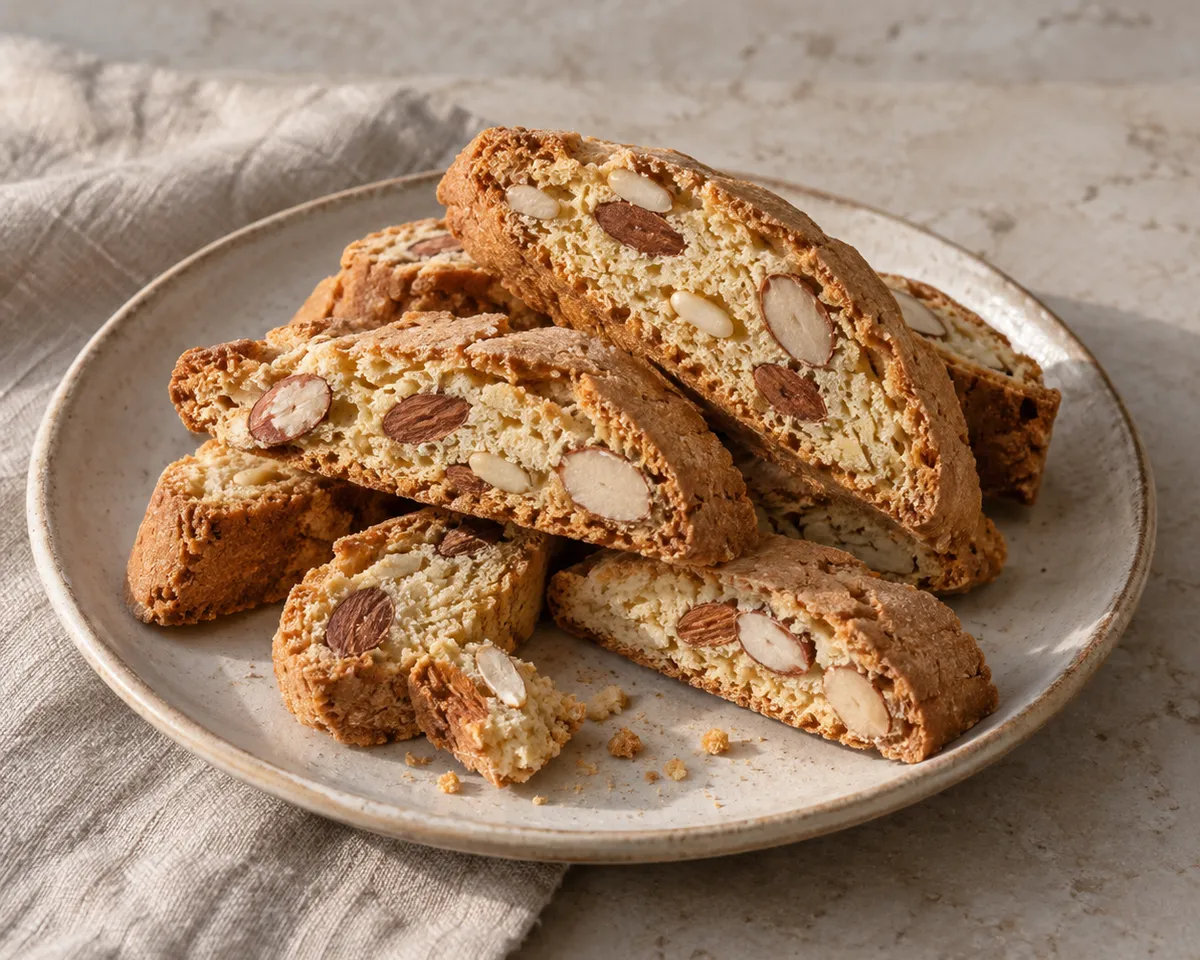
Biscotti di Prato
Prato's twice-baked almond biscuits
Biscotti di Prato are hard, friable almond biscuits from the city whose name has become casually entangled with cantucci everywhere else. The family resemblance is real, but the local name carries a particular expectation of a dry, clean break and an almond in nearly every bite.
The dough is austere in the best Tuscan manner. Eggs provide its only richness; there is no butter or oil to soften the texture. Whole skin-on almonds, a few pine nuts, and a short second bake give the sliced loaves their crack. The irregular diagonal cut is practical too: it leaves a broad surface to catch a quick dip of Vin Santo.
An eighteenth-century Prato manuscript records the biscuits; Antonio Mattei's bakery, opened in 1858, helped make the city's version famous far beyond Tuscany.
Ingredients
For the biscotti
- 250 gunbleached all-purpose flour (see note)
- 235 ggranulated sugar
- 150 gwhole unblanched almonds, lightly toasted and cooled (see note)
- 25 gpine nuts
- 2large eggs, at room temperature
- 8 g(2 tsp)baking powder
- 1 g (a generous pinch)fine sea salt
For finishing
- 1egg, beaten with 1 tsp water
Kitchen notes
- Flour
- Ordinary unbleached all-purpose flour gives the biscuits their dry, friable texture. Self-rising flour adds unwanted leavener; cake flour and high-protein bread flour change the crumb.
- The name
- Biscotti di Prato is the city's local name for these friable almond biscuits. Cantucci is a familiar broader Tuscan name.
- Almonds and pine nuts
- Use whole almonds with their brown skins, not blanched, slivered, or almond flour. Light toasting brings out the almonds' aroma; the smaller quantity of pine nuts adds a softer, richer bite.
- No added fat
- Do not enrich these with butter, oil, milk, or cream. Egg supplies the richness; the dry, dip-ready texture comes from that lean dough and the second baking.
- Vin Santo
- Vin Santo is the traditional companion, not an ingredient in this dough. It is easy to find through Italian wine shops, but the biscuits are complete on their own; no substitute is needed for baking.
Method
Toast the almonds and make a firm dough
- Heat the oven to 350°F (180°C). Spread the almonds on a small baking sheet and toast just until fragrant, 6–8 minutes; they should not darken noticeably. Cool completely. Whisk the flour, sugar, baking powder, and salt in a large bowl. Make a well, add the 2 eggs, and work them into the dry ingredients with a fork, then your hands, until a rough, firm dough forms. Work in the cooled almonds and pine nuts just until evenly distributed. It may look a little dry at first, but do not add butter, oil, or liquid; keep pressing and folding until it holds together.
Shape and first-bake the loaves
- Line a large baking sheet with parchment. Divide the dough in two and, on the sheet, shape each piece into a loaf about 25 cm (10 inches) long and 4 cm (1½ inches) wide. Leave at least 8 cm (3 inches) between them; they spread. Brush lightly with the beaten egg. Bake at 350°F (180°C) until the loaves are golden, puffed, and firm enough to slice but still give slightly when pressed, 25–30 minutes. Transfer the sheet to a rack and let the loaves stand for 8–10 minutes.
Slice warm and bake again
- Lower the oven to 325°F (165°C). With a sharp serrated knife, cut the warm loaves diagonally into slices about 1.5 cm (½–¾ inch) thick, using a gentle sawing motion so the nuts do not tear the crumb. Lay the slices cut-side down on the baking sheet. Bake 5 minutes, turn every piece, and bake another 5–7 minutes, until dry at the center and a shade deeper at the edges. They will crisp further as they cool.
Cool completely
- Cool the biscotti in a single layer on a rack. When completely cold, they should snap cleanly rather than bend. Store airtight for up to two weeks, and serve with Vin Santo if you like; dip one briefly rather than leaving it to collapse in the glass.