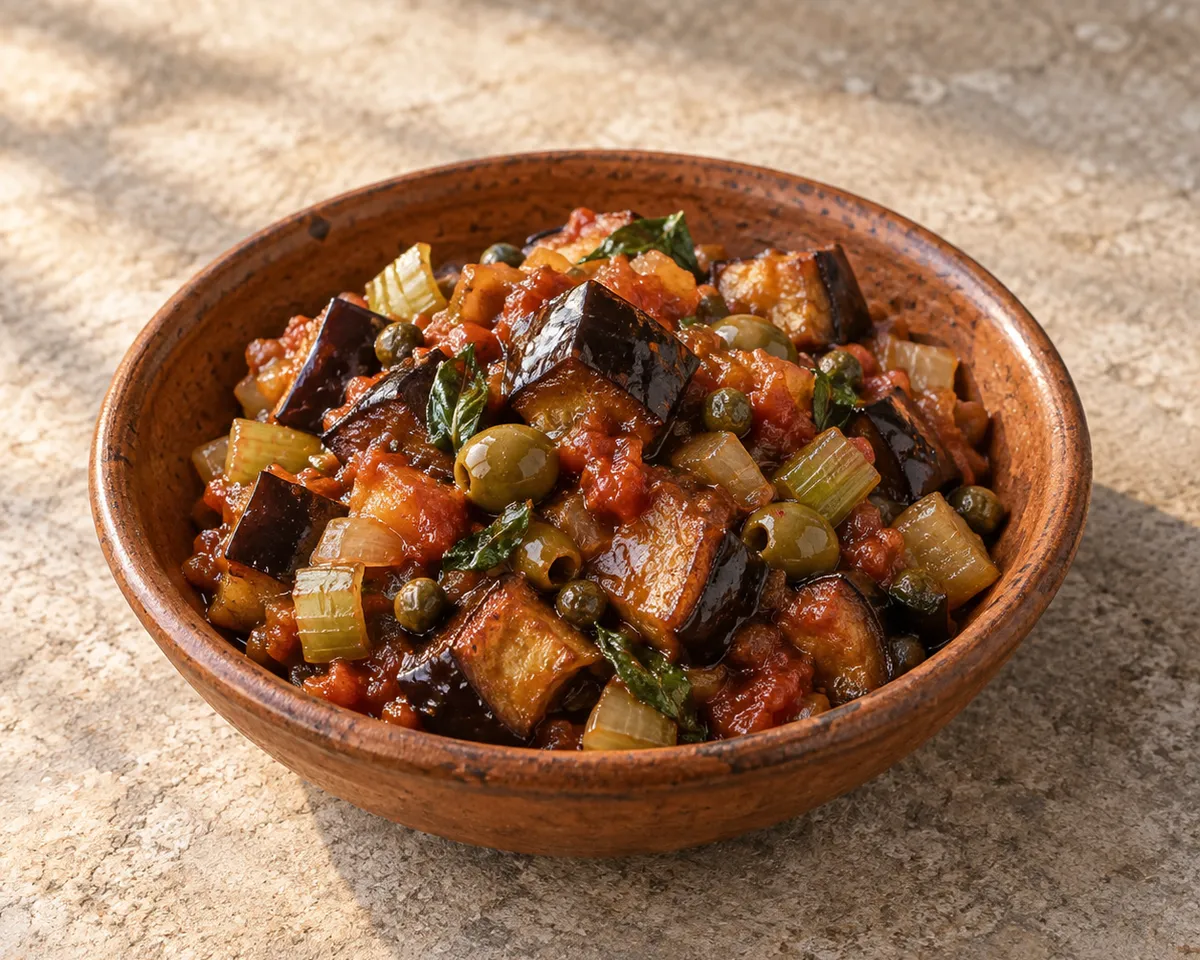
Caponata
Palermo-style sweet-and-sour eggplant
Caponata works because its parts do not dissolve into one another. The eggplant keeps its browned edges; celery stays recognizable; olives and capers arrive in salty flashes. The agrodolce is the last connective stroke, sweet enough to round the vinegar and sharp enough to wake every vegetable back up.
Sicily has many caponate. Around Palermo, fried eggplant, celery, onion, tomato, green olives, capers, and basil make a particularly savory combination, with the olives' mild bitterness balancing the sweetened vinegar.
Give it a night. Fresh from the pan, the vinegar stands at attention; by the next day it has moved into the vegetables. Serve the caponata cool or at room temperature, with good bread if you like, but never straight from the refrigerator.
Ingredients
For the eggplant
- 900 g(2 lb)firm long purple or black eggplant, cut into 2 cm (¾-inch) cubes (see note)
- coarse salt, for draining
- peanut or other neutral high-heat oil, for frying
For the caponata
- 250 gcelery hearts and tender inner ribs, strings removed and cut into 1 cm (⅜-inch) pieces
- 180 gyellow onion, thinly sliced
- 400 gtomato passata
- 100 gfirm green olives in brine, pitted and roughly chopped (see note)
- 35 gsalt-packed capers, well rinsed and drained (see note)
- 45 ml(3 tbsp)red-wine vinegar
- 25 g(2 tbsp)granulated sugar
- 45 ml(3 tbsp)extra-virgin olive oil
- 10fresh basil leaves, torn
- fine salt
Kitchen notes
- Eggplant
- Choose firm, long purple or black eggplant with glossy skin. Long, dense-fleshed types hold their shape through frying and the final fold into the sauce.
- Salt-packed capers
- These are capers cured in salt, not the shelf-stable capers floating in vinegar brine. Rinse them well and taste one before adding salt elsewhere. Look for them at specialty Italian markets.
- Green olives
- Use firm, briny green table olives, ideally Sicilian-style, rather than soft canned black olives. Their mild bitterness is part of the dish's counterweight to tomato and sugar.
Method
Drain and fry the eggplant
- Put the eggplant in a colander, salt it generously, and weigh it down with a plate. Leave it for 45–60 minutes. Rinse quickly, then squeeze gently and dry very thoroughly. Heat 4–5 cm (about 1½–2 inches) of neutral oil in a wide heavy pan to 350°F (175°C). Fry in small batches until the cubes are tender through and deeply golden at the edges, 4–6 minutes per batch. Drain on a rack or paper towels. The eggplant should be browned and soft, not pale and oil-soaked.
Blanch the celery
- Bring a small saucepan of lightly salted water to a boil. Blanch the celery for 3–4 minutes, until the raw bite is gone but the pieces are still green and have some firmness. Drain well.
Build the vegetable base
- Warm the olive oil in a wide skillet over medium-low heat. Add the onion and a pinch of salt; cook until soft, sweet, and translucent without browning, about 8 minutes. Add the celery, olives, and capers and cook for 2 minutes. Stir in the passata and simmer until it is reduced to a light coating sauce rather than a pool, about 10 minutes.
Make the agrodolce
- Stir the vinegar and sugar together until the sugar is mostly dissolved. Add it to the simmering vegetables and cook for 1–2 minutes, until the raw vinegar smell has lifted. Taste: it should be clearly sweet-sour, not sugary or harsh. Fold in the fried eggplant with a broad spoon, turning just enough to coat it without breaking the cubes. Cook for 2 minutes, then take the pan off the heat and fold in the basil.
Rest before serving
- Transfer to a shallow dish and cool uncovered. Refrigerate overnight if possible, then bring it back to cool room temperature before serving. Taste after the rest and correct only with a few drops of vinegar or a pinch of salt if the balance needs it.