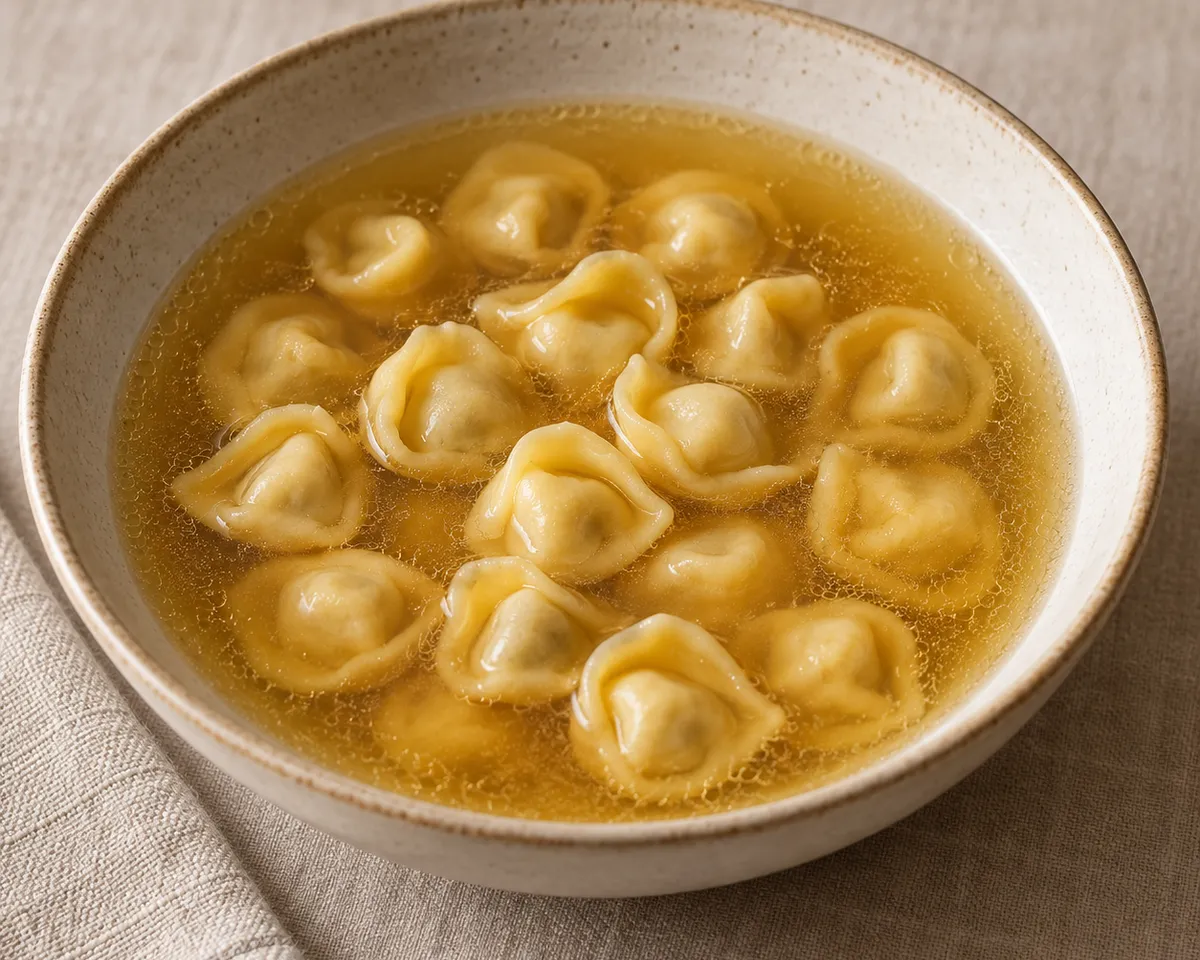
Cappelletti in brodo
Rimini-style little hats in clear broth
At a Romagna holiday table, the first spoonful is usually broth: clear, hot, and crowded with small parcels of pasta. The local word is caplèt, and its little brim distinguishes it from the tighter Bolognese tortellino. Each household has an opinion about the filling.
Around Rimini, the filling often takes a more substantial path than it does farther north in Romagna. Pork and beef join ricotta and Parmigiano, with lemon zest and nutmeg lifting the rich mixture. The parcels are not delicate in the fussy sense; they are built to be made in quantity, then cooked gently enough to stay closed and tender.
A good brodo keeps the dish from becoming heavy. Make it clear and deeply chickeny, with enough body to carry the pasta but not so much fat that it blurs the fresh cheese and lemon in the compenso, the Romagnol name for the filling.
Ingredients
For the pasta
- 200 g00 flour or all-purpose flour, plus more for the work surface
- 2large eggs
For the Rimini-style filling
- 75 gground pork
- 75 gground beef
- 5 ml(1 tsp)extra-virgin olive oil
- 150 gwhole-milk ricotta, well drained
- 50 gfinely grated Parmigiano Reggiano
- 1large egg yolk
- 1 tspfinely grated untreated lemon zest
- 1 generous pinchfreshly grated nutmeg
- fine salt and freshly ground black pepper
For the brodo
- 1 kg(about 2¼ lb)bone-in capon pieces, preferably including back, neck, wings, and legs
- 450 g(1 lb)beef shank, bone in
- 1small yellow onion, peeled and halved
- 1medium carrot, peeled and halved
- 1celery stalk, halved
- 3.5 L(about 15 cups)cold water
- fine salt
Kitchen notes
- Rimini-style filling
- Cappelletti vary sharply across Romagna. Around Rimini, a mixed-meat compenso may include ricotta, Parmigiano, nutmeg, and lemon. Elsewhere, cheese-only fillings and other combinations of meat are common.
- Brodo
- This capon-and-beef broth is part of the recipe, not a purchased shortcut. Keep it plain: no tomato, wine, garlic, or assertive herbs. A clear, deeply flavored broth complements the filling's cheese and lemon.
Method
Make the brodo
- Make the broth before beginning the pasta. Put the capon, beef shank, onion, carrot, celery, and cold water in a stockpot. Bring it slowly just to a simmer, skimming off any foam that rises. Keep it at the barest simmer for about 2 hours; a hard boil will cloud the broth and toughen the meat. Salt only toward the end, then strain carefully through a fine sieve. Keep 2.5 L (about 10½ cups) hot over the lowest heat for service, or cool it promptly, refrigerate it, and reheat it gently when ready to cook the pasta; reserve any extra for another meal.
Make and rest the dough
- Mound the flour on the work surface, make a well, and add the eggs. Draw the flour in with a fork, then knead until the dough is smooth, elastic, and no longer tacky, about 8–10 minutes. Wrap and let it rest at room temperature for at least 30 minutes; the dough should relax enough to roll thinly without snapping back.
Cook and season the filling
- Warm the olive oil in a small skillet over medium heat. Add the pork and beef, season lightly, and cook while breaking up the meat until no pink remains and the moisture has cooked away. Cool completely. Mix with the ricotta, Parmigiano, egg yolk, lemon zest, nutmeg, and a few grinds of pepper. Taste a small bit only after cooking it in the skillet or microwave, then adjust the salt. The compenso should be moist enough to hold together, but never loose or wet.
Shape the cappelletti
- Roll the dough into thin sheets, about 1 mm thick. Cut 4 cm (1½ in) rounds with a cutter. Put a scant ½ teaspoon filling in the center of each round. Fold into a half-moon, pressing out trapped air and sealing the edge firmly; then bring the two points together around a fingertip and pinch to make a small hat. Keep the finished pasta on a lightly floured tray, covered loosely with a clean towel. Gather and reroll scraps once only.
Cook in broth
- Return 2.5 L of the strained broth to a wide pot and bring it to a gentle simmer; it should move quietly, not boil hard enough to batter the pasta. Add the cappelletti in batches if needed and stir once, gently, to free any that settle. Cook until the pasta is tender and the filling is hot, usually 3–5 minutes depending on thickness. Let them sit in the broth for 1 minute, then ladle into warm bowls with plenty of broth and serve immediately.