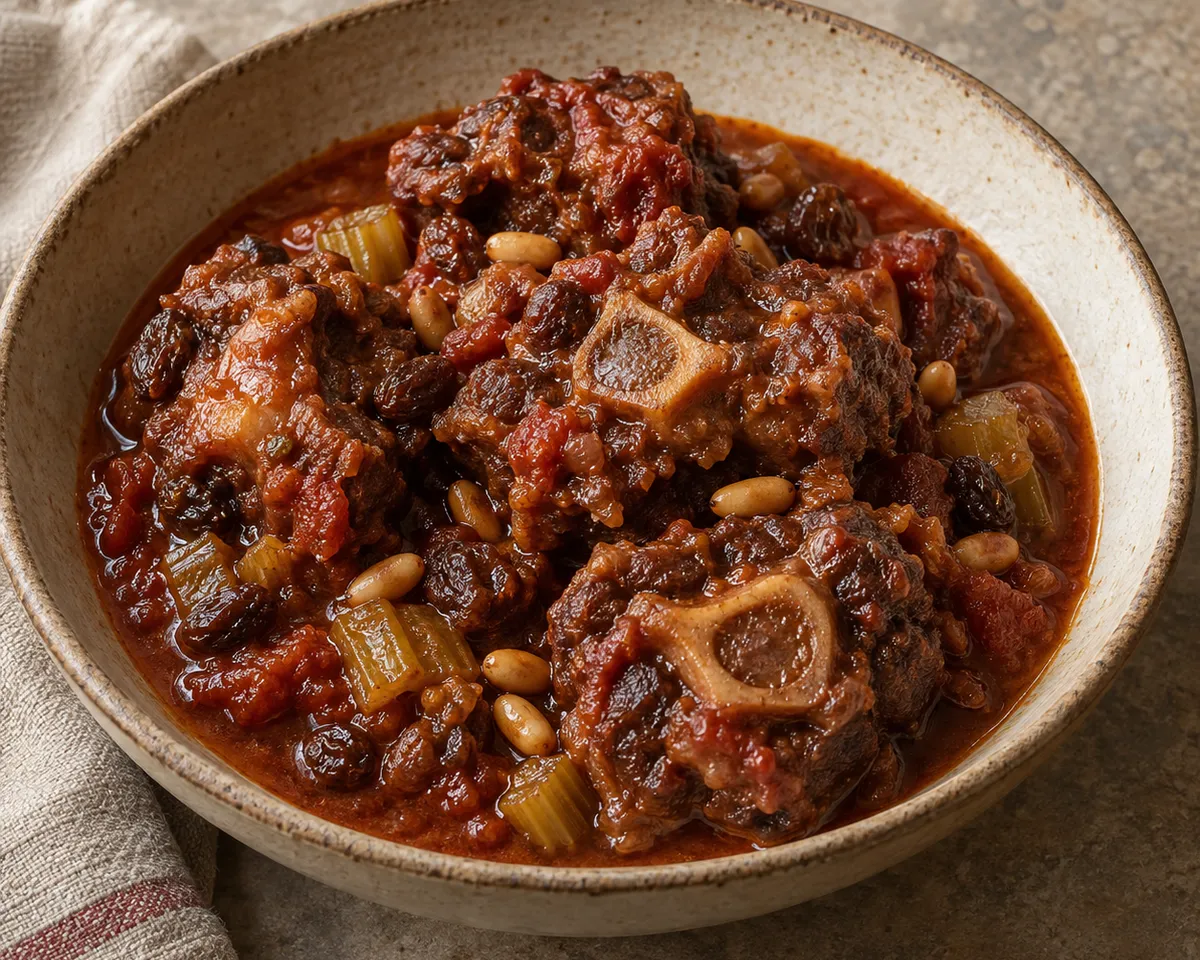
Coda alla vaccinara
Roman braised oxtail with celery and cocoa
Hours in the pot turn oxtail's joints and connective tissue into a sauce with a sticky body; the meat should yield with the smallest pull, yet stay in recognizable rocchi, the vertebral pieces that give the dish its Roman character.
The name is commonly linked to Rome's vaccinari, the cattle workers and skinners associated with Rione Regola. Testaccio's slaughterhouse later made the quinto quarto central to the neighborhood's cooking, and coda became its grandest long stew. Tail, tomato and celery remain the foundation.
Some Roman pots stop at tomato and celery. This follows a richer trattoria form: celery is glossed in the finished sauce with raisins, pine nuts and a little bitter cocoa. The sauce is dark, savory and faintly sweet, with tender celery pieces throughout. It is traditionally served with rigatoni before the tail is brought out as its own course.
Ingredients
For the braise
- 1.5 kg(3.3 lb)beef oxtail, cut through the joints into rocchi (vertebral pieces)
- 50 g(1¾ oz)plain rendered pork lard (strutto; see note)
- 45 ml(3 tablespoons)extra-virgin olive oil
- 1 largeyellow onion, finely chopped
- 1 mediumcarrot, finely chopped
- 1 ribcelery, finely chopped
- 1garlic clove, lightly crushed
- 1 small handfulflat-leaf parsley, finely chopped
- 3whole cloves
- 180 ml(¾ cup)dry white wine
- 1 kg(2.2 lb)whole peeled tomatoes, crushed by hand with their juices
- 500 ml (2 cups), plus more as neededhot beef stock or water
- fine salt and freshly ground black pepper
For the celery finish
- 350 g(12 oz)pale inner celery ribs, strings removed and cut into 5 cm (2-inch) lengths
- 25 g(about 3 tablespoons)golden raisins
- 25 g(about 3 tablespoons)pine nuts
- 2 tspunsweetened cocoa powder (see note)
Kitchen notes
- Oxtail
- Ask a butcher for beef tail cut cleanly through the joints into its natural vertebral sections, called rocchi in Rome. Do not substitute boneless stew meat: the bones, collagen and marrow are what give the sauce its particular body. Tail from mature beef has the fuller flavor associated with the traditional dish; veal tail is also used in Rome and will cook somewhat faster.
- Rendered pork lard (strutto)
- Strutto is plain rendered pork fat, sold as lard in the United States. It is different from cured lardo or raw fatback, and it is not bacon or a sweet pastry shortening. A butcher or well-stocked grocery can supply it. The rich Roman formula combines it with olive oil.
- Pale inner celery
- Use the tender, paler ribs and remove the strings. Celery is not a garnish here: it is a defining late addition, meant to stay visible and tender in the finished sauce.
- Unsweetened cocoa powder
- Use plain natural or Dutch-process cocoa with no sugar, milk, or flavoring. Two teaspoons should deepen the sauce without making it taste of chocolate; do not replace it with sweetened drinking cocoa or a chocolate bar.
Method
Brown the tail
- Pat the oxtail very dry and season it lightly with salt and pepper. In a wide, heavy Dutch oven over medium heat, warm the lard and olive oil. Add the oxtail in a single layer, working in batches if needed, and brown it lightly on all sides without building a hard crust. Move the pieces to a platter; keep the fat in the pot.
Build the braise
- Lower the heat to medium-low. Add the onion, carrot, chopped celery, garlic and parsley to the pot and cook, stirring often, until the vegetables are soft and their moisture has cooked away, 10 to 12 minutes. Tie the cloves in a small square of cheesecloth and add the packet with the oxtail and any juices. Pour in the wine and let it reduce until the raw alcohol smell has gone and the pot is nearly dry.
- Add the tomatoes and their juices, then pour in enough of the hot stock to come about three-quarters of the way up the meat. Bring the liquid just to a simmer. Cover with the lid slightly ajar and cook at the barest bubble, turning the pieces now and then and adding a splash of hot stock if the sauce threatens to dry out, for 3½ to 4½ hours. The tail is ready for the finish when the sauce is dense, the vegetables have nearly melted away, and the meat is beginning to release from the bones but has not collapsed.
Finish with celery
- About 30 minutes before the tail is ready, soak the raisins in warm water for 10 minutes. Meanwhile, blanch the celery in salted boiling water until just tender, 4 to 5 minutes; drain well. Stir the celery, drained raisins, pine nuts, and cocoa into the braise. Simmer uncovered, turning the tail gently once or twice, until the celery is tender and the cocoa has disappeared into a glossy, darkened sauce, 15 to 20 minutes. Taste and correct the salt and pepper.
Rest and serve
- Take the pot off the heat and let the coda rest for 10 minutes. Remove the clove packet before serving, and bring the pot to the table while the sauce is still loose enough to spoon over each rocchio. If serving pasta first, toss rigatoni with some of the sauce before portioning the tail.