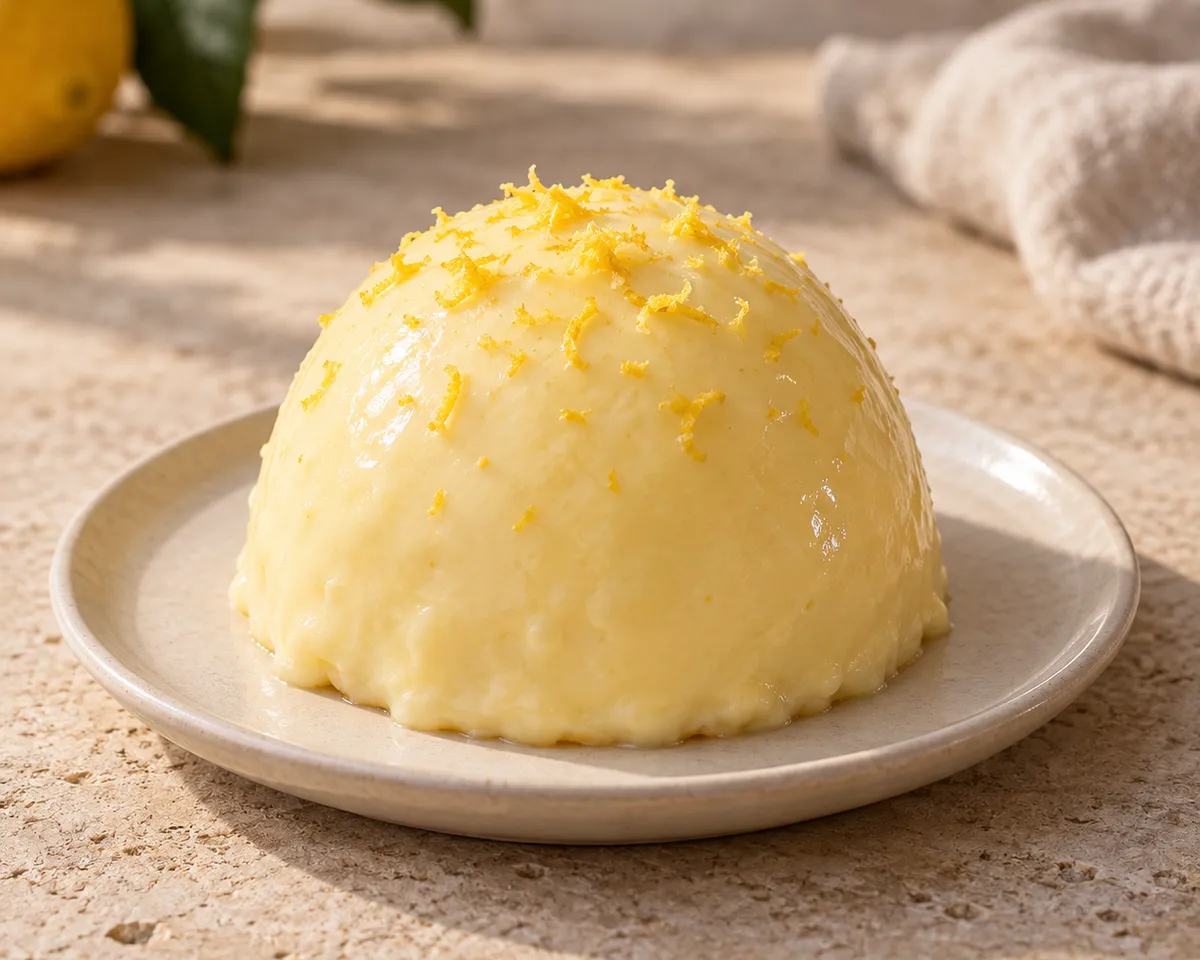
Delizia al limone
Lemon-cream sponge dome
A delizia al limone is a soft sponge dome, soaked just enough with limoncello, hiding lemon cream beneath a pale coating. The pleasure is less in sharpness than in fragrance. Lemon peel, cream and butter make the citrus round and almost floral.
The dessert belongs to both the Sorrento and Amalfi coasts. It is young by the standards of the region's pastry case, dating to the 1970s, but its fragrant lemon creams have become a familiar part of coastal Campanian pastry.
Two cooked creams, a light sponge and a cool glaze all need time to settle before they meet. The finished pastries should look softly coated rather than iced, and should be served cold on the day they are made, when the sponge is tender but still has shape.
Ingredients
Lemon pastry cream
- 90 g(6 tbsp)whole milk
- 40 g(about 3 tbsp)heavy cream
- ½large fragrant lemon, peel removed in wide strips (see note)
- 40 gegg yolks, about 2 large
- 30 g(2½ tbsp)sugar
- 8 g(1 tbsp)cornstarch
- ½ tspvanilla extract
- 1 pinchfine salt
Lemon cream
- 40 gegg yolks, about 2 large
- 40 g(3 tbsp)sugar
- 40 g(about 3 tbsp)fresh lemon juice
- 1lemon, finely grated zest only
- 40 g(3 tbsp)unsalted butter, cut into small pieces
Sponge domes
- 50 gegg yolks, about 3 large
- 100 gegg whites, about 3 large
- 90 g(7 tbsp)sugar, divided
- 40 g(⅓ cup)all-purpose flour
- 25 g(¼ cup)finely ground blanched almond flour
- ½ tspvanilla extract
- ½lemon, finely grated zest only
- 1 pinchfine salt
Limoncello syrup and finish
- 30 ml(2 tbsp)water
- 30 g(2½ tbsp)sugar
- ½lemon, peel removed in a wide strip
- 60 ml(4 tbsp)limoncello, divided (see note)
- 140 g(a little more than ½ cup)heavy cream, divided
- 30–50 ml(2–3 tbsp)cold whole milk, as needed for the glaze
- finely grated lemon zest, to finish
Kitchen notes
- Fragrant lemons
- The coastal lemons are the dessert's central perfume. Choose fragrant lemons with unwaxed or thoroughly scrubbed peel, because the peel is both infused and grated. Amalfi or Sorrento fruit is wonderful when actually available.
- Limoncello
- Use limoncello, the Italian lemon-peel liqueur. It belongs in the syrup and the cream, where its alcohol and peel aroma give the dessert its unmistakable aftertaste; lemon extract does not do the same work.
- Heavy cream
- Use dairy heavy cream with at least 35% milk fat and whip it only to soft peaks. It must fold into the cold creams while staying fluid enough to make the characteristic soft coating; canned whipped topping is unsuitable.
- Hemisphere mold
- The half-sphere mold gives the pastry its familiar dome. A six-cavity silicone mold around 7 cm (2¾ inches) across is ideal. A muffin tin will make a good lemon pastry, but it will not have the traditional dome shape.
Method
Make the pastry cream
- Put the milk, 40 g heavy cream and lemon peel in a small saucepan. Heat until steam rises and tiny bubbles gather at the edge, then cover, take off the heat and infuse for 20 minutes. In a heatproof bowl, whisk the 40 g yolks, 30 g sugar, cornstarch, vanilla and salt until smooth. Rewarm the dairy, remove the peel, and whisk it gradually into the yolk mixture. Return everything to the pan and cook over medium-low heat, whisking continuously into the corners, until it becomes thick, glossy and reaches 180°F (82°C). Scrape into a shallow bowl, press plastic wrap directly on the surface, and chill completely.
Make the lemon cream
- Rub the finely grated zest into the 40 g sugar in a small saucepan. Whisk in the 40 g yolks and lemon juice. Cook over low heat, stirring constantly with a flexible spatula, until it thickens enough to leave a clean path when the spatula is drawn across the pan and reaches 175°F (80°C). Take it off the heat; when it has cooled to about 120°F (50°C), blend in the butter until smooth and glossy. Press plastic wrap onto the surface and chill completely.
Bake the domes
- Heat the oven to 350°F (175°C). Set out six nonstick silicone hemisphere cavities, each about 7 cm (2¾ in) across. Whisk the 50 g yolks with 45 g of the sugar, vanilla and lemon zest until pale and thick. In a clean bowl, whip the whites with the salt to soft peaks; gradually add the remaining 45 g sugar and whip to a glossy medium-firm peak that still bends at the tip.
- Fold the yolk mixture gently into the whipped whites in two additions. Sift the flour over the foam in two additions, scattering the almond flour with it, and fold with broad strokes just until no dry pockets remain. Divide among the molds, filling each about two-thirds full. Bake until the domes are lightly golden, spring back when pressed, and a tester comes out clean, 12–15 minutes. Cool for 5 minutes, turn out onto a rack, and cool completely.
Make the syrup and composite cream
- For the syrup, bring the water, 30 g sugar and lemon peel just to a simmer, stirring until the sugar dissolves. Remove from the heat and cool completely; remove the peel and stir in 50 ml of the limoncello. Whisk the cold pastry cream and lemon cream together until smooth. Divide it into two portions: about 230 g for the glaze and the remainder for filling.
Fill and soak
- Whip 20 g of the heavy cream to soft peaks. Fold it and the remaining 10 ml limoncello into the smaller portion of combined cream. Transfer to a piping bag fitted with a small plain tip. From the flat underside of each dome, make a small hole and pipe in about 1–2 tablespoons filling, stopping as soon as the pastry feels noticeably heavier but before it cracks. A little filling may remain, depending on how much the sponge rose. If the domes feel fragile, freeze them on a tray for 20–30 minutes before soaking; the brief freezer rest firms the sponge for handling. The finished dessert is served chilled.
- Brush the syrup generously over every surface of each dome, or dip each one very quickly and let excess drain. The sponge should be fragrant and moist, never sodden. Set the domes flat-side down on a rack over a tray.
Glaze and serve
- Whip the remaining 120 g heavy cream to soft peaks. Fold it gently into the reserved 230 g combined cream. Add cold milk a teaspoon at a time only until the glaze is fluid enough to fall in a thick, even curtain from a spoon and coat a dome without running bare. Spoon it over each pastry, encouraging it down the sides. Chill at least 30 minutes, finish with fine lemon zest, and serve cold the same day.