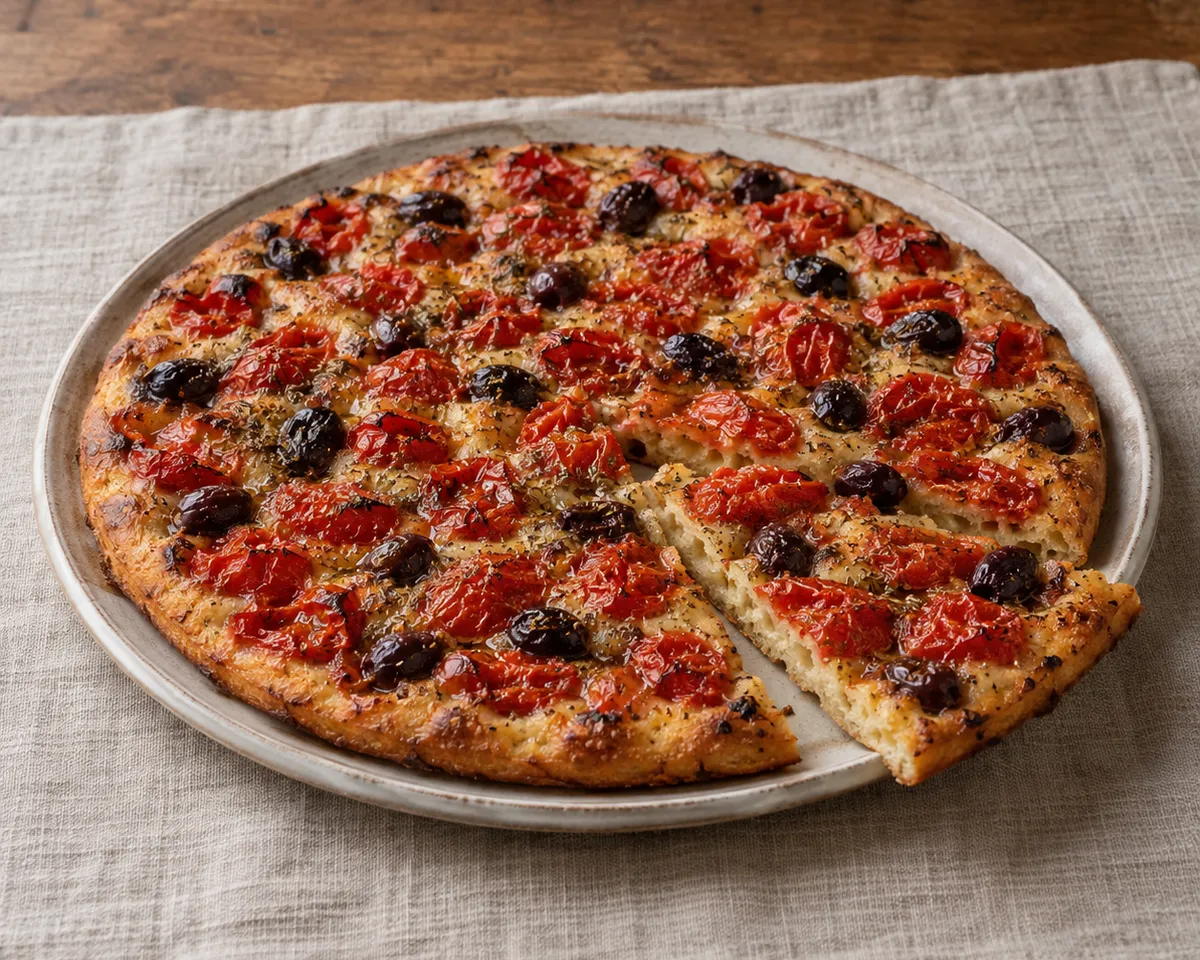
Focaccia barese
Bari tomato-and-olive focaccia
A proper focaccia barese holds two textures in one wedge: a crisp base browned in the oiled pan and a tender crumb that gives way without feeling cakey. Its unusual softness comes from boiled potato worked into the dough, while remilled durum semolina brings a golden color and a faintly wheaty bite.
The top is hardly an afterthought. Cherry tomatoes are pressed cut-side down into the risen dough with briny olive baresane and oregano, letting their juice seep into the dimples as the surface bakes. Olive oil pools around the fruit, carrying its acidity into the crust as well as the crumb.
Ingredients
For the dough
- 300 gItalian type 0 flour
- 200 gremilled durum-wheat semolina (semola rimacinata; see note)
- 100 gfloury potato, boiled, peeled, and riced while warm
- 320 gwater, at room temperature
- 6 g fresh yeast or 2 g instant dry yeast (see note)baker's yeast
- 10 gfine sea salt
- 50 gextra-virgin olive oil
For the pans and topping
- 50 gextra-virgin olive oil, for the pans and top
- 400 gripe cherry tomatoes, halved
- 20olive baresane in brine (see note)
- 1 g(1 tsp)dried oregano
- flaky or coarse sea salt
Kitchen notes
- Semola rimacinata
- Use finely remilled durum semolina, often sold as semola rimacinata or semola rimacinata di grano duro. It is finer than the coarse semolina used for porridge or dusting pizza peels. Its durum flavor and color are part of this Bari dough.
- Potato
- Choose a dry, floury potato and rice or mash it without milk or butter while still warm. A waxy potato or watery prepared mashed potato makes the dough gummy and changes the soft, open crumb.
- Olives
- Olive baresane are small, dark, firm table olives cured in brine. Look for them at a specialty Italian market or order them ahead. Avoid oily canned black olives, which have a different texture and taste.
- Fresh yeast
- Fresh yeast is common in Italian bread baking but can be hard to obtain reliably in the United States. The small instant-dry-yeast alternative preserves the same straightforward same-day dough; weigh it rather than estimating by spoon.
Method
Mix the potato dough
- If using fresh yeast, dissolve it in the water; if using instant yeast, whisk it into the flours. Combine the type 0 flour, semola rimacinata, and warm riced potato in a large bowl or mixer bowl. Add the water and yeast and mix until no dry flour remains. Work in the 10 g salt, then the 50 g olive oil. Knead until the dough is smooth, elastic, and very soft but no longer shaggy, about 10 minutes in a mixer on low to medium-low or 12–15 minutes by hand. It should feel tacky, not dry enough to handle like pizza dough. Cover and let rise at room temperature until nearly doubled, about 2 hours.
Oil, divide, and stretch
- Pour 20 g olive oil into each of two round 12-inch (30 cm) metal pans, coating the bases and sides well. Turn the risen dough onto an oiled work surface, divide it in half, and gently round each piece. Set a piece in the center of each pan and turn it once to oil both sides. Cover and rest 20 minutes, then press each outward with oiled fingertips until it nearly reaches the rim. If it springs back, leave it for 10 minutes and press again; do not force or tear it. Cover and let the dough become puffy, 45–60 minutes.
Dress the focacce
- Heat the oven to 475°F (245°C), with racks in the lower and upper thirds. Toss the tomatoes with 10 g olive oil and a pinch of salt. Press firm, irregular dimples into each risen dough with oiled fingertips. Scatter the tomatoes over the pans, pushing them cut-side down into the dimples so their juice runs into the dough. Add the olives, oregano, and a few grains of coarse salt, then spoon any oil and tomato juices left in the bowl over the dough. Let stand, uncovered, while the oven finishes heating, about 15 minutes.
Bake and eat warm
- Bake for 10 minutes, then switch the pans between racks and rotate them front to back. Continue until the tops are deeply golden at the edges, the tomatoes are collapsed, and the undersides are crisp and well browned, 8–12 minutes more. Lift the focacce from their pans onto racks at once so the bases stay crisp. Rest 10 minutes, then cut into wedges and serve warm; it is best the day it is baked.