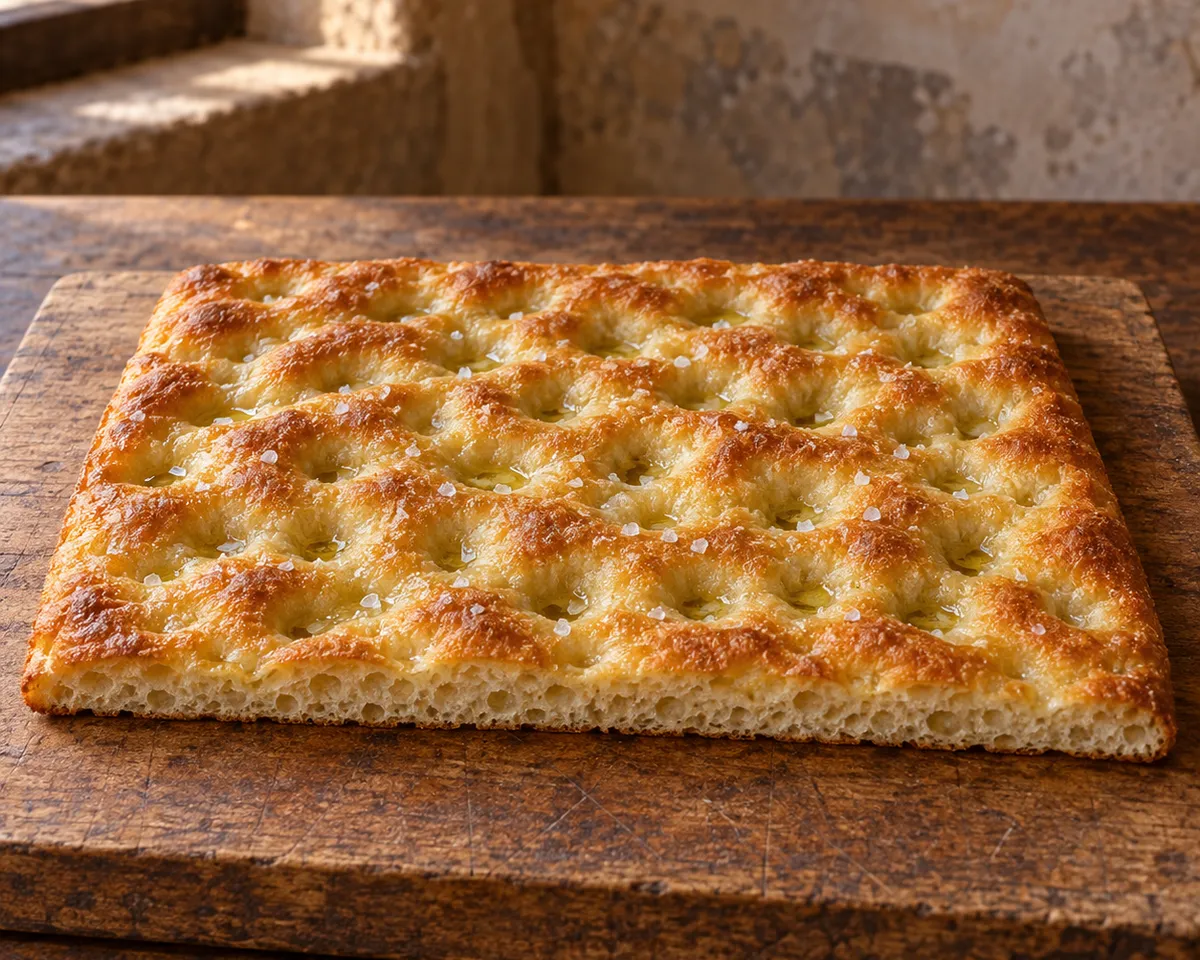
Focaccia genovese
Genoese dimpled olive-oil focaccia
In Genova, focaccia is breakfast, a midmorning strip carried from the bakery in paper, something salty to eat with an aperitivo. Locals call it fügassa, and the good kind is thin, glossy with olive oil, and marked all over with little wells.
The wells hold a salamoia of water, olive oil, and salt; in the oven, it leaves their bottoms pale, moist, and almost creamy while the ridges turn golden and crisp.
Ingredients
For the dough
- 400 gItalian type 0 or 00 flour, or strong bread flour with 11.5–12.5% protein (see note)
- 250 gwater, barely warm
- 6 g fresh yeast or 2 g instant yeast (see note)baker's yeast
- 4 gnon-diastatic barley malt syrup (see note)
- 8 gfine sea salt
- 25 gmild extra-virgin olive oil
For the pan and salamoia
- 30 gmild extra-virgin olive oil, for the pan
- 35 gwater
- 35 gmild extra-virgin olive oil
- 2 gfine sea salt
- 4 gcoarse sea salt
- 5 gmild extra-virgin olive oil, for finishing
Kitchen notes
- Flour
- Choose plain bread flour in the stated protein range, not self-rising flour or a very high-protein pizza flour. It needs enough strength for the folds but should still stretch easily in the oiled pan.
- Barley malt extract
- Estratto di malto is barley malt extract, used in Italian baking for fermentation and color. Choose non-diastatic barley malt syrup, not enzyme-active diastatic malt powder or a sweetened malted-milk drink mix. The small amount helps the dough color and adds a faint malt note.
- Olive oil
- Oil is the defining richness here, so use a good but mild extra-virgin olive oil whose bitterness will not dominate the bread. The pan oil and water-oil-salt salamoia keep the bread moist; draining them away or skimping on them produces a different, drier focaccia.
- Salamoia
- This is the loose emulsion of water, olive oil, and salt that collects in the dimples. It is not a brushing oil: its water is what keeps the centers of the hollows pale and tender while the raised parts crisp.
Method
Mix, rest, and fold the dough
- Dissolve the fresh yeast and malt extract in the barely warm water; if using instant yeast, whisk it into the flour instead. Add the flour and mix until no dry patches remain. Work in the 8 g fine salt, then the 25 g olive oil. Knead until the dough is smooth, elastic, and soft enough to cling slightly to your hands without flowing, 8–10 minutes by mixer on low to medium-low or a little longer by hand. Cover and let rest 15 minutes. On a lightly oiled surface, pull the dough gently into a rectangle and fold it in thirds, then in thirds again. Do not add enough flour to make it stiff.
Oil, rise, and stretch into the pan
- Pour the 30 g oil into a 13 × 18-inch (33 × 46 cm) rimmed metal pan and spread it over the base and sides. Set the dough in the center, turning it once so both sides are oiled. Cover and let it rise in a draft-free room until visibly puffed, 45–60 minutes. Press it gently from the center toward the corners; it need not reach every edge yet. Cover and rest 25–30 minutes, then ease it the rest of the way out without tearing or aggressively stretching it. Cover again and let it relax until puffy and lightly bubbly, about 30 minutes.
Dimple and apply the salamoia
- Whisk the 35 g water, 35 g olive oil, and 2 g fine salt until cloudy. With the pads of your three middle fingers, press deep, closely spaced dimples over the dough. Press straight down almost to the pan without puncturing it; the dimples should be numerous enough that the surface looks quilted. Pour the salamoia evenly over the top, guiding it into the hollows. Sprinkle with the coarse salt, cover, and leave until the dough has risen around the dimples and looks tender and aerated, 35–50 minutes. Keep the pan level so the liquid stays on top rather than running underneath the dough.
Bake until golden and still supple
- While the dough finishes rising, heat the oven to 450°F (230°C), with a rack in the lower-middle position. Bake until the ridges are deeply golden, the dimple bottoms remain paler, and the underside is browned, 14–16 minutes. If the top colors before the base is done, move the pan down one rack for the last few minutes. The focaccia should be crisp at the edges but bend readily rather than bake into a hard cracker.
Finish and serve
- Immediately lift the focaccia from the pan onto a rack so its underside does not steam soft. Brush lightly with the remaining 5 g olive oil. Let it cool only long enough to handle, then tear or cut into strips and serve warm. It is at its best on baking day.