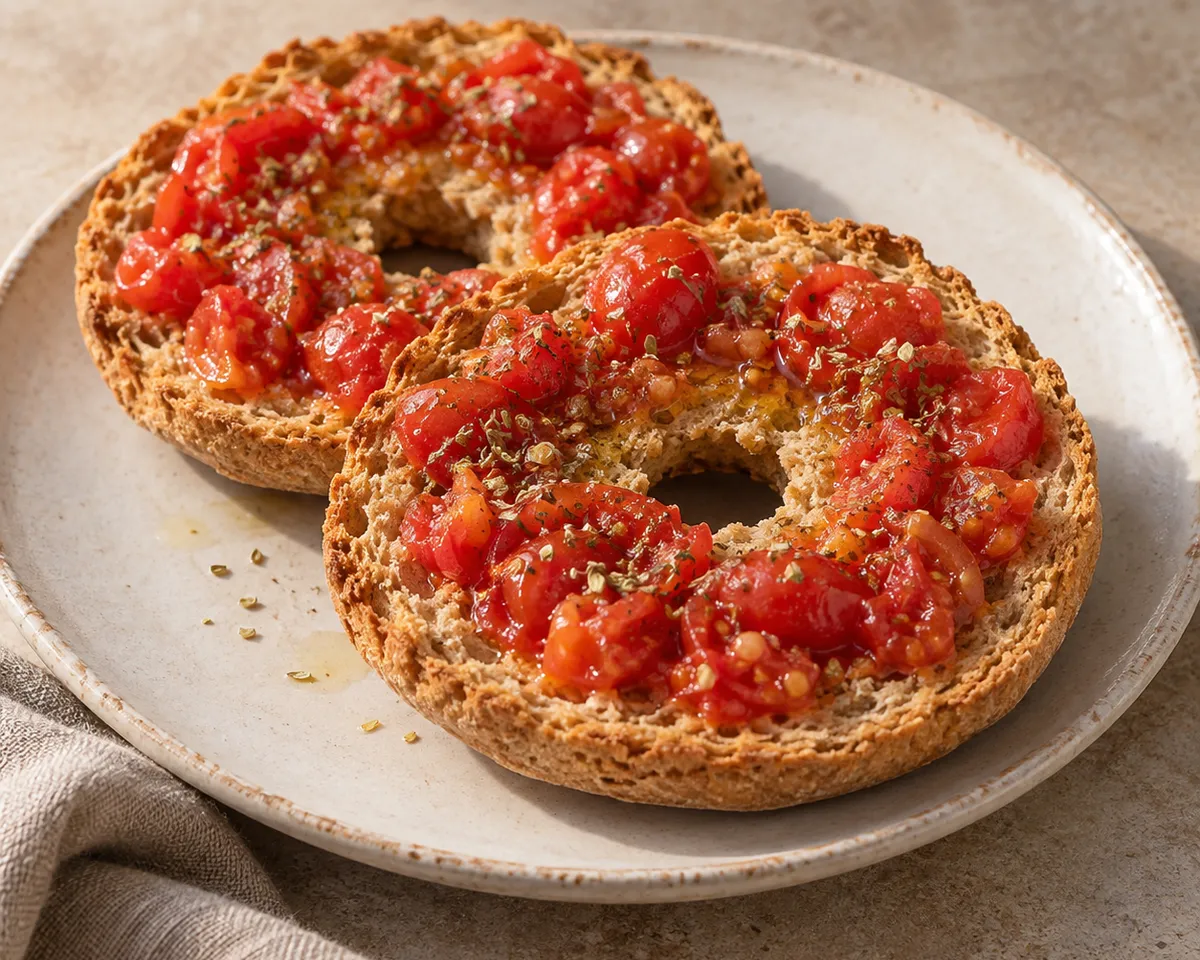
Friselle col pomodoro
Apulian twice-baked rusks with tomato
A frisella is bread designed to wait. The ring is baked once until risen, split across its middle, then returned to the oven until every crumb is dry and hard. That second bake makes it ready for a quick pass through water and a last-minute dressing at the table.
In Salento, the small act of soaking is called sponsare. The aim is not to make the rusk soft all the way through, but to give its cut face enough moisture to catch the dressing while the rim keeps its crackle. Sweet tomatoes, generous olive oil, salt, and oregano are the elemental version.
Ingredients
For the friselle
- 275 gItalian type 0 flour (see note)
- 275 gfine durum-wheat semolina
- 320 gwater, at room temperature
- 6 g fresh yeast or 2 g instant dry yeast (see note)baker's yeast
- 30 gextra-virgin olive oil
- 10 gfine sea salt
- fine durum-wheat semolina, for the trays
For dressing all 16 half-rusks
- 800 gripe cherry or grape tomatoes
- 120 ml(½ cup)fruity extra-virgin olive oil
- 2 tspdried oregano
- fine sea salt
Kitchen notes
- Flours
- Use fine, twice-milled durum semolina (semola rimacinata), not coarse polenta-like semolina. Paired with Italian type 0 soft-wheat flour, it supplies the characteristic wheat flavor and firm bite. Seek type 0 at an Italian grocery or a well-stocked specialty market.
- Fresh yeast
- Fresh baker's yeast is highly perishable and not consistently stocked for U.S. home cooks. Either 6 g fresh yeast or 2 g instant dry yeast works for this dough; weigh it on a precise scale and follow the handling directions in the first step.
- Soaking
- Do not soak the friselle like stale bread. The brief wetting, called sponsare in Salento, should moisten the cut surface but leave a crisp edge and a firm interior. Dense, very dry purchased friselle may need a second or two more water; fresh homemade ones usually need less.
- Tomatoes and olive oil
- Choose ripe, juicy cherry or grape tomatoes and fruity extra-virgin olive oil. Lightly salting the cut tomatoes for 10 minutes draws out juices for the dressing. Watery winter tomatoes and neutral oil leave little flavor in such a simple preparation.
Method
Mix and give the dough its first rise
- Dissolve the fresh yeast in the water; if using instant dry yeast, whisk it into the two flours before adding the water. Put the type 0 flour, semolina, yeast, water, olive oil, and salt in a bowl and mix until no dry flour remains. Knead until the dough is smooth, springy, and only faintly tacky, about 8–10 minutes by hand or 6–8 minutes with a dough hook. Cover and let rise at a moderate room temperature until doubled, about 2 hours.
Shape the rings
- Divide the dough into 8 equal pieces, about 115 g each. Shape each into a taut ball, then poke a thumb through its center and widen the hole to about 5 cm (2 inches); the hole will narrow as the dough rises. Put the rings on semolina-dusted parchment-lined trays, cover, and let rise until visibly puffy, about 1 hour.
Bake once, split, and bake again
- Heat the oven to 400°F (200°C). Bake the rings until lightly golden and set, 25–30 minutes; they should be cooked through but not deeply browned. Cool them on a rack just until safe to handle. With a serrated knife, split each ring horizontally through its middle to make two thin half-rusks. Lay them cut-side up on the trays. Lower the oven to 325°F (160°C) and bake until completely dry and crisp, 25 minutes; raise the heat to 340°F (170°C) and bake 10 minutes more if needed for a pale golden color. Cool completely. A properly dried frisella should snap cleanly and feel dry at its center.
Dress only what you will eat
- Halve or quarter the tomatoes and crush them lightly in a bowl with a pinch of salt, the oregano, and the olive oil. For each half-rusk, run the cut side very briefly under cold water, about 1–2 seconds, then set it cut-side up on a plate. It should still feel firm. Spoon over the tomatoes and their juices, finish with a little more oil if it looks dry, and eat at once. Repeat only as many as you plan to serve; keep the remaining plain friselle airtight.