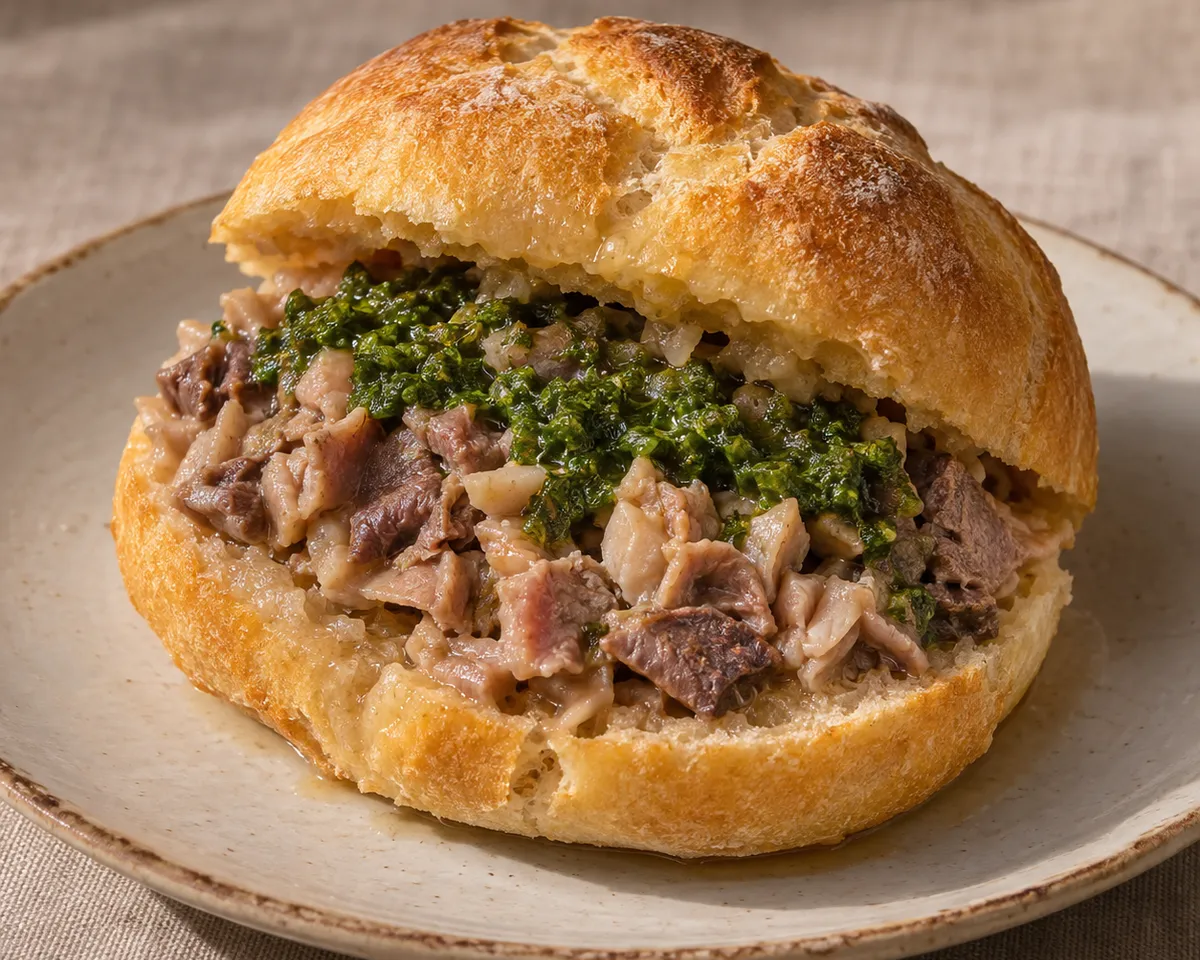
Lampredotto
Florentine tripe sandwich with salsa verde
Lampredotto is the part that makes a Florentine tripe sandwich specifically Florentine: the abomasum, the ruminant's fourth and true stomach. Long cooking turns its two different surfaces tender enough to chop together, so a bite carries both the leaner, darker gala and the richer, folded spannocchia.
Abomasum cooks with the ordinary smells of a Florentine broth — carrot, celery, onion, tomato — until the broth is red-tinged and the meat has lost all rubberiness. Then comes the decisive street-stall gesture: dip the cut side of the bread in that broth. The roll should be juicy, never reduced to paste.
Salsa verde gives the sandwich its lift: parsley, anchovy, capers, hard-boiled egg, garlic, and olive oil cut through the offal's depth. At the street stall, salt, pepper, and chile sauce offer other ways to season a broth-dipped roll.
Ingredients
For the lampredotto and broth
- 1 kg(2.2 lb)cleaned beef or veal abomasum (lampredotto), preferably with both gala and spannocchia portions (see note)
- 1beef marrow or soup bone (optional but traditional)
- 2.5 L(10½ cups)cold water
- 2medium carrots, cut into large pieces
- 2celery ribs, cut into large pieces
- 1medium yellow onion, quartered
- 250 g(about 1 cup)tomato passata
- 10 gfine sea salt, plus more to taste
For the salsa verde and sandwiches
- 50 g(about 1 packed cup)flat-leaf parsley leaves and tender stems
- 1large hard-boiled egg, peeled
- 20 g(about 1½ tbsp)salt-packed capers, rinsed and soaked for 10 minutes, or well-rinsed capers in brine
- 4oil-packed anchovy fillets, drained
- 1small garlic clove
- 15 ml(1 tbsp)white-wine vinegar
- 75 ml(5 tbsp)extra-virgin olive oil
- 4small salted rosette or michetta rolls (see note)
- freshly ground black pepper
- hot chile sauce or chile oil, to serve if desired
Kitchen notes
- Lampredotto / abomasum
- Lampredotto is abomasum, the fourth, glandular stomach of cattle. It is not the honeycomb tripe from the reticulum, nor generic pre-cooked “tripe.” Ask a specialist butcher for cleaned beef or veal abomasum; a complete piece includes the dark, leaner gala and the paler, fattier folded spannocchia. Both belong in the sandwich. Other tripe cuts have a different texture and cannot replace abomasum here.
- The bread
- The old Florentine semelle was a small salted roll; modern lampredottai commonly use a rosetta. Choose a salted, crisp-crusted roll with an airy interior, such as a rosetta or michetta. Unsalted Tuscan country bread is right alongside the boiled meat, but it is not the roll that should be broth-dipped for this sandwich.
- Salsa verde
- This Florentine sandwich sauce is sharp and savory. It uses parsley, egg, capers, anchovy, garlic, white-wine vinegar, and olive oil; it is not chimichurri, pesto, or a sweet bottled green sauce. Rinse salt-packed capers thoroughly, then taste before adding extra salt.
Method
Start the aromatic broth
- Rinse the cleaned abomasum under cold running water. Put it and the optional beef bone in a roomy pot with the cold water, carrots, celery, onion, passata, and 10 g salt. Bring it slowly to a boil, skimming any gray foam from the surface. Lower the heat until the surface barely trembles, cover partly, and simmer for 1½ hours.
Cook until properly tender
- Turn the abomasum in the broth and continue at the quietest simmer until a skewer slides through the thickest folded section with little resistance, usually another 30–60 minutes. Two hours total is a useful guide, but tenderness decides it; brisk boiling will tighten the folds and cloud the broth. Lift the lampredotto onto a board, keep it warm under a little broth, and strain the cooking liquid. Taste the broth and adjust its salt only now.
Make the salsa verde
- Chop the parsley, egg, capers, anchovies, and garlic very finely by hand or pulse them briefly in a food processor; the sauce should be a coarse green paste, not a smooth purée. Stir in the vinegar, then the olive oil. Taste before salting: anchovies and capers normally provide enough. Let stand for 15 minutes while you cut the lampredotto.
Chop and dress the lampredotto
- Cut the warm abomasum into thin strips, then chop those into bite-size pieces, mixing the paler, fattier folds with the darker, leaner section as you work. Moisten the pieces with a few spoonfuls of hot broth; they should glisten and steam but not sit in a puddle. Season with black pepper and a pinch of salt only if the broth needs it.
Dip the bread and serve
- Split each roll. Briefly dip the cut side of each top half into the hot broth, then hold it over the pot for a few seconds: it should be saturated at the surface but still hold its shape. Heap the bottom halves with the chopped lampredotto, spoon over salsa verde, and add chile sauce or chile oil only for those who want it. Close with the broth-dipped top and serve immediately.