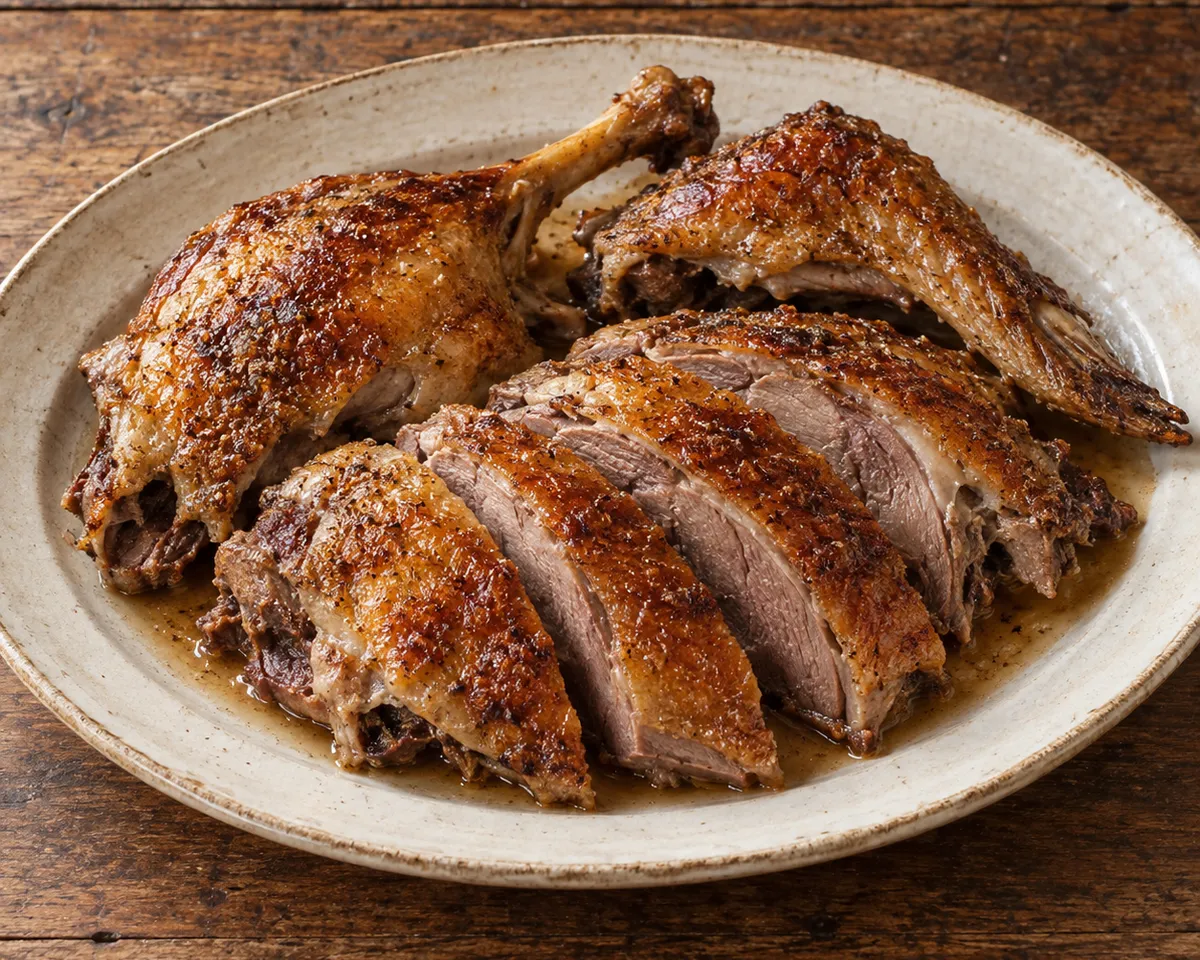
Ocio arrosto
Valdarno roast goose with wild fennel
Ocio is the Aretino country word for goose, and a goose was a serious piece of household wealth. In the Valdarno, its size made it fit for the long day of wheat threshing, when neighbors worked together and then sat down to a meal meant to feed a crowd. The bird could become sauce, broth, a stuffed neck, or a roast; thrift showed in using all of it, not in making the feast feel mean.
Ponte Buriano's roast version is called “in porchetta”, though no pork is involved. The term describes the treatment: the cavity is filled with wild fennel and garlic, the skin is seasoned simply, and a glass of white wine is added after the bird has taken color. That spare seasoning makes sense for goose, whose own fat is already most of the sauce.
Ingredients
For the roast goose
- 1(4.5–5.5 kg / 10–12 lb)domestic goose, thawed if frozen, with giblets removed (see note)
- 30 gfresh wild fennel fronds, coarsely chopped (see note)
- 5garlic cloves, lightly crushed
- 15 g(about 2½ tsp)fine sea salt
- 1 tspfreshly ground black pepper
- 15 ml(1 tbsp)extra-virgin olive oil
- 240 ml(1 cup)dry white wine
Kitchen notes
- Ocio
- In the Arezzo area, ocio means goose; it may especially mean the male domestic goose, but local usage also covers the bird more broadly. Buy a domestic goose, not a wild goose, duck, turkey, or chicken. A 10–12 lb bird makes a generous roast for a crowd.
- Wild fennel
- Use the feathery green fronds of wild fennel, finocchietto selvatico. Their aroma defines this Ponte Buriano preparation. The bulb and fennel seed do not give the same fresh, leafy fragrance.
- Goose fat and doneness
- Goose renders a striking amount of excellent fat. Pour it off carefully as it accumulates and save it refrigerated for roast potatoes or greens; do not discard it down a sink. Use a rack to keep the bird above that fat, and check for 165°F (74°C) in the breast, innermost thigh, and wing before resting. A home oven gives a different roast from the festival wood oven.
Method
Season the goose and prepare it to render
- Pat the goose very dry, inside and out, and trim only the large loose flaps of fat at the cavity opening; reserve them for another use if you like. With the point of a skewer or a thin knife, prick the skin all over the breast, thighs, and lower back without piercing the meat. Loosely fill the cavity with the wild fennel and garlic. Rub the skin and cavity with the salt, pepper, and olive oil. Set the bird breast-side up on a rack in a deep roasting pan and refrigerate, uncovered, for 8–24 hours so the skin dries.
Give it a hot start, then render the fat
- Heat the oven to 425°F (220°C). Let the goose stand at room temperature for 30 minutes while the oven heats. Roast for 25 minutes, until the skin has begun to bronze, then lower the oven to 350°F (175°C). Continue roasting, carefully pouring off rendered fat into a heatproof container whenever the pan grows more than 1 cm (½ inch) deep. When the skin is a deep, even gold and the breast is about 155°F (68°C), proceed with the wine; for a 10–12 lb bird, this will usually be after 2–3 hours total roasting. Cook to the thermometer rather than the clock.
Add the white wine and rest
- Carefully pour the white wine into the roasting pan around, never over, the golden bird. Return it to the oven and roast until the wine is bubbling and an instant-read thermometer reaches 165°F (74°C) in the thickest part of the breast and the innermost thigh and wing without touching bone, usually another 15–30 minutes. Move the goose to a warm board and rest it, loosely tented, for 20–25 minutes. Spoon off excess fat from the pan, leaving the browned juices and wine behind; scrape those juices together and strain if you want a cleaner sauce.
Carve and serve
- Remove and discard the fennel and garlic from the cavity. Separate the legs and wings, carve the breast meat across the grain, and arrange the pieces on a warm platter. Spoon over a little of the defatted winey pan juice and bring the rest to the table. Goose stays hot and handsome longer than chicken, but its crisp skin is best within minutes of carving.