Olive all'ascolana
Ascoli Piceno's crisp stuffed olives
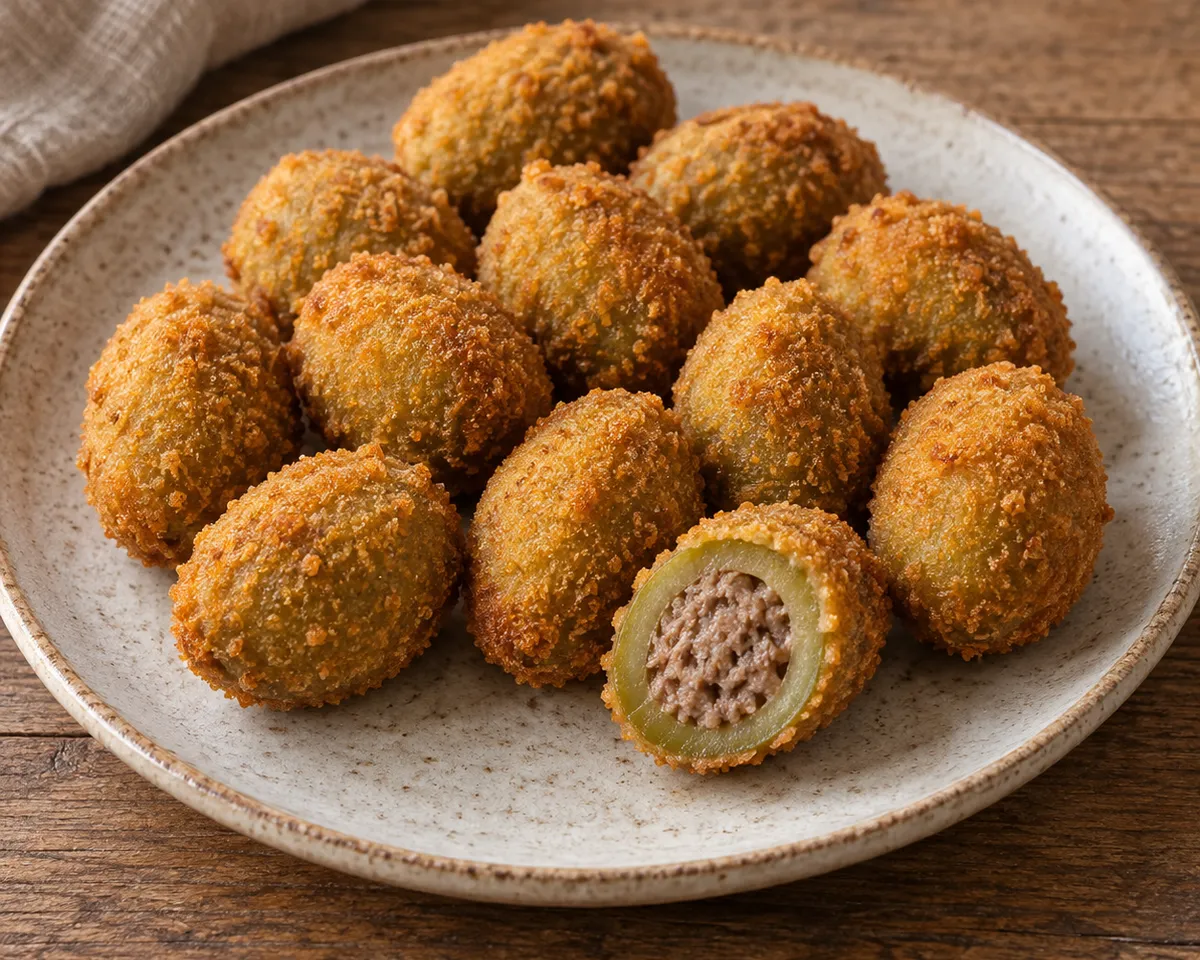
An olive all'ascolana is a piece of small-scale butchery disguised as a bar snack. The olive's flesh is cut away from its pit in one long spiral, wrapped around a little ball of cooked meat, then fried inside a fine breadcrumb shell. The finished shape looks almost natural until the first bite reveals its savory core.
Its proper raw material is the large, tender Ascolana Tenera olive of the Piceno. That cultivar has enough flesh to survive the knife work and enough bitterness to keep the rich filling from turning monotonous. The filling combines beef and pork with a little poultry, cooked slowly with onion, carrot, and celery before being ground fine with egg, aged cheese, and nutmeg.
A thin breadcrumb shell crackles around the filling, while the olive beneath remains distinct, green, and faintly sharp.
Ingredients
For the filling and olives
- 500 gOliva Ascolana del Piceno DOP in brine, whole and unpitted (see note)
- 180 gboneless beef chuck or stewing beef, cut in small pieces
- 135 gboneless pork shoulder, cut in small pieces
- 35 gboneless chicken thigh, cut in small pieces
- 25 ml(1 tbsp plus 2 tsp)extra-virgin olive oil
- 40 gyellow onion, finely chopped
- 35 gcarrot, finely chopped
- 30 gcelery, finely chopped
- 60 ml(¼ cup)dry white wine
- 45 gfinely grated Parmigiano Reggiano or another aged Italian grating cheese
- 1large egg
- ½ tspfinely grated untreated lemon zest
- 1 generous pinchfreshly grated nutmeg
- fine salt and freshly ground black pepper
For breading and frying
- 100 gall-purpose flour
- 2large eggs, beaten
- 180 gfine, dry breadcrumbs
- 1.5 L(about 6 cups)peanut oil or another neutral high-heat frying oil
Kitchen notes
- Oliva Ascolana del Piceno DOP
- The defining olive is the large, tender Ascolana Tenera cultivar preserved in brine. Look for Oliva Ascolana del Piceno DOP from a specialty Italian market or online Italian-food supplier, preferably whole so it can be cut in a continuous spiral. Ordinary pitted green cocktail olives have too little flesh and cannot reproduce this dish.
- Filling
- Cook the beef, pork, and small amount of poultry with soffritto and dry white wine before grinding. Starting with raw ground meat or sausage gives the filling a different, denser texture.
- Breading and oil
- Use fine dry breadcrumbs and a single flour–egg–breadcrumb coat. Frying at 340°F (170°C), in small batches, gives the filling time to heat without darkening the crumbs before the center is hot.
Method
Cook and grind the filling
- Warm the olive oil in a small heavy casserole over medium-low heat. Add the onion, carrot, and celery with a pinch of salt; cook until soft and sweet, 8–10 minutes, without browning. Add the beef and cook for 4–5 minutes, then the pork for 3 minutes and the chicken for 2 minutes, turning until the pieces lose their raw color. Add the wine, scrape the pan, and let it evaporate. Cover partly and cook over low heat until the meat is tender and the pan is almost dry, about 30–40 minutes; add a spoonful of water only if it threatens to catch. Cool completely, then grind or pulse the meat and vegetables very finely. Mix with the grated cheese, egg, lemon zest, nutmeg, pepper, and salt only if it needs it. The filling should be firm enough to roll into small balls, never wet or warm. Chill for 30 minutes.
Cut the olives into spirals
- Drain the olives, rinse briefly if they taste aggressively salty, and dry them thoroughly. Starting at the stem end of one olive, use a short sharp paring knife to cut the flesh in one continuous, narrow spiral around the pit, like peeling an apple. Lift out the pit without breaking the ribbon. Roll a filling ball just a little larger than the pit, set it at one end of the olive ribbon, and wind the flesh back around it to restore the olive's shape. Repeat; keep the first broken spirals as practice rather than forcing them into the frying batch.
Bread the olives
- Arrange the flour, eggs, and breadcrumbs in three shallow bowls. Roll each reconstructed olive in flour and shake off the excess, then coat it in egg and finally breadcrumbs, pressing only enough to make a thin, complete shell. Set on a tray and refrigerate uncovered for 20–30 minutes, so the coating dries and adheres.
Fry and serve
- Heat the oil in a deep, heavy pot to 340°F (170°C). Fry 6–8 olives at a time, turning gently, until evenly golden and crisp, about 3–4 minutes; the oil should return to temperature before the next batch. Drain on a rack or paper towels and serve while hot. The breadcrumb crust should cling to the olive rather than separating, and the center should be hot but still soft.