Sa panada
Assemini lamb-and-potato savory pie
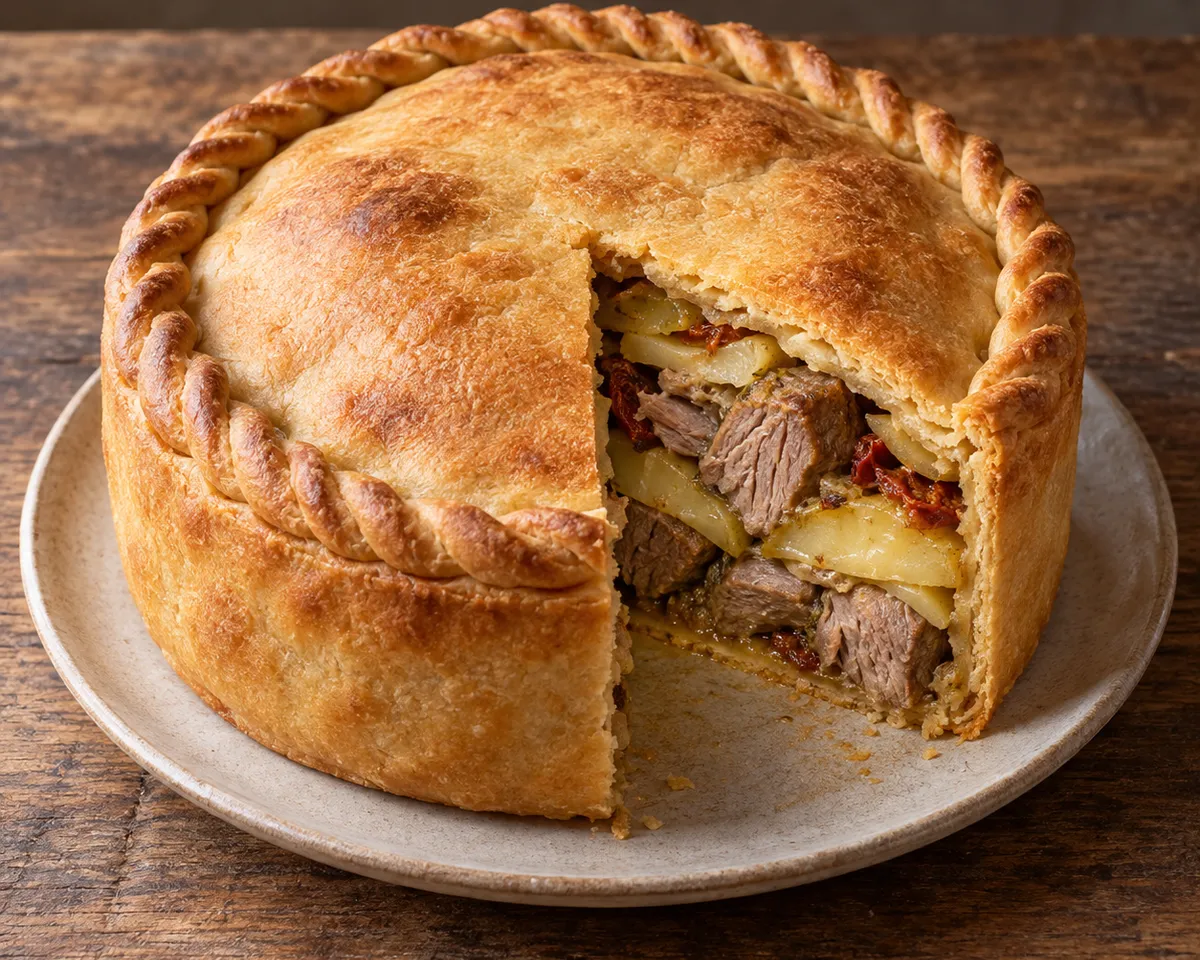
A proper sa panada looks less like a pie than a small, burnished pot with a lid. In Assemini, a town in the lower Campidano, the pastry is raised into a deep case, filled while everything is still raw, and sealed with a corded rim known as sa cosidura. It goes to the table intact and is opened only when its concentrated perfume has nowhere left to go but out.
Eel is the best-known historic filling around the Santa Gilla lagoon, but lamb has an equally established place in the Assemini repertoire. With lamb and potatoes, dried tomato, garlic, parsley, olive oil, and a little lard season the filling. The pastry holds the lamb's juices through the long bake and becomes part of the meal.
The crimp takes patience, but its purpose is practical. A tight seam keeps the filling in its own steam, while the high sides give the pie its characteristic domed profile. Let the baked panada rest before lifting the lid; the filling settles, the juices thicken, and six generous wedges become possible.
Ingredients
For the pastry
- 420 gall-purpose flour
- 80 gfinely remilled durum-wheat semolina (semola rimacinata; see note)
- 60 gpork lard, softened
- 30 g(2 tbsp)extra-virgin olive oil
- 8 gfine sea salt
- 170–190 g(about ¾ cup)warm water
For the lamb filling
- 650 gboneless lamb shoulder, trimmed and cut in 2 cm (¾-inch) pieces
- 500 gwaxy potatoes, peeled and sliced 3 mm (⅛ inch) thick
- 30 g (about 6 halves)dried tomatoes, soaked until supple, squeezed dry, and finely chopped
- 2garlic cloves, finely chopped
- 15 g(about ½ cup)flat-leaf parsley leaves, finely chopped
- 45 g(3 tbsp)extra-virgin olive oil
- 25 gpork lard, cut into small pieces
- 10 gfine sea salt
- 1 g(about ½ tsp)freshly ground black pepper
Kitchen notes
- Lamb shoulder
- Use shoulder, not tenderloin or a lean leg roast. The enclosed, slow bake needs a cut with enough collagen and fat to stay succulent and create its own juices. Keep the pieces distinct rather than using ground lamb.
- Semola rimacinata
- This is finely remilled durum-wheat semolina, much finer than coarse porridge semolina. The Assemini pastry tradition uses flour and semola with lard and olive oil; coarse semolina makes the dough gritty and prone to cracking.
- Dried tomatoes
- Use plain dried tomatoes, softened briefly in hot water and squeezed dry before chopping. Their concentrated salt and acidity are traditional seasoning here; do not substitute fresh tomatoes, which release too much water in the sealed pie.
- The sealed rim
- The braided cord is not just decoration. It closes the pastry pot so the raw lamb and potatoes cook in a contained, aromatic environment. Imperfect pleats are fine; a continuous seal matters more than a showpiece crimp.
Method
Make the pastry
- Mix the all-purpose flour, semola, and salt in a wide bowl. Work in the lard and olive oil until the mixture looks sandy and clumps when squeezed. Start with 170 g (about ¾ cup) of the warm water and knead until the dough is smooth, firm, and pliable, adding up to 20 g more only if dry flour remains. Shape into a disk, cover, and rest at room temperature for at least 30 minutes. The dough should roll without springing back, but it should be sturdier than pasta dough.
Season the raw filling
- Heat the oven to 375°F (190°C) with a rack in the lower third. Combine the raw lamb with the dried tomatoes, garlic, parsley, olive oil, 6 g of the salt, and pepper in a large bowl. Toss well. In a second bowl, lightly toss the potato slices with the remaining 4 g salt; keep them separate from the lamb. Keep the filling raw: the closed panada is designed to cook it in its own juices.
Build the pastry pot
- Set a 24–26 cm (9½–10-inch) round cake pan or shallow ovenproof dish nearby. Divide the dough into about two-thirds for the base and one-third for the lid. On a lightly floured surface, roll the larger piece into a 38–40 cm (15–16-inch) round, about 3–4 mm thick. Ease it into the pan, leaving a tall overhang. Lift and pleat the edge as needed to form a deep, upright pastry case rather than a flat tart shell.
Fill, lid, and crimp
- Arrange half the potato slices in the pastry case, spread the seasoned lamb over them, then cover with the remaining potatoes. Scatter the lard pieces over the top; they are the lamb version's final richness. Roll the smaller dough piece into a round just wide enough to cover the filling. Lay it on top, trim the base overhang to about 2 cm (¾ inch), and pinch the two layers together. Working around the rim, repeatedly pinch, thin, and twist the joined dough into a tight rope-like cord. It should be sealed all the way around; do not cut vents into the lid.
Bake slowly and rest
- Bake until the pastry is deeply golden and the filling is tender, about 1½ hours. If the rim darkens before the time is up, loosely tent only the rim with foil. Let the panada rest, uncovered, for at least 45 minutes and preferably 1 hour before serving. Bring it to the table whole, cut away or lift its lid, and divide the settled filling and pastry into wedges. The lamb should be yielding and the potatoes fully soft, with a little savory juice but no thin puddle.