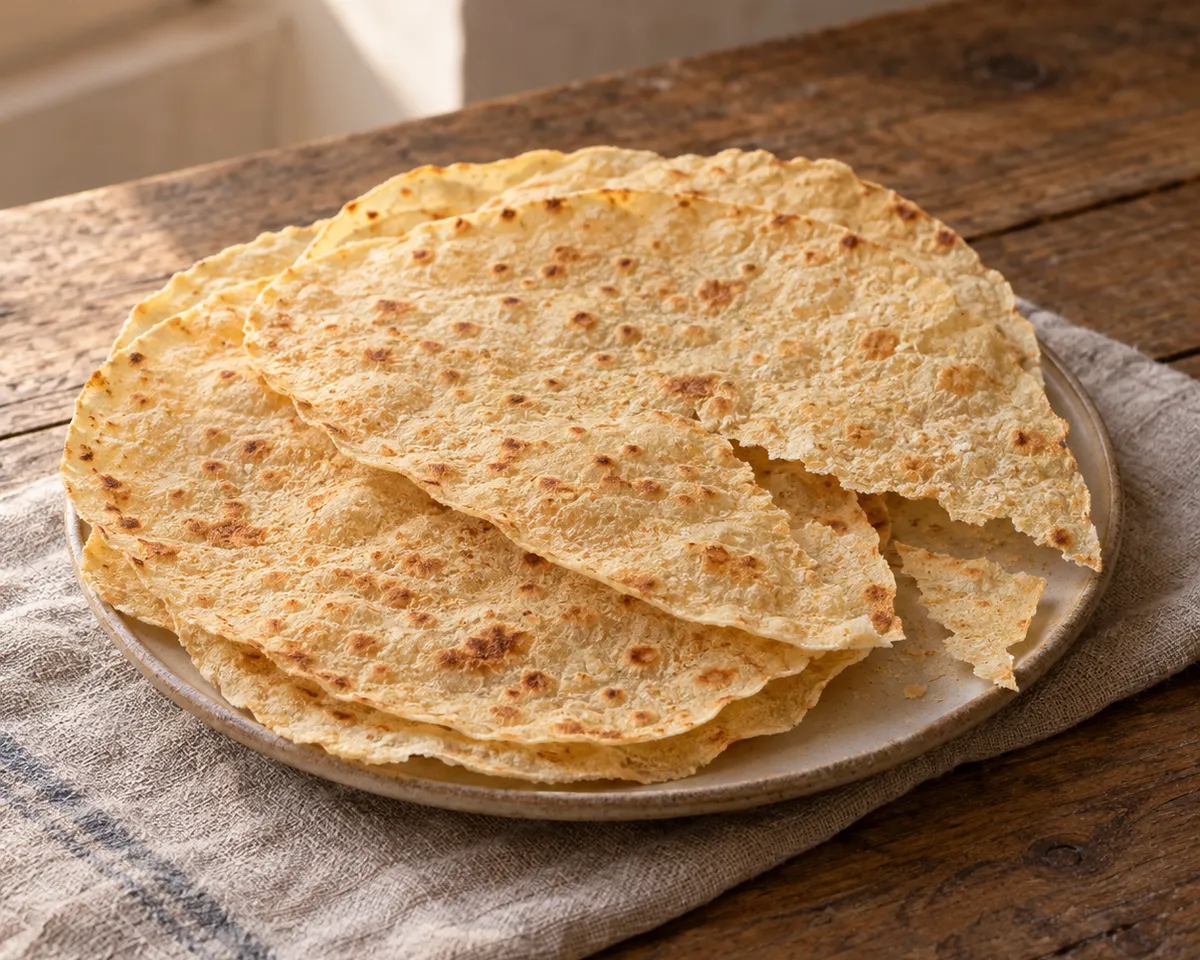
Pane carasau
Sardinian double-baked crisp flatbread
Break a good sheet of pane carasau and the room gets a little louder. The bread is all brittle edge and toasted durum, so thin that it acquired the name carta da musica, music paper. Its apparent simplicity is misleading: the decisive act is a first furious bake that inflates a disk into a hollow balloon.
While that balloon is still hot, it is opened into two sheets. Each sheet goes back for carasadura, the final toast that makes the bread dry, crisp, and remarkably durable.
Sardinian bakers work in wood-fired ovens far hotter than a home range. A baking steel or stone, thoroughly preheated, gives a domestic oven its best chance. The home version will be smaller and less spectacularly inflated, but it must still puff, split, and re-toast; a thin cracker rolled once and baked once is another bread.
Ingredients
For the dough
- 500 gfinely remilled durum-wheat semolina (semola rimacinata; see note)
- 300 g(1¼ cups)water, lukewarm
- 4 g fresh or 1.3 g instant drybaker's yeast (see note)
- 7 gfine sea salt
- Additional semola rimacinata, for rolling
Kitchen notes
- Semola rimacinata
- Use fine remilled durum-wheat semolina, often labeled semola rimacinata di grano duro. It is much finer than coarse semolina for porridge or pizza-peel dusting and gives pane carasau its toasted wheat flavor. Do not use precooked couscous or ordinary all-purpose flour as a shortcut.
- Baking steel or stone
- Traditional carasau is baked in a wood-fired oven at roughly 840–1,020°F (450–550°C), far beyond a domestic oven. A thoroughly heated steel or stone provides the sudden blast of heat needed to inflate the two-layer disk. An inverted heavy sheet pan retains less heat and makes inflation less reliable.
- Yeast
- Use 4 g fresh baker's yeast or 1.3 g instant dry yeast for this small same-day dough. Mix instant yeast through the semola; dissolve fresh yeast in a little of the measured water.
Method
Mix and give the dough its first rise
- If using fresh yeast, dissolve it in a little of the lukewarm water; if using instant yeast, mix it through the semola. Combine the semola, water, yeast, and salt in a bowl, then knead on an unfloured work surface until smooth, elastic, and compact but pliable, about 10 minutes. Cover and let rise at room temperature for 30 minutes. The dough should relax and become lighter, but this is not a high, airy loaf dough.
Divide, rest, and preheat hard
- Divide the dough into 16 pieces of about 50 g each and round them tightly. Arrange them on a lightly semolina-dusted tray, cover, and let rest until relaxed and slightly puffy, 60–90 minutes. At least 45 minutes before baking, set a baking steel or stone on the lower-middle rack and heat the oven at its maximum setting, ideally 550°F (290°C). A heavy inverted sheet pan may work in a pinch, but its lower heat retention makes inflation less reliable.
Roll paired disks
- Lightly dust the work surface. Roll one ball into a 12 cm (5-inch) round, place a second ball directly on it, and roll the pair together into a nearly translucent 30 cm (12-inch) disk. Use only enough semola to prevent sticking and brush off excess before baking. The two lightly adhered layers are intentional: the intense first bake will separate them. Keep the remaining balls covered and repeat only as quickly as you can bake.
First bake and split
- Slide one paired disk onto the blazing steel or stone and close the oven immediately. Bake only until it balloons dramatically and the surface is set with little color, usually 45–90 seconds at 550°F (290°C); watch continuously because oven performance varies. Remove it with a peel or two wide spatulas and wait just long enough for the steam to stop scalding, about 10 seconds. Slip the point of a small knife into the edge and carefully separate the two hot layers into individual sheets. Stack the sheets under a clean towel while you repeat with the remaining paired disks. A disk that does not puff was rolled too thick, baked on a surface that was not hot enough, or allowed to dry out; re-roll the next pair thinner rather than trying to split an unpuffed one into ragged sheets.
Carasare the sheets
- Lower the oven to 340°F (170°C). Return the sheets, one or two at a time, directly to the steel or stone for 5–8 minutes, turning once, until dry through, lightly golden, and brittle at the edge. Cool completely on racks, then stack gently. The finished sheets should snap cleanly rather than bend. Store airtight once cold; moisture is the enemy of their keeping quality.