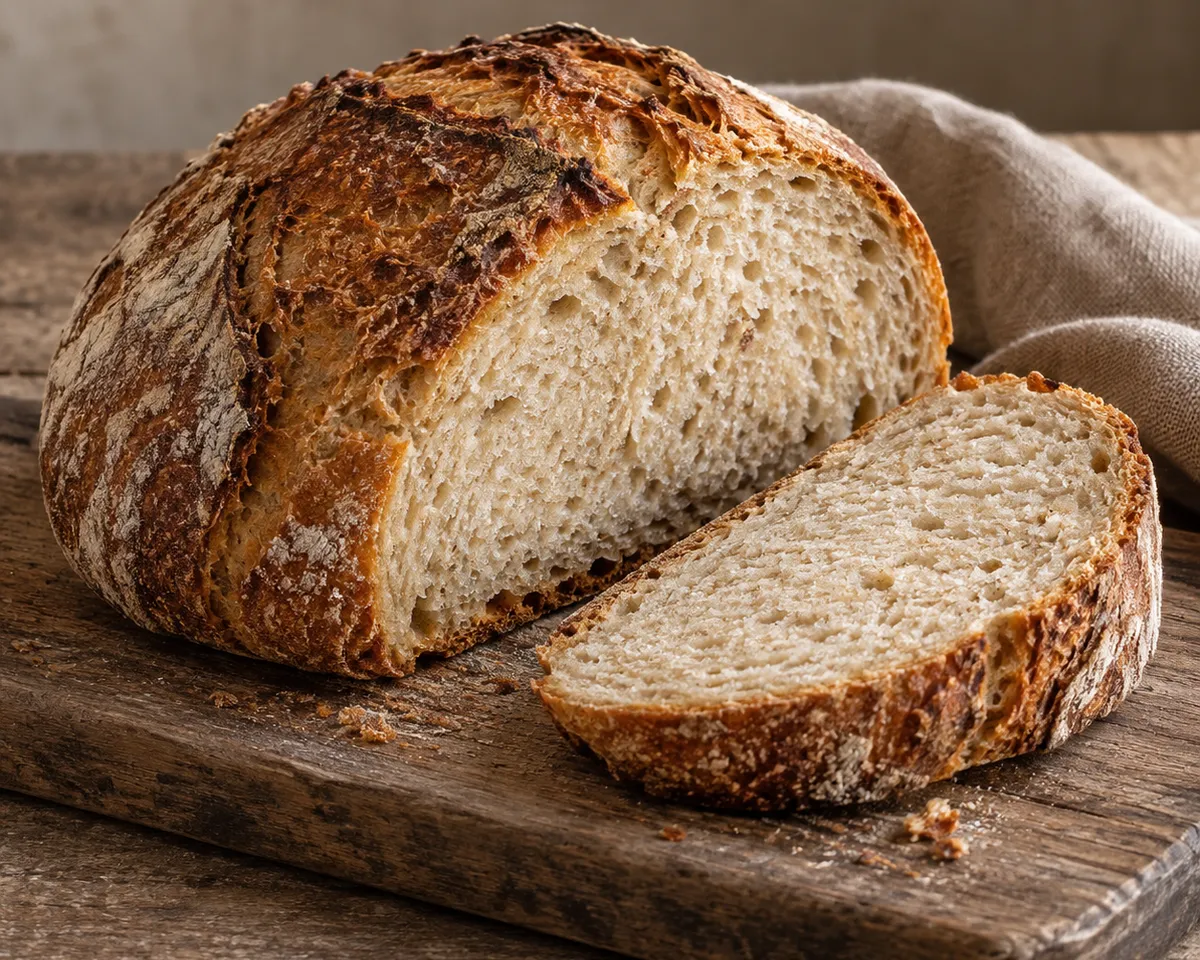
Pane di Cuti
Rogliano sourdough hearth loaf
In the Cuti quarter of Rogliano, women prepared the evening's levato, the local mother dough, then worked it into bread for the next day. Pane di Cuti grows out of that older bread culture of the Savuto valley, with its stone-ground grain, sourdough, and wood ovens.
A Rogliano bakery gave the bread a distinctive stamped form in 1985. Its large loaf, baked in a chestnut-wood oven and perforated with the word CUTI, has a substantial crust and a close, resilient crumb. That firm bake and clean sourdough tang connect it to the household bread from which it developed.
Ingredients
For the bread
- 1 kg(about 2.2 lb)stone-ground Italian type 1 wheat flour (see note)
- 600 g(600 ml / about 2½ cups)water, about 68°F (20°C)
- 200 gripe stiff sourdough starter at 50% hydration (see note)
- 20 g(about 1 tbsp)fine sea salt
- rice flour or additional type 1 flour, for dusting
Kitchen notes
- The home loaf
- Pane di Cuti is a named Rogliano bakery loaf with a private formula and local starter. This recipe makes two smaller loaves from a Calabrian house-bread dough, using type 1 flour and a stiff starter. It differs from the bakery's loaf in flour blend, starter, water, and oven.
- Italian type 1 flour
- Italian “tipo 1” describes a moderately refined, mineral-rich wheat flour; it is not a U.S. grocery category and is not the same thing as bleached all-purpose flour. Seek imported Italian type 1 or a stone-ground medium-extraction bread flour from a miller that states its extraction. Ordinary whole-wheat flour is more bran-forward and changes both the crumb and water absorption.
- Stiff sourdough starter
- The Calabrian levato or criscenti is traditionally a firm mother dough, maintained by repeated refreshment. Here 50% hydration means 100 g flour to 50 g water in the starter. Use it only when it has recently doubled after a refreshment; a sluggish, sharply acidic starter will not give these loaves the needed rise.
- Home oven
- A thoroughly preheated stone and a short period of steam help a home oven set a firm hearth-style crust.
Method
Mix and develop the dough
- Break the ripe starter into a large bowl with the water and stir until mostly dispersed. Add the type 1 flour and mix until no dry flour remains. Add the salt and knead on an unfloured surface until the dough is smooth, elastic, and only slightly tacky, about 8–10 minutes by hand. The finished dough should hold its shape rather than spread like batter. Cover and rest it for 30 minutes.
Shape the two loaves
- Turn the rested dough onto a lightly floured surface and divide it into two equal pieces. Shape each into a tight round or short oval, keeping the smoother side uppermost, and set seam-side down on separate parchment sheets. Cover and proof until the loaves have nearly doubled, look visibly puffy, and a light fingertip press springs back slowly. Heat a baking stone or heavy inverted sheet in the oven to 450°F (230°C) for at least 30 minutes while the loaves proof.
Bake with a firm crust
- Slash the top of each loaf with one decisive cross or long central cut. Slide each parchment sheet and loaf onto the hot stone or sheet, then add a small pan of boiling water to the oven floor or lower rack for steam. Bake 15 minutes at 450°F (230°C), then carefully remove the steam pan, reduce the oven to 400°F (200°C), and bake until the crust is a deep amber brown and the center is at least 205°F (96°C), about 25–35 minutes more. Cool on a rack for at least 2 hours before slicing; cutting early compresses the still-setting crumb.