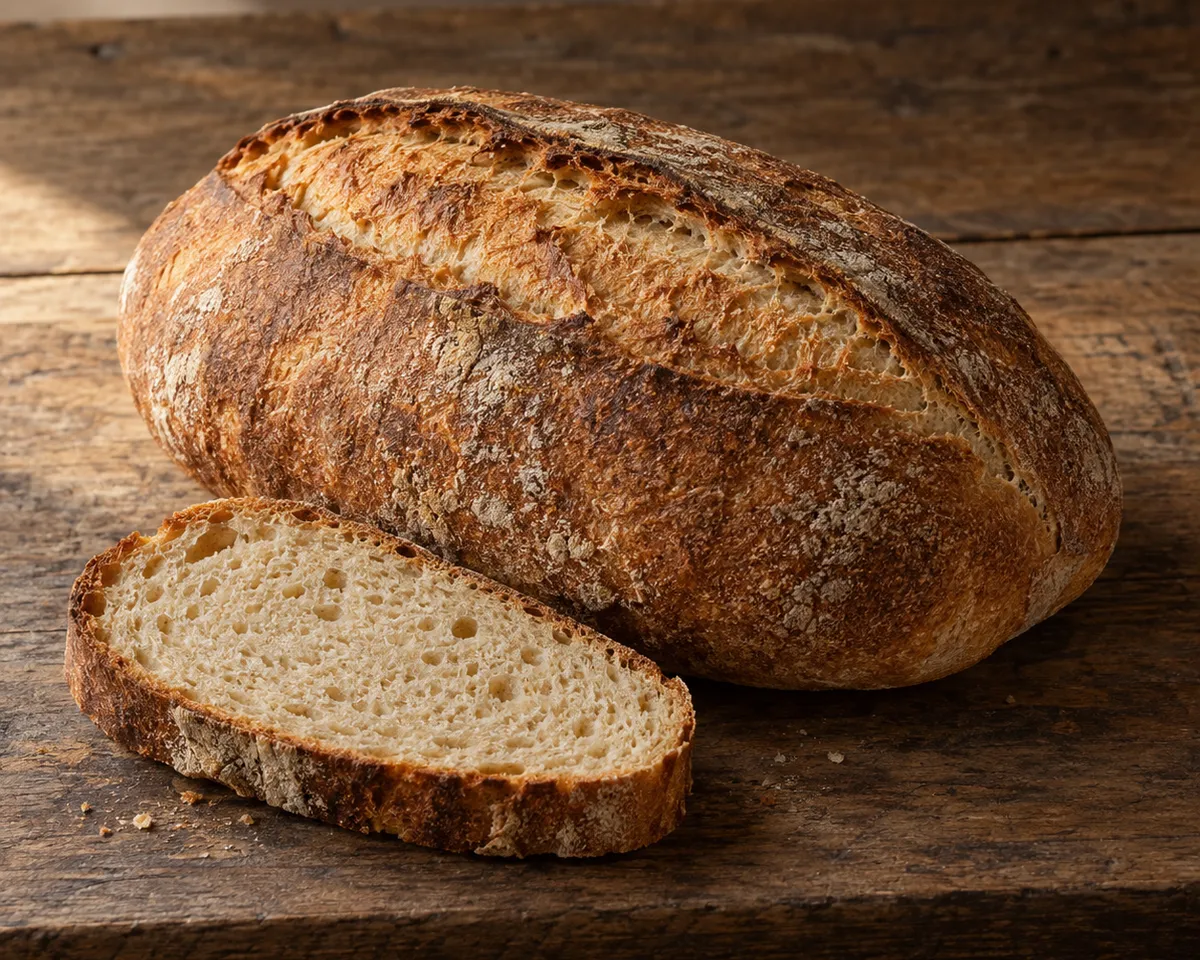
Pane sciocco
Unsalted Umbrian country loaf
Without added salt, a good Umbrian loaf has a crisp, crackling crust and a soft, faintly tangy crumb. Flour, fermentation, and a thorough bake give pane sciocco its clean wheat flavor.
A slice accompanies the strong flavors of the Umbrian table: cured pork, aged cheese, beans, olive oil, a long-cooked sauce. Its mild crumb absorbs juices and softens the sharpness of foods that bring plenty of seasoning of their own.
A famous Perugian legend gives the loaf a dramatic birth in the Salt War of 1540. The story is too neat to treat as settled history: local historical research points to bread made without salt before the conflict. What is certain is the bread's continuing place in Umbrian kitchens, where its apparent plainness has become a decided regional taste.
Ingredients
For the loaf
- 500 gItalian type 0 soft-wheat flour (see note)
- 340 gcool water
- 75 gripe, active sourdough starter (lievito madre; see note)
- rice flour or additional type 0 flour, for the proofing basket
- 240 ml(1 cup)boiling water, for oven steam
Kitchen notes
- Italian type 0 flour
- Italian type numbers describe the flour's refinement; they are not direct U.S. protein grades, and a bag marked 00 is not automatically the same flour. Seek Italian type 0 flour, preferably from a specialty Italian market or online Italian-food supplier, for the intended tender country-loaf crumb.
- Lievito madre
- Use starter that has recently risen substantially after feeding and smells cleanly fermented, not sharply alcoholic or collapsed. Lievito madre, also called pasta madre, gives the unsalted dough a slow fermentation and fuller wheat flavor.
- No salt
- Do not add even a small pinch to the dough. Pane sciocco is defined by its complete absence of added salt, which is why it belongs beside Umbrian foods that bring their own pronounced seasoning.
Method
Mix the unsalted dough
- Put the flour and active starter in a large bowl. Add about 300 g of the water and mix until the flour is fully moistened, then work in the remaining water gradually. Knead until the dough is smooth, supple, and a little tacky but no longer shaggy, about 8–10 minutes by hand or 5–6 minutes on low to medium-low in a mixer. There is intentionally no salt to add. Cover and refrigerate for 1 hour.
Fold and begin the rise
- Turn the cool dough onto a lightly floured surface. Pull each edge toward the center, then turn it seam-side down and gently draw it toward you to make a smooth round. Put it in a lightly floured bowl, cover, and let it rise at room temperature for 1 hour. It should feel smoother and show some expansion, not yet be doubled or loose.
Build the loaf
- Ease the dough onto the floured surface and press it into a rough rectangle without knocking out every bubble. Fold it in thirds like a letter, cover it with an inverted bowl or cloth, and let it rest for 30 minutes. Gently lengthen the relaxed dough into a rectangle, then roll it up from a short side, pinching the seam closed to make a compact oval loaf. Set it seam-side up in a well-floured proofing basket or a towel-lined bowl. Cover and proof in a warm spot until puffy and slowly springing back from a lightly floured fingertip, about 2 hours.
Bake until the crust is dry and crisp
- During the final proof, heat a conventional oven to 465°F (240°C), with a rack in the middle and an empty cast-iron or sturdy metal pan on a lower rack. Turn the loaf seam-side down onto a parchment-lined baking sheet. Score one shallow lengthwise slash across the top with a sharp blade so the loaf can expand cleanly. Put the loaf on the middle rack, carefully pour the boiling water into the lower pan, and close the door at once; keep your hands and face clear of the steam. After 20 minutes, carefully remove the steam pan and lower the heat to 425°F (220°C). Bake for 20 minutes more. The loaf is ready when its crust is richly browned and dry to the touch and the base sounds hollow when tapped. Cool on a rack for at least 1 hour before slicing, so the crumb finishes setting.