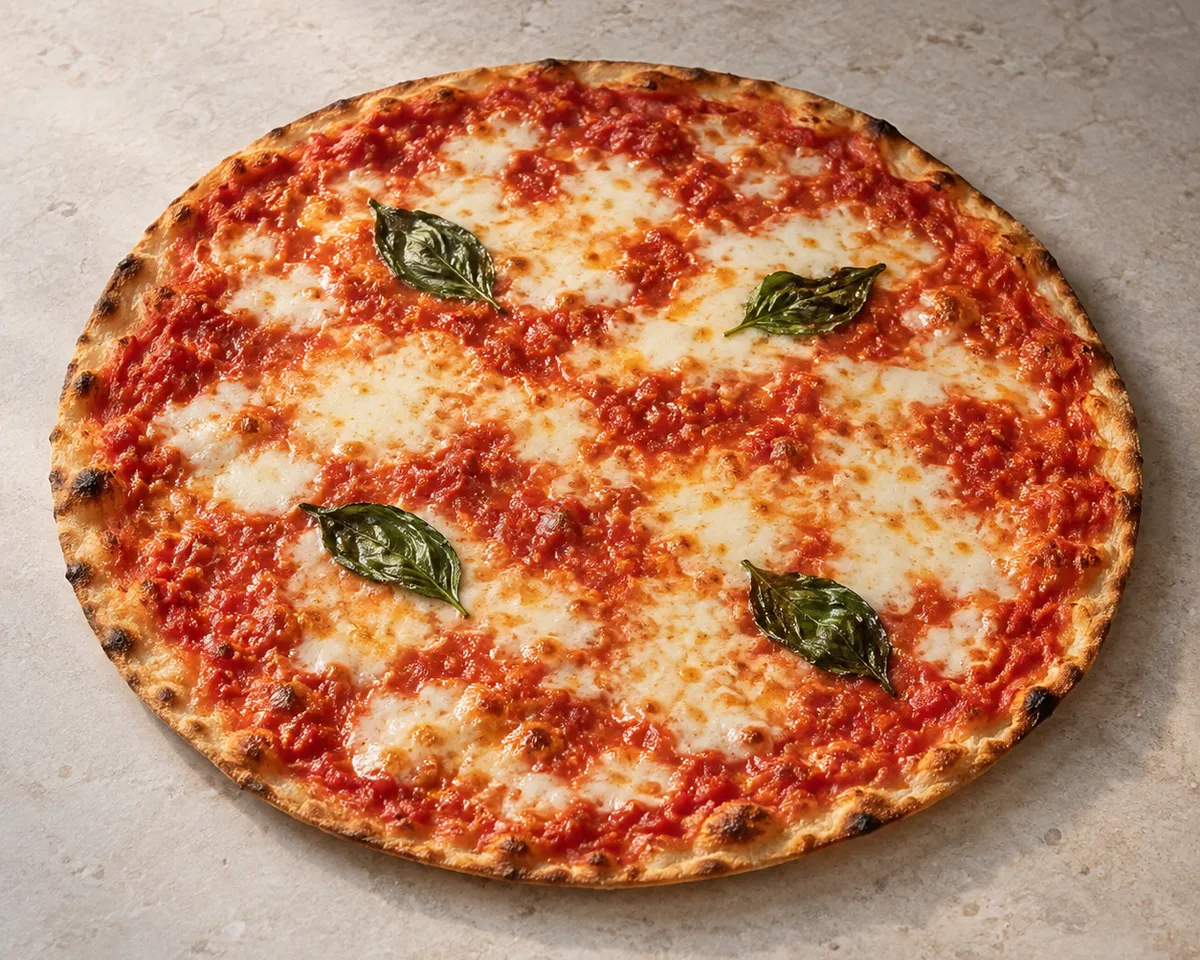
Pizza romana (tonda), Margherita
Thin, crisp Roman-style Margherita
The rolling pin tells you what kind of pizza this is. It presses the fermentation gas out of a small dough ball and leaves a broad, nearly level disk: no inflated cornicione to fold around a soft center. When the tonda romana is right, the bite begins with a dry crackle and stays crisp almost to the edge.
Margherita is a welcome topping here, even if the older Roman red pizza can be far plainer. Tomatoes, mozzarella, basil, and oil need a light hand; this is a pizza designed to carry its own texture. Drain the cheese ruthlessly and keep the sauce uncooked and sparing, or the fine base loses the thing that makes it worth making.
A pizzeria's hot oven sets the tonda in about two minutes. A home oven takes longer, making a thoroughly heated steel especially valuable. Its fine base loses crispness quickly after baking.
Ingredients
Dough
- 450 gstrong type 00 pizza flour (W 260–350; see note)
- 248 gcool water
- 1 g(about ⅓ tsp)instant dry yeast
- 10 gfine sea salt
- 11 g(about 2½ tsp)extra-virgin olive oil
Margherita topping
- 320 gwhole peeled tomatoes, crushed by hand
- 4 g(about ¾ tsp)fine sea salt
- 320 gwell-drained fresh cow's-milk mozzarella (fior di latte), torn or cut into small pieces (see note)
- 20 g(about 1½ tbsp)extra-virgin olive oil
- 16small fresh basil leaves
Kitchen notes
- Roman tonda dough
- This is pizza tonda al matterello: a 33 cm round, rolled thin and baked low and crisp. It is separate from Rome's high-hydration pizza in teglia or alla pala, sold by the cut, and from a soft Neapolitan pizza with an inflated cornicione. Do not hand-stretch it while preserving a rim.
- Type 00 pizza flour
- Choose an Italian-style pizza flour labeled type 00 with a W strength between 260 and 350 when that information is available. The W number is a flour-strength measure, not a grade of fineness. A moderately strong pizza flour supports the long refrigerated fermentation.
- Fior di latte
- Use fresh cow's-milk mozzarella that has been drained well, rather than pre-shredded low-moisture mozzarella. Buffalo mozzarella is much wetter and needs exceptional draining to keep the thin crust crisp.
- A home oven
- A Roman pizzeria oven bakes the pizza at about 610–660°F (320–350°C) for roughly two minutes. A thoroughly heated steel gives a crisp base in a domestic oven, but the longer bake changes its texture.
Method
Mix the dough
- Stir the yeast into the water in a large bowl. Add the flour and mix until no dry flour remains, then knead until the dough is smooth and firm, about 8 minutes by hand. Work in the salt, then the olive oil. Keep kneading until the dough is supple and no longer oily on the surface. It should feel far firmer than a high-hydration tray-pizza dough. Cover and let it rest at room temperature for 20 minutes.
Ball and mature the dough
- Divide the dough into four pieces of about 180 g and form taut balls. Put them in lightly covered containers with room to expand and refrigerate for at least 24 hours. This slow maturation is part of the style, but the balls should remain compact rather than inflate dramatically.
Warm the dough
- About 1 hour before baking, set the dough balls at room temperature. They should relax slightly but remain compact; this is deliberately a low, firm dough, not a billowy Neapolitan one.
Prepare the topping and oven
- Crush the tomatoes by hand with the salt; do not cook them into a sauce. Spread the mozzarella on paper towels for at least 30 minutes. Put a pizza steel on an upper rack and heat the oven at its maximum bake setting, ideally 525–550°F (275–290°C), for at least 45 minutes. A hot steel is important because the home oven has far less heat than a pizzeria oven.
Roll thinly
- Work with one ball at a time, keeping the others covered. Lightly flour the counter and rolling pin. Roll the dough from the center outward, turning it often, until it is a round 32–33 cm (about 13 in) across with no raised rim. It should be very thin and even; any trapped large bubble should be pressed out. Move the disk to a lightly floured peel and give it a shake to make sure it slides.
Top and bake
- Spread one-quarter of the tomato evenly almost to the edge, then scatter one-quarter of the mozzarella and add 4 basil leaves. Drizzle with about 1 teaspoon olive oil. Launch onto the steel and bake until the underside is deeply crisp and browned, the rim is low and lightly charred in spots, and the mozzarella has melted without flooding the center, about 4–6 minutes. If the base is ready before the top, broil briefly while watching continuously. Repeat with the remaining pizzas, letting the steel reheat for a few minutes between each one. Serve immediately.