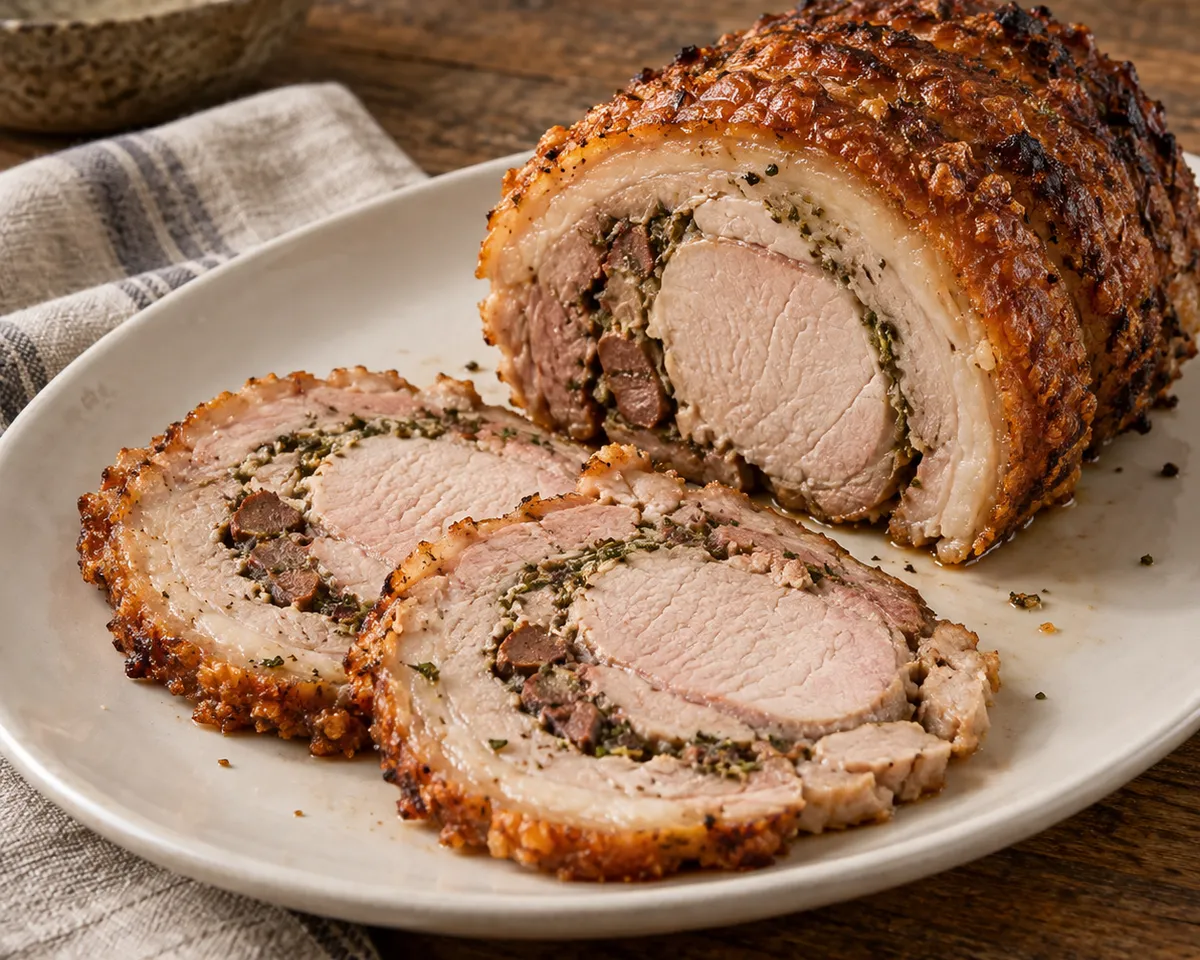
Porchetta
Umbrian fennel-scented roast pork
Cut through the crackling of Umbrian porchetta and the first aroma is wild fennel. It runs through the rich pork with garlic and black pepper, while the skin gives the roast its brittle edge. The regional tradition works on a grander scale than the word ‘roast’ suggests: a whole deboned pig, seasoned inside, tied and cooked for a crowd.
Seasoned liver and other offal traditionally go back into the pig's cavity. That darker, savory thread runs through the lean meat and belly, while wild fennel scents the whole roast. Rosemary may join the fennel, but remains secondary to its green, anise-like fragrance.
This kitchen-sized version rolls skin-on belly around a piece of loin and a modest amount of pork liver. It keeps the contrast of lean meat, fat, crackling and seasoned offal, though a domestic oven cannot reproduce the shape and scale of the whole animal.
Ingredients
For the roast
- 1(about 2 kg / 4 lb 7 oz)rectangular skin-on pork belly, large enough to wrap around the filling, with ribs removed (see note)
- 700 g(1 lb 9 oz)boneless pork loin, in one long piece
- 250 g(9 oz)fresh pork liver, trimmed (see note)
- 30 g(1 oz)fresh wild fennel fronds, finely chopped (see note)
- 8 gfresh rosemary leaves, finely chopped
- 4garlic cloves, finely chopped
- 40 gfine sea salt
- 5 gfreshly ground black pepper
- 250 ml(1 cup)water, for the roasting pan
Kitchen notes
- The pork cuts
- Ask a butcher for a single rectangular, skin-on slab of fresh pork belly that will wrap around the loin and liver. American ‘bacon’ is cured or smoked belly and gives the wrong flavor; it cannot stand in for fresh belly. The loin contributes the lean portion that a whole animal naturally contains.
- Pork liver
- Umbrian whole-pig porchetta often returns the seasoned offal to the animal's cavity. This smaller roast uses fresh pork liver to preserve that savory part of the tradition. Buy it from a butcher and keep it cold; it should reach 160°F (71°C) at the center of the roll.
- Wild fennel
- Finocchietto selvatico means the feathery leaves of wild fennel, not the bulb of cultivated fennel. Its strong, green anise scent is central to the Umbrian roast. Ask a specialty Italian market or knowledgeable grower for fresh wild fennel; ordinary bulb-fennel fronds are milder and should not silently replace it.
- Whole roast and home roll
- Traditional Umbrian porchetta is a whole deboned pig, including the head, seasoned, tied and oven-roasted. A roll of skin-on belly, lean pork and liver brings it to household scale. The smaller cuts and home oven give a different shape and texture from the whole-animal roast.
Method
Season and roll
- Before seasoning, check that the belly will wrap around the loin and liver with only a small overlap; ask the butcher to trim excess belly before assembly so thick layers of skin are not trapped inside. Lay the belly skin-side down, with its longest side facing you. Butterfly the loin if needed so it forms a long, fairly even strip rather than a thick cylinder. Cut the liver into small pieces. Combine the fennel, rosemary, garlic, and pepper. Set aside about one twelfth of this herb mixture with 3 g of the salt for the liver; mix the rest with 29 g salt and rub it over the exposed belly and loin. Toss the liver with its reserved seasoning. Set the loin lengthwise near one edge of the belly and arrange the liver alongside it. Roll the belly snugly around the filling, skin outward, and tie with kitchen twine every 3–4 cm (1¼–1½ inches).
Dry the skin
- Prick the skin all over with a thin skewer, stopping before the meat, and rub it with the remaining 8 g salt. Set the roll on a rack over a pan and refrigerate uncovered for 8–24 hours; the surface should feel dry rather than tacky before it goes into the oven.
Roast gently, then crisp
- Heat the oven to 350°F (180°C). Place the rack and roll over a deep roasting pan and add the water to the pan, below the meat. Roast for about 1½ hours, turning the pan once; replenish a little water if the drippings threaten to burn dry. Raise the heat to 425°F (220°C) and continue roasting for about 45–75 minutes, until the skin is deeply golden and crackling. Check the center of the pork and a piece of liver in the thickest part of the roll with an instant-read thermometer: both must reach at least 160°F (71°C). If the skin browns too quickly before the center is done, lower the oven to 350°F (180°C) and keep roasting to temperature. Use the readings and the skin, not the clock, to decide when it is ready.
Rest and slice
- Transfer the porchetta to a board and rest uncovered for 20–30 minutes so the juices settle without steaming the crackling. Remove the twine. Use a sharp serrated knife to cut through the skin and slice the meat about 1 cm (⅜ inch) thick. Serve warm, with a piece of crisp skin in each portion.