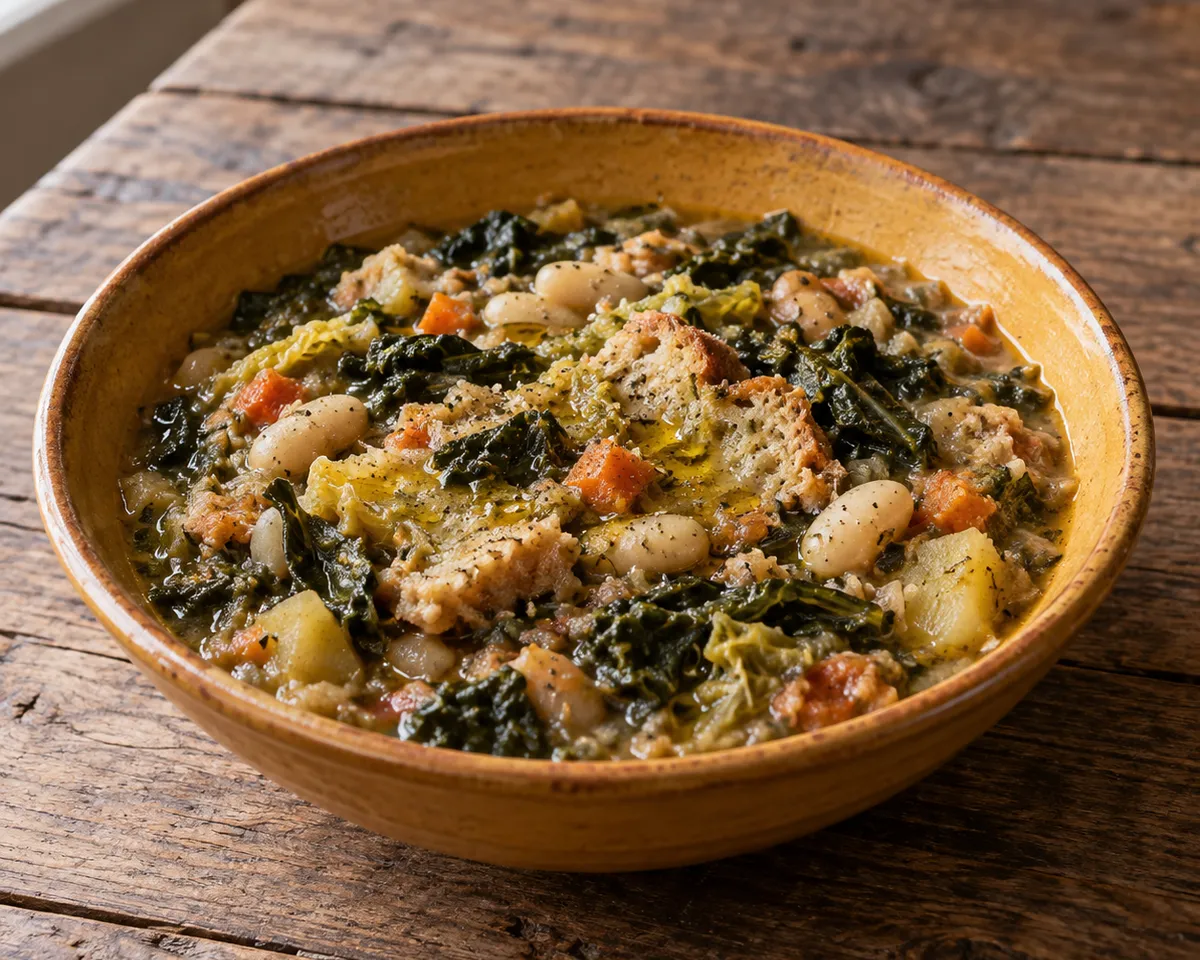
Ribollita
Tuscan reboiled bread and bean soup
Ribollita is cooked across two days. First comes a long, plain vegetable-and-bean soup. Then stale bread is layered into it, and the whole pot rests overnight. When it is heated again the next day, the bread has thickened the broth and the vegetables have settled into something darker, denser, and more deeply flavored.
Cavolo nero and cannellini give the dish its characteristic flavor, joined by savoy cabbage, chard, potato, onion, carrot, and celery. The bread is structural, and a raw finish of good olive oil is as necessary as the slow first cooking.
Ingredients
For the beans
- 400 g(about 2 cups)dried cannellini beans, picked over and soaked overnight (see note)
- 3 L(about 12½ cups)water, plus boiling water as needed to make 2 L (8½ cups) reserved bean broth after cooking
For the soup
- 80 ml(⅓ cup)extra-virgin olive oil, plus more to serve
- 2 medium (about 250 g)yellow onions, thinly sliced
- 2 medium (about 180 g)carrots, thinly sliced
- 2 stalks (about 160 g)celery, thinly sliced
- 300 gcanned whole peeled tomatoes, crushed by hand with their juices
- 400 gTuscan kale (cavolo nero), tough center ribs removed and leaves cut into 3 cm (1¼-inch) ribbons (see note)
- 500 gsavoy cabbage, cored and cut into ribbons
- 200 gSwiss chard, stems and leaves separated and sliced
- 2 medium (about 350 g)waxy potatoes, peeled and cut into 2 cm (¾-inch) pieces
- 500 gstale Pane Toscano DOP or another lean country loaf, sliced about 1 cm (½ inch) thick (see note)
- 8 gfine sea salt, plus more only if needed
- freshly ground black pepper
Kitchen notes
- Cannellini beans
- Cannellini are Italian white kidney beans: large, creamy, and distinct from navy beans, Great Northern beans, or butter beans. Dried beans and their own cooking liquid give the soup its characteristic body. Canned cannellini can make a useful vegetable-and-bean soup, but they do not provide the same bean broth this version needs.
- Cavolo nero
- Look for lacinato, dinosaur, black, or Tuscan kale: these are common U.S. names for the long, dark, crinkled leaves used here. Do not substitute curly kale; it cooks and tastes differently. Remove the tough central ribs before weighing the leaves.
- Pane Toscano
- The traditional Pane Toscano DOP is a naturally leavened wheat loaf made without added salt. It is a perishable regional bread and not routinely practical to obtain in the U.S. Use a 1- to 2-day-old, lean country loaf with no fat or sugar and as little salt as possible; avoid soft sandwich bread, brioche, focaccia, ciabatta, and sourdough loaves with an aggressively sharp flavor. Adjust salt late if the substitute bread is salty.
- The second cooking
- Ribollita literally means reboiled. The overnight rest and following-day reheating are defining, not optional holding instructions. The result should be thick and spoonable, with the bread fully integrated but still showing a few soft layers.
Method
Cook the cannellini and save their broth
- Drain the soaked beans and put them in a large pot with the 3 L (12½ cups) water. Bring to a gentle simmer and cook until tender but not collapsing, usually 45–75 minutes depending on the beans. In the last 10 minutes, add 4 g of the salt. Remove the beans with a slotted spoon. Measure the cooking liquid, adding boiling water if necessary to make 2 L (8½ cups), and reserve it. Purée just over half the beans with 350 ml (1½ cups) of that reserved liquid until smooth; keep the remaining beans whole.
Build the vegetable soup
- Warm the olive oil in a heavy 6–8 L (6–8 quart) pot over medium-low heat. Add the onions, carrots, celery, and chard stems with the remaining 4 g salt. Cook slowly, stirring often, until soft and sweet but not browned, 12–15 minutes. Add the tomatoes and their juices, potatoes, cavolo nero, savoy cabbage, and chard leaves. Pour in 1.4 L (6 cups) of the reserved bean broth. Add several grinds of pepper, bring to a quiet simmer, cover partly, and cook for 35–45 minutes, stirring occasionally, until the greens are tender and the potato gives way easily. Keep the remaining broth hot for later adjustments.
Thicken with the beans
- Stir in the bean purée and whole beans. Simmer uncovered for 20–25 minutes, stirring from the bottom often as the soup thickens. Add the remaining 250 ml (about 1 cup) bean broth a splash at a time only if it becomes stiff before the vegetables are fully tender. Taste and correct the salt. The first-day soup should still be loose enough to flow around the bread; it will tighten substantially overnight.
Layer with bread and rest overnight
- Divide half the bread between two shallow, heatproof 3–4 L (3–4 quart) containers. Ladle half the total soup over the bread, dividing it equally between the containers. Layer in the remaining bread, then divide the remaining soup between them and press any dry edges below the surface. Set the containers in an ice-water bath if you have one, then cover and refrigerate promptly, no later than 2 hours after cooking; do not leave a deep, hot pot on the counter to cool. This overnight rest is the step that turns a good soup into ribollita.
Ribollire and serve
- The next day, scrape the bread and soup back into a heavy pot if needed. Reheat over medium-low heat for about 10 minutes, stirring gently and scraping the bottom, until it bubbles slowly throughout and is thick enough to sit in a spoon without standing dry. Add a little reserved bean broth or water only if it is catching. Serve hot with black pepper and a generous pour of raw extra-virgin olive oil.