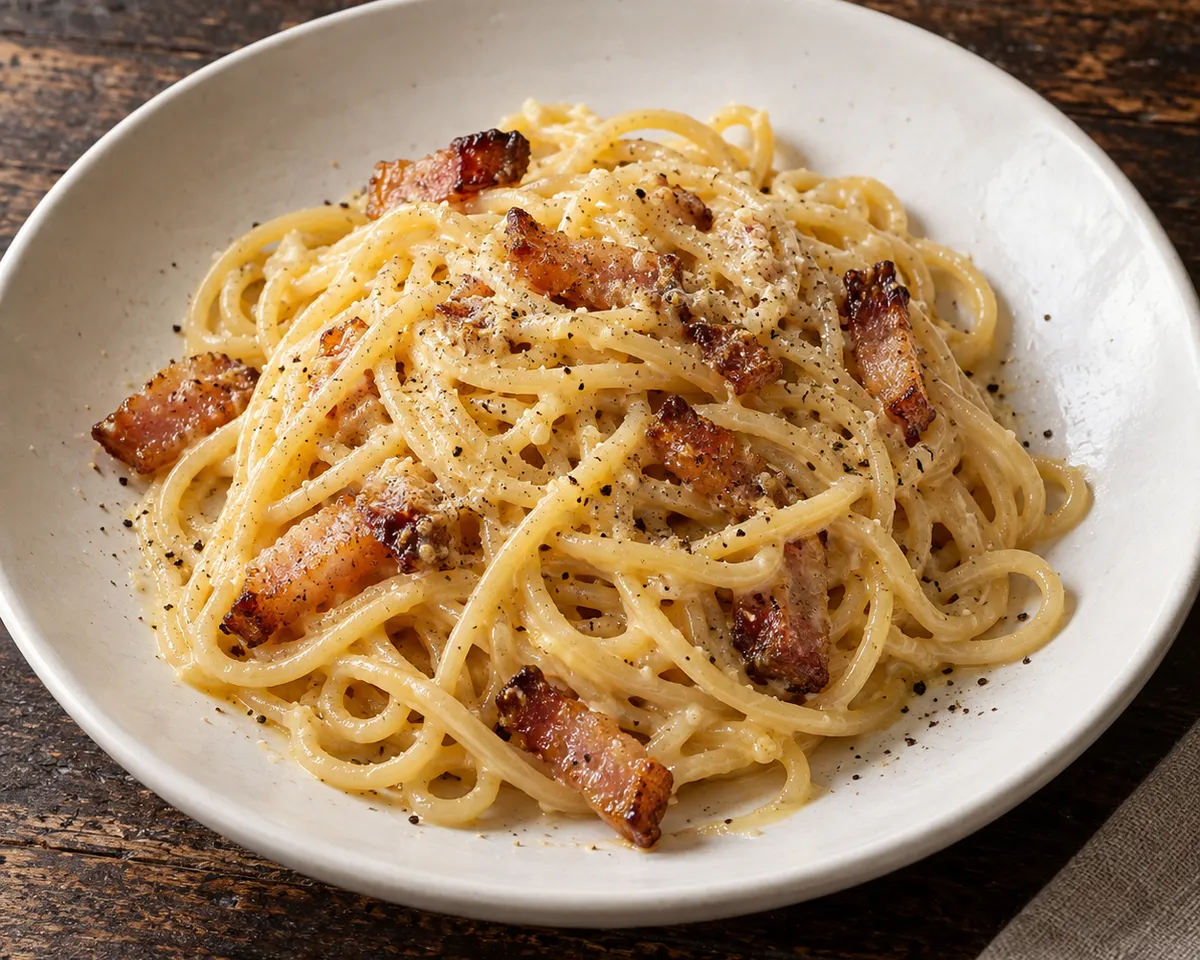
Spaghetti alla carbonara
Roman pasta with guanciale, egg and pecorino
A good carbonara is made in the interval between boiling water and the table. The sauce is not cooked into submission: egg yolks, finely grated Pecorino Romano, pasta water and rendered guanciale fat meet hot spaghetti, then become a pale, glossy coating. The crisp pork stays distinct against the silkier sauce; black pepper provides the dark, aromatic edge.
It belongs to the compact family of Roman pastas in which a few pantry ingredients are rearranged with remarkable force. Here, cured pork jowl supplies both fat and flavor, while the sheep's cheese is sharp enough to hold its own. Pecorino, guanciale and salt are all assertive, so the pasta water should be salted with a lighter hand than usual.
Its origin stories are plentiful and unresolved. The often repeated charcoal-burner and postwar-American accounts are theories, not settled fact; the written record instead shows a dish gaining real visibility in the early 1950s, when its published formulas still included ingredients now left behind. Modern Roman carbonara has narrowed its focus to five things: pasta, guanciale, eggs, pecorino and pepper.
Ingredients
- 400 gdried spaghetti
- 150 gunsmoked guanciale, rind removed and cut into 1 cm (⅜ in) strips (see note)
- 4large egg yolks
- 100 gfinely grated Pecorino Romano DOP (see note)
- freshly ground black pepper
- fine salt
Kitchen notes
- Guanciale
- Guanciale is cured pork jowl. Its broad seams of soft fat render cleanly while the lean stays pleasantly chewy; pancetta comes from the belly and produces a different flavor and texture. Buy unsmoked guanciale from a specialty Italian market or a good butcher counter.
- Pecorino Romano DOP
- Use a firm, aged sheep's-milk Pecorino Romano and grate it very finely just before cooking. It is not fresh pecorino or a mild generic grated cheese. Its saltiness is part of the dish, which is why the pasta water is deliberately only lightly salted.
Method
Render the guanciale
- Put the guanciale in a wide, unheated skillet and set it over medium-low heat. Let the fat render slowly, stirring now and then, until the strips are golden and crisp at the edges but still a little yielding in the center, about 8–10 minutes. Do not add oil. Lift about one-third of the guanciale to a warm bowl for the finish; leave the rest and all of its rendered fat in the skillet. Turn off the heat.
Prepare the egg mixture
- Bring a large pot of water to a boil and salt it lightly. In a large heatproof serving bowl, beat the yolks with the Pecorino and a generous amount of black pepper until thick and paste-like. Set the bowl near the stove. Before draining the pasta, reserve at least 250 ml (1 cup) of the starchy cooking water.
Toss off the heat
- Cook the spaghetti until it is still clearly firm at the center, about 2 minutes short of the package time. Transfer it directly to the skillet with the guanciale and its fat and toss for 30–60 seconds, adding a small splash of cooking water only if the pasta looks dry. Take the skillet fully off the heat, then transfer the spaghetti, guanciale and rendered fat together to the bowl of yolks and Pecorino. Toss and turn vigorously with tongs, adding the hot cooking water a tablespoon at a time until the sauce loosens into a glossy coating that clings to every strand. It should flow slowly when the bowl is tipped, never sit in clumps or look like scrambled egg.
- Taste and add salt only if it needs it. Divide at once among warm bowls. Top with the reserved crisp guanciale and more black pepper; add a little more Pecorino only if the balance needs it.