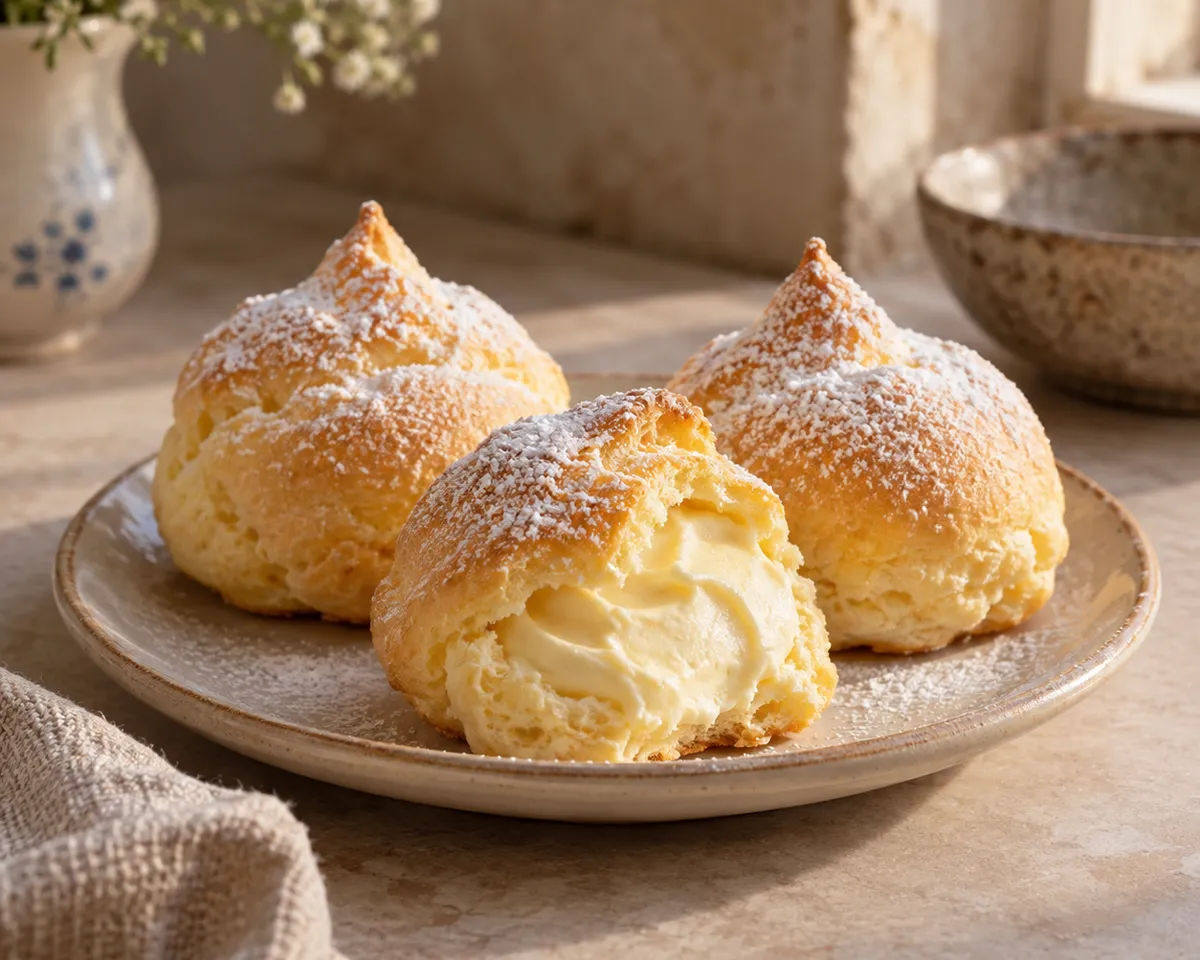
Tette delle monache
Altamura's cream-filled sponge pastries
The name is cheeky, the construction exacting. Each Altamura pastry is a pale, peaked dome of exceptionally light sponge with cream piped into its center. A little powdered sugar finishes the shape; there is no thick crust to compete with the filling.
The pastries are linked in local tradition to the nuns of Santa Chiara, though the many stories offered for their name are better kept as stories. Their identity is much clearer on the plate: an airy egg foam, just enough flour to hold it, and a cool, soft center that fills the shell rather than sitting between two cut halves.
The sponge's volume comes from carefully whipped eggs and a measured bake, not chemical leavening. Give the shell time to dry before filling it, then pipe the cream through the underside. It should feel improbably light in the hand and generous at the first bite.
Ingredients
For the sponge shells
- 175 gegg whites (about 5–6 large whites)
- 50 gegg yolks (about 3 large yolks)
- 15 gwhole beaten egg
- 85 ggranulated sugar, divided into 50 g and 35 g
- 53 gweak Italian type 00 pastry flour or U.S. pastry flour, sifted (see note)
For the cream filling
- 250 ml(1 cup)whole milk
- 2egg yolks
- 50 ggranulated sugar
- 15 gweak Italian type 00 pastry flour or U.S. pastry flour
- 1strip of lemon zest, without white pith
- 180 ml(¾ cup)cold heavy whipping cream
- powdered sugar, for a light finish
Kitchen notes
- Pastry flour
- Use low-protein Italian type 00 flour intended for pastry, or U.S. pastry flour. Type 00 describes fineness, not strength; do not use bread flour. Some modern bakeries use a commercial sponge mix called mix africano; these shells get their volume from whipped eggs.
- Cream filling
- The filling here is crema diplomatica: cooled pastry cream folded with whipped cream. It is more stable than plain whipped cream and gives the Altamura pastry its soft, generous center. It goes into the cooled shell so the cream does not melt.
Method
Rest the egg mixtures
- The day before baking, stir the egg whites with 50 g sugar in one bowl, and the yolks, 15 g whole egg and 35 g sugar in another; do not whip them yet. Cover directly and refrigerate for 24 hours. The rest helps the egg foam hold its shape.
Make and chill the cream
- Warm the milk with the lemon zest until steaming; remove the zest. Whisk the 2 yolks with 50 g sugar and 15 g flour until smooth, then slowly whisk in the hot milk. Return to the pan and cook over moderate heat, whisking constantly, until thick and bubbling; continue 1 minute to cook the flour. Spread in a shallow dish, cover the surface, and chill until completely cold. Whip the cold cream to soft, stable peaks and fold it into the chilled pastry cream. Refrigerate while the shells bake.
Whip and pipe the shells
- Heat the oven to 340°F (170°C) in conventional, not convection, mode. Line a baking sheet with parchment. Beat the rested whites until glossy and firm enough to hold a peak without looking dry or broken. Beat the yolk mixture briefly until loosened, then stir in the sifted 53 g flour. Fold in a small portion of the whites to lighten it, then gently fold that mixture into the remaining whites. Transfer promptly to a piping bag with a plain 14 mm (about ½-inch) tip. Pipe six well-spaced 7–8 cm (about 3-inch) mounds in tight circles, finishing each with a small central point.
Bake and dry
- Bake immediately with the oven door held just 5 mm (¼ inch) ajar with a tightly folded piece of foil so moisture escapes. Bake about 30–35 minutes, until the domes are set, light golden and dry to the touch. Turn off the oven and leave them inside with the door ajar for 10 minutes, then cool completely on a rack. If a shell collapses dramatically, it was underbaked or the foam lost too much air during folding.
Fill and serve
- Fit a piping bag with a narrow filling tip and fill it with the cold cream. Make a small opening in the flat underside of each cooled shell and pipe until the pastry feels full and slightly heavy, without bursting it. Dust lightly with powdered sugar. Refrigerate until serving, and eat the same day for the best contrast between delicate shell and cream.