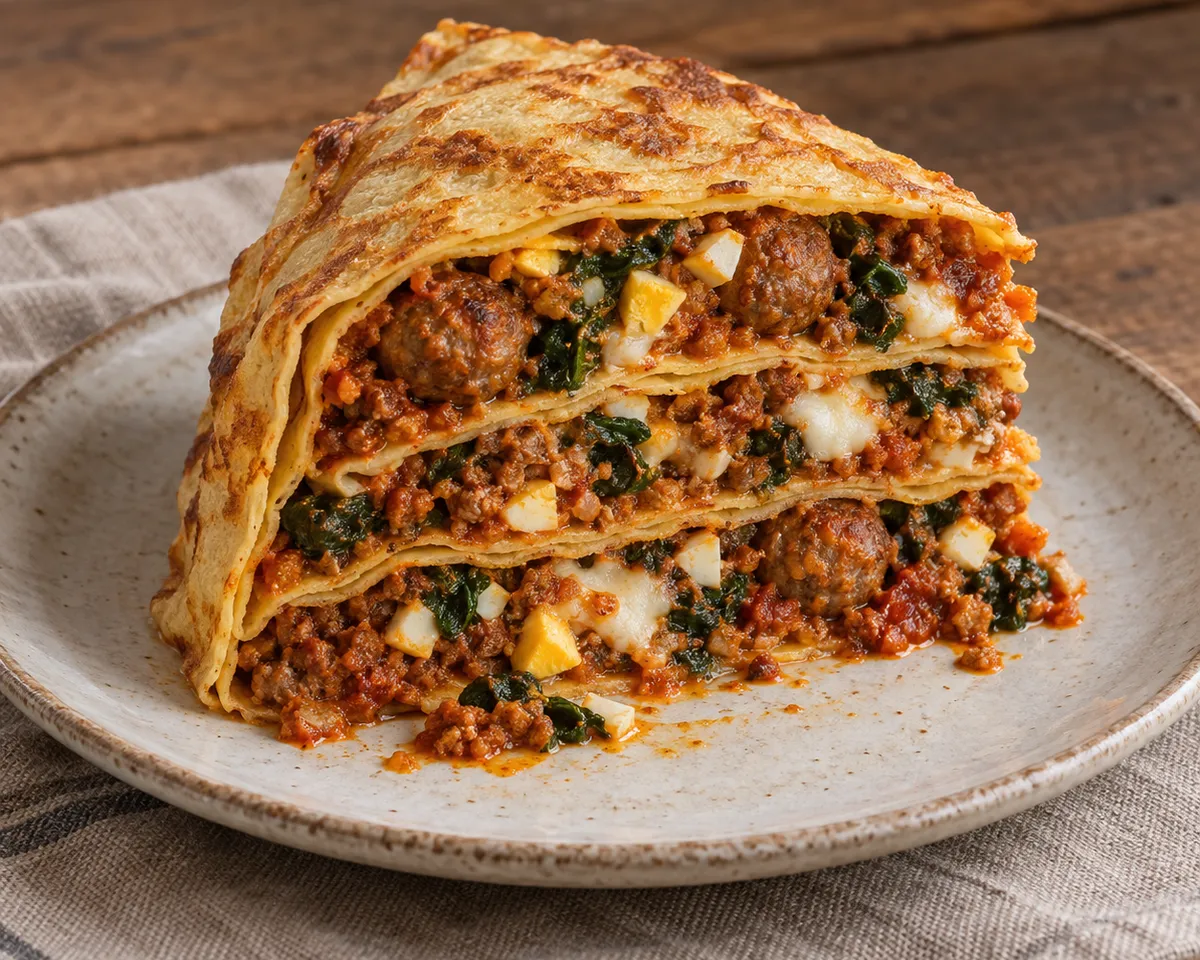
Timballo teramano di scrippelle
Teramo crêpe timballo with tiny meatballs
In the Teramo kitchen, the layer is a scrippella: a very thin, water-based crêpe, yellow with egg and soft enough to bend around a filling. That alone changes the nature of the timballo. Pasta sheets make other baked dishes; these tender rounds form a parcel whose cut reveals folded edges, tomato, cheese, greens, egg, and a scatter of tiny pallottine.
The pleasure is generous but organized. The meatballs should be no bigger than a small olive, browned before they meet the sauce, so they remain small points of savor rather than a second ragù. Mozzarella must be well drained, and the spinach squeezed dry. Each element is cooked before the oven; baking melds the layers and gives the enclosed top a little color.
There is no single household inventory for a Teramo timballo. Some versions bring in chicken, a longer meat sauce, scamorza, or different garden greens. Scrippelle, red sauce, pallottine, mozzarella, cooked greens, and hard-boiled egg make a festive combination, held within the soft crêpe wrapper.
Ingredients
For the tomato ragù
- 30 ml(2 tbsp)extra-virgin olive oil
- 120 gyellow onion, finely chopped
- 350 g(12 oz)ground beef and pork, mixed
- 80 ml(⅓ cup)dry white wine
- 700 g(about 3 cups)passata di pomodoro
- fine sea salt and freshly ground black pepper
For the pallottine
- 300 g(10½ oz)ground beef
- 1large egg
- 30 g(about ⅓ cup)Parmigiano Reggiano or Grana Padano, finely grated
- 25 g(about 3 tbsp)fine, unseasoned dry breadcrumbs
- 1 generous pinchfreshly grated nutmeg
- fine sea salt and freshly ground black pepper
- about 120 ml(½ cup)extra-virgin olive oil, for shallow frying
For the scrippelle and filling
- 5large eggs
- 175 g00 flour or all-purpose flour
- 450 ml(scant 2 cups)cold water
- 3 g(½ tsp)fine sea salt
- 15 ml(1 tbsp)extra-virgin olive oil, for the pan
- 250 g(9 oz)whole-milk mozzarella, diced and drained very dry
- 250 g(9 oz)frozen leaf spinach, thawed, squeezed very dry, and chopped
- 3large eggs, hard-boiled and coarsely chopped
- 80 g(about 3 oz)Parmigiano Reggiano or Grana Padano, finely grated
- 15 g(1 tbsp)unsalted butter, for the baking dish
Kitchen notes
- Scrippelle
- These scrippelle are made with eggs, flour, water, and salt—no milk. They are much thinner and more yielding than American breakfast pancakes. Do not replace them with dried lasagna or ordinary pasta sheets; that produces a different kind of timballo.
- Pallottine
- These are tiny fried meatballs, not full-size meatballs. Keep them near 2 cm (¾ in), about the size of a small olive, so each layer eats as a soft mosaic instead of a stack of separate meatballs.
- Mozzarella and spinach
- Use fresh whole-milk mozzarella, not low-moisture pizza cheese, and drain it thoroughly. Squeeze the thawed spinach until it feels almost dry; excess moisture is what makes a scrippelle timballo slump.
- Passata di pomodoro
- Passata is plain strained tomato purée, not sweetened jarred pasta sauce. Cook it down until it is dense enough to support the crêpe layers.
Method
Cook a dense ragù
- Warm the olive oil in a wide skillet over medium heat. Cook the onion with a pinch of salt until soft and translucent, about 8 minutes. Add the mixed ground meat and cook, breaking it up finely, until no pink remains. Add the wine and let it evaporate fully. Stir in the passata, season with pepper, and simmer uncovered at the barest bubble until thick and glossy, 35–45 minutes. It should mound on a spoon, with no watery ring around it. Cool until just warm.
Make and fry the pallottine
- Mix the beef, egg, 30 g grated cheese, breadcrumbs, nutmeg, salt, and pepper until just combined. With lightly oiled hands, roll the mixture into small-olive-sized balls, about 2 cm (¾ in) across; you should have roughly 90–110. Heat a thin layer of olive oil in a wide skillet over medium-high heat. Fry the pallottine in batches, rolling the pan often, until browned and cooked through, about 4–5 minutes. Drain on a rack or paper towel. Stir half into the ragù and keep the rest aside for distributing through the layers.
Cook the water-based scrippelle
- Whisk the five eggs, flour, water, and salt until completely smooth. Rest the batter for 20 minutes. Heat a 24 cm (9½ in) nonstick skillet over medium heat and brush it very lightly with oil. Use about 50–55 ml (a scant ¼ cup) batter per round, swirling at once to make it very thin. Cook until the top is set and the edge releases, 45–60 seconds; turn briefly to dry the second side. Stack the scrippelle on a plate as you go, covering them with a clean towel. Make about 14 thin rounds; keep any imperfect ones for patching.
Line the dish and build three filling layers
- Heat the oven to 375°F (190°C). Butter a 24 cm (9½ in) round baking dish at least 8 cm (3 in) deep. Lay 6 scrippelle in the dish, overlapping them across the bottom and up the sides, with generous edges hanging over the rim. Spread one third of the ragù over the base. Add one third each of the remaining pallottine, mozzarella, spinach, chopped egg, and grated cheese. Cover with 2 scrippelle, then repeat the filling once; cover with 2 more scrippelle and add the final filling.
Close, bake, and rest
- Fold the overhanging scrippelle over the final filling, then lay 2 rounds across the center to make a complete lid; use spare rounds to patch any gaps. Cover the dish tightly with parchment-lined foil and bake for 25 minutes. Uncover and bake until the top is lightly browned and the center is visibly bubbling, 12–15 minutes more. Rest for 15 minutes before cutting so the parcel holds together.