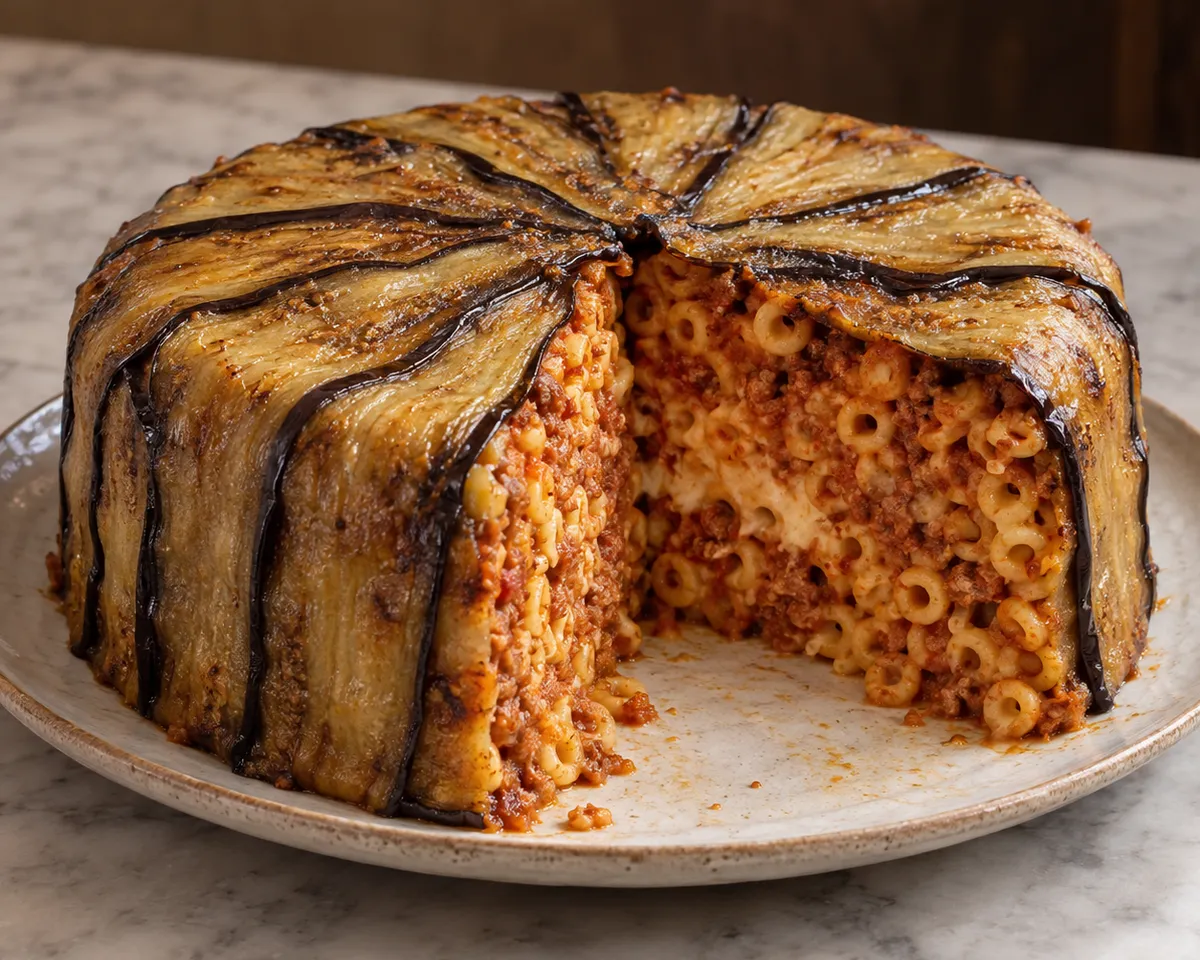
Timballo di melanzane
Eggplant-wrapped baked pasta from western Sicily
The eggplant shell of a timballo appears only when the pan is lifted away. Long slices of fried eggplant line the pan; inside goes pasta dressed with a substantial ragù and pockets of young cheese. Only after baking and a rest does the whole thing turn out, its dark eggplant skin making the simplest possible decoration.
The anelletti in this version are a Palermo choice: tiny pasta rings that hold sauce and settle neatly into a slice. Western Sicilian timballi vary widely in their extras, but the structure matters more than a maximal list of fillings. Here pork ragù and caciocavallo give the eggplant something rich to enclose without burying it under salumi, eggs, or béchamel.
This belongs to the celebratory side of Palermo cooking, although leftovers travel remarkably well. Serve it warm rather than fiercely hot. A clean wedge is the reward for letting the pasta and eggplant settle before lifting the pan away.
Ingredients
Eggplant lining
- 1.2 kg(about 2⅔ lb)firm, long dark eggplants, cut lengthwise into 4–5 mm (a scant ¼-inch) slices
- coarse salt, for draining the eggplant
- peanut or other neutral high-heat oil, for frying
Pork ragù
- 45 ml(3 tbsp)extra-virgin olive oil
- 100 gyellow onion, finely chopped
- 60 gcarrot, finely chopped
- 60 gcelery, finely chopped
- 400 gground pork
- 100 ml(scant ½ cup)dry red wine
- 40 gdouble-concentrated tomato paste
- 650 gplain tomato passata (see note)
- 1bay leaf
- fine salt and freshly ground black pepper
Pasta and assembly
- 400 gdried Sicilian anelletti pasta (see note)
- 150 gyoung caciocavallo, cut into small cubes (see note)
- 30 gfine unseasoned breadcrumbs, for the pan and base
- 15 ml(1 tbsp)extra-virgin olive oil, for the pan
Kitchen notes
- Anelletti
- These are the small Sicilian pasta rings used in Palermo baked pasta, not large American-style ring pasta or canned pasta shapes. Look for dried anelletti at a specialty Italian market or online; the shape helps the timballo pack and slice.
- Young caciocavallo
- Use a relatively young, sliceable cheese that softens in the oven, not a hard, long-aged grating caciocavallo.
- Tomato passata
- Passata is smooth, unseasoned strained tomato, not a jar of sweetened American pasta sauce. Reduce it with the pork until the ragù coats the pasta without making the eggplant shell soggy.
Method
Cook the ragù
- Warm the olive oil in a heavy saucepan over medium-low heat. Cook the onion, carrot, and celery until softened, about 10 minutes. Add the pork, break it into small pieces, and brown it thoroughly. Pour in the wine and reduce until the pan is nearly dry. Stir in the tomato paste, passata, and bay leaf. Simmer gently, partly covered, for 60–75 minutes, stirring now and then, until the sauce is thick and the meat is tender. Remove the bay leaf, season with salt and pepper, and set aside about 150 g of the ragù for a middle layer.
Fry the eggplant
- Salt the eggplant slices lightly in a colander and leave for 30–45 minutes. Rinse briefly and dry each slice thoroughly. Heat about 2 cm (¾ inch) of neutral oil in a wide pan to 350°F (175°C). Fry the slices in batches until pliable and golden at the edges, about 2–3 minutes per side. Drain on a rack or paper towels. Keep the broadest intact slices for lining the pan; chop any small or torn ones to fold into the pasta.
Prepare the pasta and pan
- Heat the oven to 375°F (190°C). Oil a deep, round 23 cm by 7.5 cm (9-inch by 3-inch) cake pan with at least 3 liters (about 13 cups) of capacity, and dust its bottom and sides with a little of the breadcrumbs. Line the base and sides with overlapping eggplant slices, letting long slices overhang the rim; if slices are too short to reach from base to rim, overlap separate slices across the base and up the sides so there are no gaps. Cook the anelletti in well-salted boiling water until distinctly firmer than al dente, about 3 minutes short of the package time. Drain and mix with the ragù that was not reserved and any chopped eggplant. The pasta should be generously coated, not swimming in sauce.
Fill, bake, and turn out
- Spoon half the dressed pasta into the lined pan and press gently into the corners. Spread over the reserved ragù and scatter on the caciocavallo. Add the remaining pasta and level it without crushing the rings. Fold the overhanging eggplant inward to cover the pasta, patching gaps with remaining slices. Dust with the remaining breadcrumbs. Bake for 25–30 minutes, until bubbling at the edges and firm at the center. Rest in the pan for at least 20 minutes, then run a thin knife around the edge, invert onto a broad platter, and lift the pan away. Cut into wedges while warm.