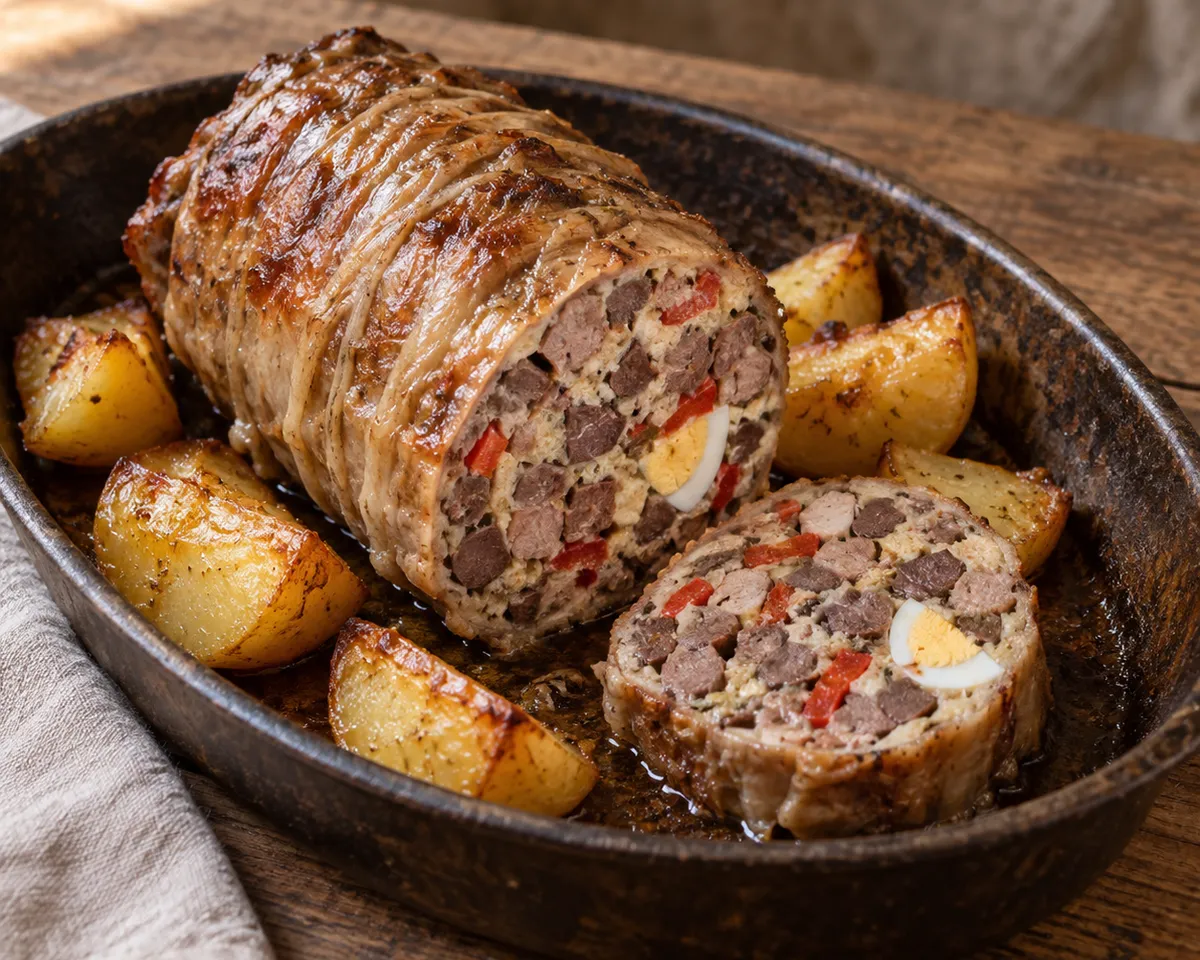
Torcinello abruzzese
Abruzzese lamb-offal roulade in caul and natural casing
A torcinello is an exercise in careful wrapping. In one Chieti tradition, a slim piece of lamb tripe is wound in lamb intestine and tied at the ends. Elsewhere in Abruzzo the name can stretch to a fuller coratella roll, rich with caul and the rest of the animal’s small cuts. The family is local; the exact form is not fixed.
For a Frentana Easter roulade, lamb offal is briefly cooked, layered with cheese, egg, pepper, and short pieces of intestine in caul, then bound in more natural casing and baked with potatoes. It is a roast for slicing, rich with the lamb and its wrappings.
A specialist butcher supplies the unusual wrappings. Caul and clean natural lamb casing do more than decorate: one bastes the roll, the other holds it in a tight spiral. Buy food-grade, pre-cleaned caul and casing, and let the roast rest before slicing so its distinct layers stay together.
Ingredients
For the torcinello
- 200 g(7 oz)lamb heart, trimmed and cut into 1 cm (½-inch) pieces (see note)
- 200 g(7 oz)lamb liver, trimmed and cut into 1 cm (½-inch) pieces
- 100 g(3½ oz)lamb kidney, trimmed and cut into 1 cm (½-inch) pieces
- about 250 g(9 oz)food-grade lamb caul fat (omento), rinsed and spread in one sheet (see note)
- about 5 m (16 ft)food-grade pre-cleaned natural lamb or sheep casing, soaked as its package directs (see note)
- 30 ml(2 tbsp)extra-virgin olive oil, divided
- 100 gyellow onion, finely chopped
- 6 g(about 2 tbsp)flat-leaf parsley leaves, finely chopped
- 2 smallgarlic cloves, finely chopped
- 120 g(about 1 cup)mild red bell pepper, cut into thin strips
- 300 g(10½ oz)Grana Padano, finely grated (see note)
- 1large egg, beaten
- 2large eggs, hard-boiled, peeled, and quartered lengthwise
- 4fresh bay leaves or 2 dried bay leaves
- 6 g(about 1 tsp)fine sea salt, divided
- 2 g(about 1 tsp)freshly ground black pepper
For the pan
- 1 kg(2¼ lb)waxy potatoes, cut into 3 cm (1¼-inch) wedges
- 15 ml(1 tbsp)extra-virgin olive oil
- 2 g(about ⅓ tsp)fine sea salt
Kitchen notes
- Lamb offal
- Traditional versions may include lamb lung along with liver, heart, and kidney. U.S. regulations do not permit livestock lung to be saved for human food, so use the three listed organs from a specialist butcher. Do not replace them with ground lamb or ordinary sausage meat; the dish’s character comes from coratella.
- Lamb caul fat and natural casing
- Caul is the lacy membrane around the organs; it melts and bastes the offal. The casing is edible small intestine, not plastic or collagen sausage casing. Buy both as food-grade, pre-cleaned lamb or sheep products, and follow the seller’s soaking instructions. These wrappers are essential to a torcinello rather than optional garnish.
- Grana Padano
- Use finely grated aged cow's-milk cheese. Dry Grana Padano binds with the egg and keeps the filling distinct; a wet melting cheese would loosen it.
Method
Prepare the wrappers and filling
- Heat the oven to 350°F (180°C). Drain and pat the caul dry, then keep it covered and chilled. Drain the soaked casing; cut six short pieces about 8 cm (3 in) long, then cut the remainder into four roughly equal lengths for binding. Warm 1 tablespoon of the olive oil in a wide skillet over medium heat. Cook the onion with a pinch of salt until soft but not browned, about 6 minutes. Add the heart, liver, and kidney; cook, stirring, just until their surfaces lose their raw sheen, about 4–5 minutes. Transfer to a plate and cool for 10 minutes. The offal will finish cooking in the oven; do not cook it hard in the skillet.
Make the filling
- Mix the parsley, garlic, grated cheese, beaten egg, black pepper, and 4 g of the salt into a thick paste; keep the cooled offal separate. Toss the pepper strips with the remaining tablespoon of olive oil and a pinch of salt. In a bowl, toss the potatoes with their olive oil and salt, then spread them across the base of a 23-by-33 cm (9-by-13 in) roasting pan, leaving a shallow clear strip through the center for the roulade.
Roll and bind the torcinello
- Lay the caul on a clean board with its larger, lacy side facing up. Arrange half the pepper strips down the center, leaving a 4 cm (1½-inch) border at the short ends. Spread the cheese-and-egg paste over the peppers, then the cooled offal and any juices from the plate. Lay the quartered hard-boiled eggs and six short casing pieces along the length, then cover with the remaining pepper. Fold the short ends inward and roll the caul into one firm, even cylinder, about 28 cm (11 inches) long. Wind the four long casing lengths around it in close spirals, working from end to end, and tuck each end beneath a final turn. The casing should hold the roll, not cut deeply into the caul. Set the torcinello, seam-side down, in the clear strip among the potatoes; tuck the bay leaves into the pan beside it so they can be removed before serving.
Roast, rest, and slice
- Roast until the casing is browned, the potatoes are tender, and the center of the roll reaches 160°F (71°C), about 55–70 minutes. Turn the potatoes once after 35 minutes and shield only the torcinello loosely with foil if the casing darkens before the center is ready. Remove and discard the bay leaves. Rest the roast for 15 minutes, then use a sharp serrated knife to cut it into 2 cm (¾-inch) slices. Serve each slice with the potatoes and pan juices while the casing is still crisp at the edges.