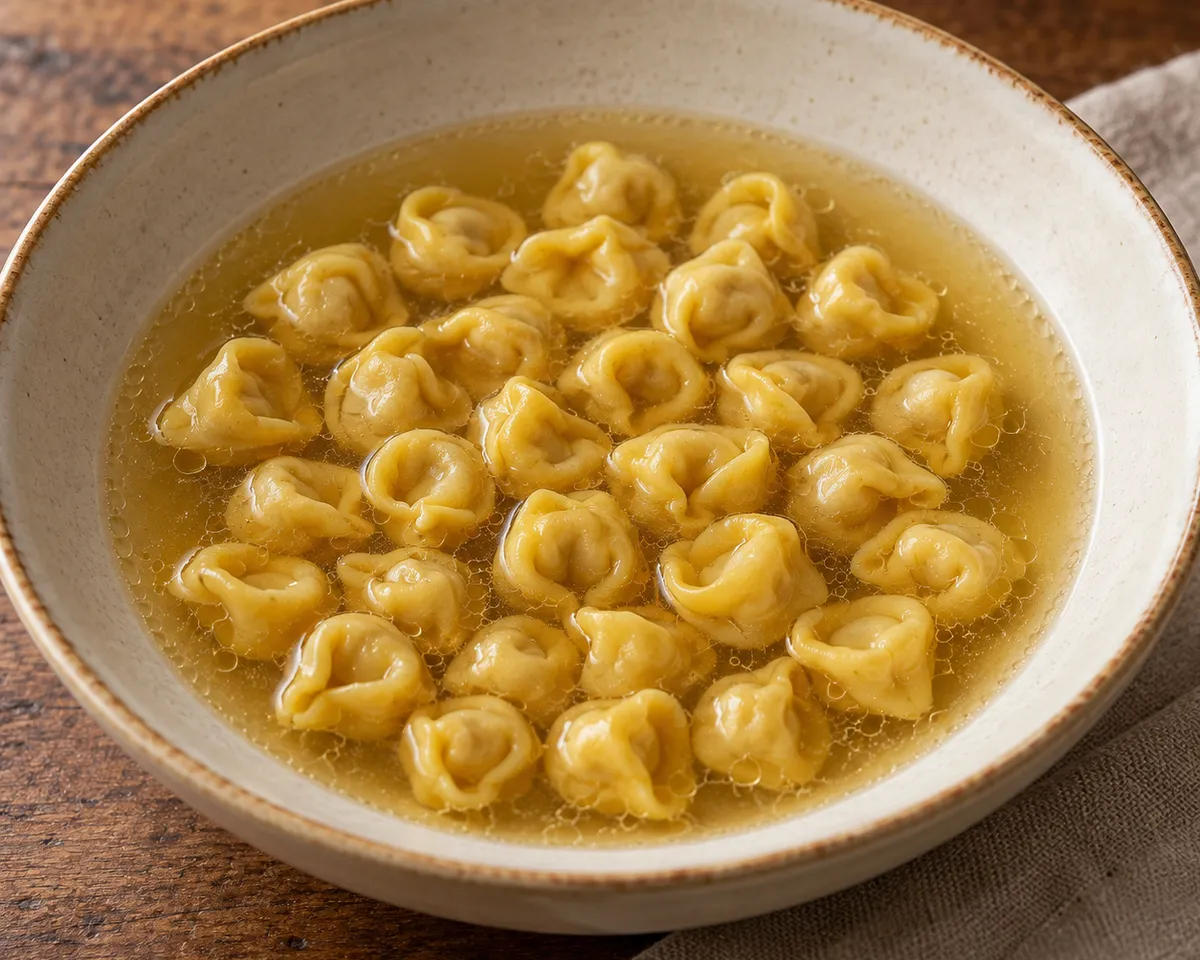
Tortellini in brodo
Bolognese filled pasta in capon and beef broth
A clear capon-and-beef broth surrounds the small, dense tortellini. One bite brings pork, sweet mortadella, prosciutto and Parmigiano Reggiano together in a rich filling.
For the Bolognese filling, pork loin is cooked first, then minced finely with dry-cured prosciutto and mortadella before Parmigiano, egg and nutmeg bind the mixture. The pasta is cut into little squares and closed into its familiar ring, a job that rewards a long afternoon, a clear counter, and a willingness to improve by the dozen.
Ingredients
For the filling
- 100 gboneless pork loin
- 1 small sprigfresh rosemary
- 1small garlic clove, lightly crushed
- 15 gunsalted butter
- 100 gprosciutto crudo, roughly chopped
- 100 gMortadella Bologna IGP, roughly chopped (see note)
- 150 gParmigiano Reggiano, finely grated
- 1large egg
- freshly grated nutmeg
- fine salt and black pepper
For the beef-and-capon broth
- 1 kg(2¼ lb)boneless beef brisket or chuck, cut into large pieces
- 1meaty beef bone, optional
- 1.2–1.5 kg(2½–3¼ lb)capon or mature hen, cut into pieces
- 1carrot, halved
- 1celery stalk, halved
- 1small yellow onion, halved
- 4 L(4 qt)cold water
- fine salt
For the pasta
- 300 gItalian 00 flour, plus a little for the work surface
- 3large eggs
Kitchen notes
- Mortadella Bologna IGP
- Use the large, finely textured cooked pork sausage from Bologna, ideally marked IGP, sliced thick from a deli counter. It is not American bologna, which is usually softer, more aggressively seasoned, and made to a different standard.
- Prosciutto crudo
- Choose a dry-cured Italian ham such as Prosciutto di Parma or Prosciutto di Modena. Do not use cooked ham; its moisture and flavor would change the filling.
- Capon or mature hen
- The Bolognese broth is made with beef plus capon or free-range hen. A capon is a large, richly flavored chicken; a mature hen gives the same traditional poultry character. Keep the broth clear and lightly seasoned.
Method
Season and cook the pork
- Put the pork loin in a small dish with the rosemary, garlic, a pinch of salt, and a few grinds of pepper. Cover and refrigerate for 24–48 hours. Scrape off the seasonings. Melt the butter in a small skillet over low heat and cook the pork gently until it is just cooked through, without taking on a hard brown crust. Cool completely; discard the rosemary and garlic.
Make and rest the filling
- Mince the cooled pork, prosciutto, and mortadella very finely, preferably with a knife or a meat grinder rather than processing them into a paste. Mix with the Parmigiano Reggiano, egg, and a restrained grating of nutmeg until evenly combined. Cover and refrigerate for at least 12 hours and up to 24 hours. The filling should be firm enough to hold a tiny mound, not wet or loose.
Make the broth
- On the day you shape and serve the tortellini, put the beef and optional bone in a large stockpot with the cold water and bring it slowly to a bare simmer, skimming the surface as needed. Add the capon or hen, carrot, celery, and onion. Keep the liquid at the gentlest simmer, never a rolling boil, for about 3 hours, skimming occasionally. Salt lightly near the end, then strain. If you make it ahead, cool and refrigerate it promptly, then reheat gently. Keep 2 L (8 cups) hot for cooking and serving this batch; cool and refrigerate any broth beyond that separately for another use.
Make the sfoglia
- Mound the flour on a board, make a well, and add the eggs. Beat the eggs with a fork, gradually drawing in flour, then knead until the dough is smooth, elastic, and no longer tacky, about 10 minutes. Cover and rest for 30 minutes. Roll the dough in batches into a very thin sheet; it should be supple and nearly translucent without tearing. Cut it into 3 cm (1¼ in) squares and keep the unused dough covered.
Fill and shape
- Put a very small mound of filling, roughly the size of a pea, in the center of each square. Fold diagonally into a triangle and press out any trapped air around the filling. Curl the two long corners around your fingertip, overlap them, and press to seal, leaving the filled center rounded. Set the tortellini on a lightly floured cloth or tray. They should be small and neat; as a guide, a finished tortellino is about 5 g.
Cook and serve
- Bring the broth to a gentle simmer, not a violent boil. Cook the tortellini in batches until the pasta is tender and the filling is hot through, usually 2–4 minutes depending on how long they have stood. Taste one before serving. Divide the tortellini among warm shallow bowls, ladle over the clear broth, and serve immediately.