Vincisgrassi alla maceratese
Macerata baked pasta with offal ragù
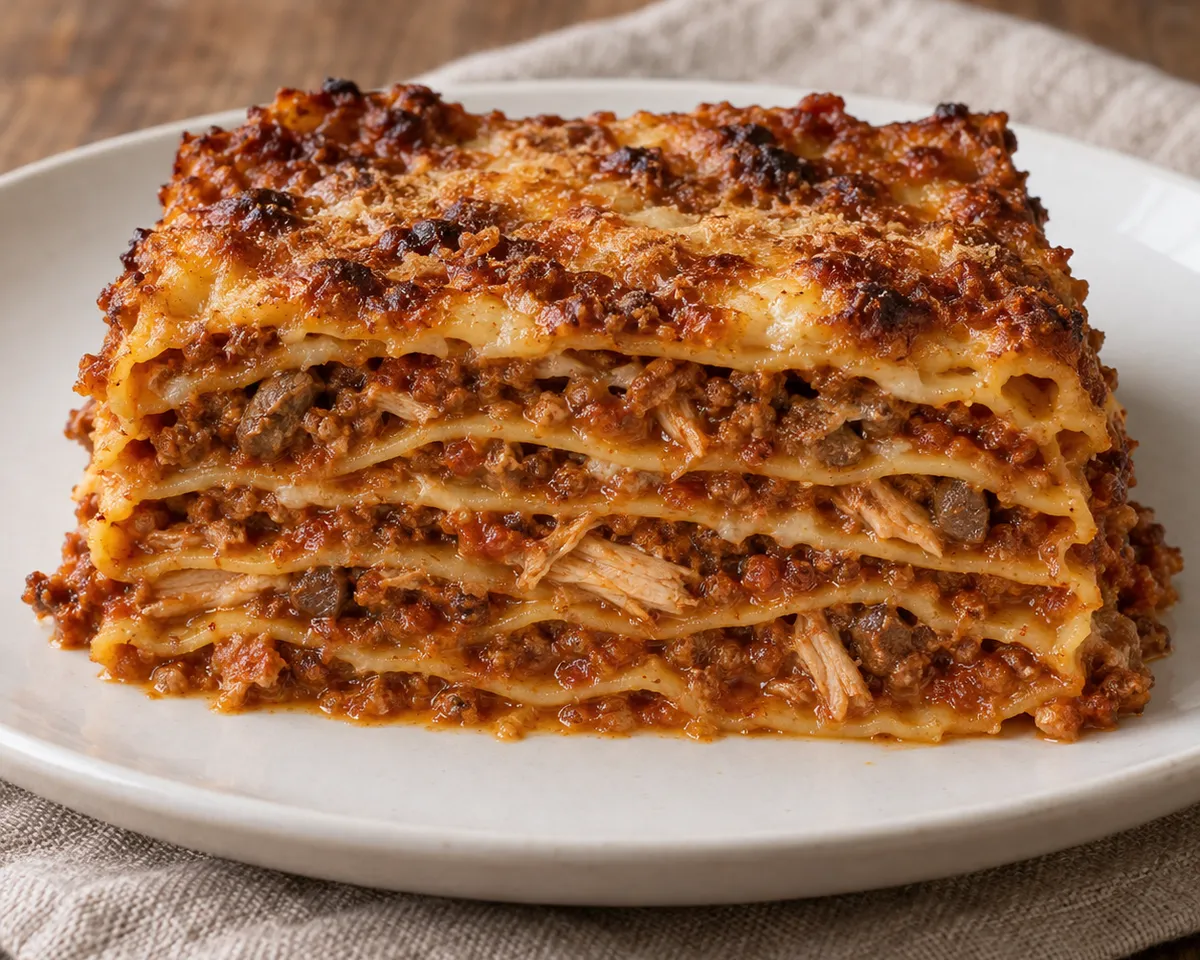
A cut through vincisgrassi reveals a dark, ragù-stained bake with enough distinct layers to hold a crisp top above a soft interior. In the Macerata tradition, the pasta is egg-rich and may carry a little vino cotto; its sauce is long-cooked, built from poultry, meat and the mineral flavor of poultry offal, or rigaglie.
Chicken, pork or beef and offal were ways of making a festive dish from the whole farmyard, while a thin veil of béchamel softens the layers without turning them pale or creamy. Here, boneless cuts are browned, simmered, and pulled into irregular pieces. Chicken livers are cooked separately near the end and left coarse enough to remain an element of the ragù rather than disappearing into it.
Seven pasta layers hold the ragù, béchamel, and cheese. Blanch the fresh sheets briefly, dry them carefully, and spread the sauce generously; the béchamel and cheese belong in modest measure. After the oven, give the pan a proper rest. The wedge should stand for a moment, then yield into a dense, glossy middle that still tastes first of the ragù.
Ingredients
For the egg pasta
- 425 g00 flour or all-purpose flour, plus more for rolling
- 4large eggs
- 1large egg yolk
- 20 ml(4 tsp)vino cotto, or dry Marsala (see note)
- 15 ml(1 tbsp)extra-virgin olive oil
- 3 g(½ tsp)fine sea salt
For the ragù
- 500 g(about 1.1 lb)boneless, skinless chicken thighs, cut in 5 cm (2 in) chunks
- 220 g(8 oz)beef chuck, cut in 5 cm (2 in) chunks
- 180 g(6½ oz)pork shoulder, cut in 5 cm (2 in) chunks
- 120 g(4 oz)chicken livers, trimmed (see note)
- 65 ml(about 4 tbsp plus 1 tsp)extra-virgin olive oil, divided
- 130 gwhite onion, halved; stud one half with 2 whole cloves
- 90 gcarrot, roughly chopped
- 70 gcelery, roughly chopped
- 120 ml(½ cup)dry white wine
- 40 g(about 2 tbsp)tomato paste
- 550 g(about 2⅓ cups)passata di pomodoro
- 40 gParmigiano Reggiano or Grana Padano, finely grated, for the ragù
- 500 ml(2 cups)hot water, plus more only if needed
- 2bay leaves
- fine sea salt and freshly ground black pepper
For the béchamel and assembly
- 220 ml(scant 1 cup)whole milk
- 18 gunsalted butter, plus 10 g for the pan
- 18 g(about 2 tbsp)all-purpose flour
- fine sea salt, black pepper, and freshly grated nutmeg
- 70 gParmigiano Reggiano or Grana Padano, finely grated, for layering
Kitchen notes
- Vino cotto
- Vino cotto is cooked grape must or wine, used in a small quantity to scent the egg pasta; it is not cooking wine, sweet vermouth, or balsamic vinegar. Seek it from a specialist Italian market. Dry Marsala is the traditional alternative.
- Chicken livers
- Chicken livers supply the ragù's poultry-offal flavor. Use them fresh, not a pâté product, and trim away greenish bile staining. They are cooked separately and folded into the sauce late, which keeps the ragù recognizably Maceratese without making it harsh or sandy.
- Passata di pomodoro
- Passata is plain strained tomato purée, sold in bottles or cartons. It is not sweetened jarred pasta sauce. The finished ragù must be red and dark but never loose enough to turn the pasta sheets into soup.
Method
Build the long ragù
- Heat 45 ml (3 tbsp) of the olive oil in a heavy, wide casserole over medium-high heat. Brown the chicken, beef, and pork well in batches; do not crowd the pot. Lower the heat to medium, add the onion, carrot, celery, and bay, and cook until the vegetables take on color at the edges, about 8 minutes. Pour in 105 ml (scant ½ cup) of the white wine and scrape up the browned bits. Stir in the tomato paste for 1 minute, then add the passata and hot water. The meat should be nearly covered; add only enough extra water to achieve that. Season lightly, bring to a very gentle simmer, cover with the lid ajar, and cook until the beef and pork break apart easily, 1½–2 hours.
Finish the meats and livers
- Lift out the chicken and the larger pieces of beef and pork. Discard the bay and the clove-studded onion. Pull or chop the cooked meat into small, irregular pieces, then return it to the sauce. Chop the chicken livers coarsely into pieces at least 5 mm (¼ in) across. Heat the remaining 20 ml (4 tsp) olive oil in a small skillet over medium-high heat, cook the livers just until no longer pink, 4–5 minutes, then add the remaining 15 ml (1 tbsp) white wine and let it evaporate. Season them and stir them into the ragù. Simmer uncovered for 10–15 minutes, until the sauce is dark, thick, and spoonable rather than watery. Stir in the 40 g cheese reserved for the ragù, then taste for salt and pepper. You should have about 1.4 kg of ragù; let it cool until warm while you make the pasta.
Make seven pasta layers from strips
- Mound the flour, make a well, and add the eggs, yolk, vino cotto, olive oil, and salt. Mix, then knead until smooth and firm, 8–10 minutes. Wrap and rest for 1 hour. Roll the dough through a pasta machine or with a rolling pin to a thin sheet, about 0.8–0.9 mm thick. For each layer, cut one strip about 15-by-33 cm (6-by-13 in) and a second about 10-by-33 cm (4-by-13 in). Together, overlapping by about 2 cm (¾ in), they cover the 23-by-33 cm (9-by-13 in) dish. Blanch one or two strips at a time in boiling salted water for 45–60 seconds, cool immediately in cold water, then lay flat on clean kitchen towels and dry both sides. Make fourteen strips for seven layers; keep any trimmings for a small patch.
Make the béchamel
- Warm the milk with a pinch each of salt, pepper, and nutmeg. In a small saucepan melt 18 g butter over medium heat, stir in the flour, and cook for 1 minute without letting it brown. Whisk in the warm milk gradually. Simmer, whisking, until smooth and thick enough to coat a spoon, 4–6 minutes. It should be a thin supporting layer, not a pooled sauce.
Layer and bake
- Heat the oven to 350°F (180°C). Butter a 23-by-33 cm (9-by-13 in) baking dish with the remaining butter. Spread 70 g ragù on the bottom. Lay in the first two-strip pasta layer, then add 175 g ragù, about 30 g béchamel, and 5 g cheese. Repeat for the next five pasta layers, pressing gently so there are no air pockets. Lay in the seventh pasta layer, then finish with the remaining roughly 280 g ragù, about 75 g béchamel, and the remaining 40 g cheese. This allocation uses about 1.4 kg ragù, 255 g béchamel, and 70 g cheese on the layers, in addition to the 40 g in the ragù. Bake uncovered until the top is deeply browned and the edges are steadily bubbling, 30–40 minutes.
Rest before cutting
- Rest the pan for 20 minutes before cutting. This is enough time for the seven layers to settle into clean portions without losing their heat. Serve hot.