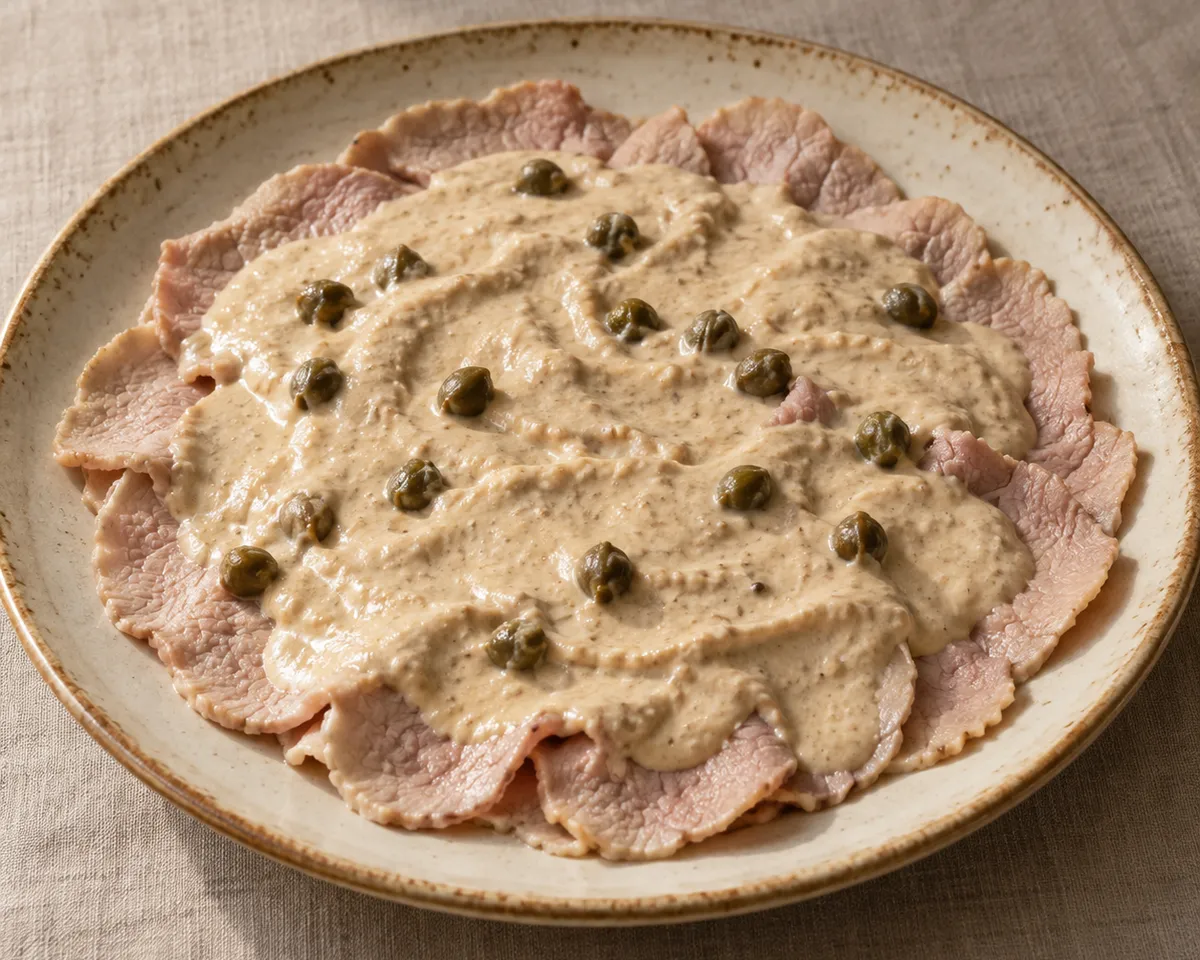
Vitello tonnato
Piedmontese cold veal with tuna-caper sauce
The pleasure of vitello tonnato is its temperature. Chilled, very thin slices of veal take on the silkiness of the sauce, while tuna, anchovy, and caper make the meat taste more itself rather than more fishy. It belongs to the generous antipasti of Piemonte, the kind of dish that improves when made ahead and brought to the table without hurry.
The name survives in Piedmontese as vitel tonnè or vitel tonà. The old-fashioned character lies less in nostalgia than in the sauce: hard-cooked egg and a little of the veal's fragrant liquor give it body. Mayonnaise is common in modern versions, but it is not needed here.
Ingredients
For the veal and poaching liquor
- 700 g(1½ lb)veal eye of round (magatello or girello), in one piece (see note)
- 2 L(about 8½ cups)water
- 250 ml(1 cup)dry white wine
- 1medium carrot, peeled and cut into large pieces
- 2celery stalks, cut into large pieces
- 1small yellow onion, peeled and halved
- 30 gflat-leaf parsley, stems and leaves
- 2bay leaves
- 4black peppercorns
- fine salt
For the salsa tonnata
- 2large hard-cooked eggs, peeled
- 100 g(3½ oz)good oil-packed tuna, drained
- 20 g(about 2 tbsp)salt-packed capers, rinsed and well drained, plus a few for serving (see note)
- 3oil-packed anchovy fillets, drained
- 120 ml(½ cup)extra-virgin olive oil
- ½lemon, juiced
Kitchen notes
- Magatello or girello
- These Italian names refer to the lean, tender eye-of-round cut from the veal leg. Ask a butcher for an evenly shaped veal eye of round; do not use a fatty pot-roast cut or a quick-cooking veal cutlet. Its firm, compact shape is what allows the chilled meat to be sliced very thinly.
- Salsa tonnata
- This is the Piedmontese hard-cooked-egg version: tuna, anchovy, capers, olive oil, lemon, and veal cooking liquor provide the emulsion. The eggs and cooking liquor give the sauce body without bottled mayonnaise.
- Capers and anchovies
- Use capers preserved in salt and rinse them well; their briny flavor is cleaner than oversized vinegar-packed capers. Choose oil-packed anchovy fillets, not the sweet, pickled white anchovies sold as boquerones.
Method
Poach the veal gently
- Put the water, wine, carrot, celery, onion, parsley, bay, peppercorns, and a good pinch of salt in a pot just large enough to hold the veal. Bring to a gentle simmer, lower in the veal, and adjust the heat so the liquid trembles rather than boils hard. Skim any foam in the first few minutes. Start checking after 60 minutes and remove the veal as soon as its center reaches 145°F (63°C); a thin skewer should meet only slight resistance, and a longer cook will dry this lean cut. Rest it for at least 3 minutes, then strain and reserve at least 250 ml (1 cup) of the cooking liquor. Let the veal cool completely, wrap, and chill it for at least 3 hours, preferably overnight; cold meat will slice far more cleanly.
Make a smooth, mayonnaise-free sauce
- Put the hard-cooked eggs, tuna, capers, anchovies, and lemon juice in a blender or use an immersion blender in a tall cup. Blend until smooth. With the motor running, add 30–45 ml (2–3 tbsp) of the strained cooking liquor, then stream in the olive oil slowly until the sauce turns smooth and emulsified. If it is thicker than a soft coat, blend in extra cooking liquor a spoonful at a time until it falls slowly from a spoon. Taste before adding salt: the tuna, anchovies, and capers are already salty. Refrigerate until needed.
Slice and dress
- Slice the thoroughly chilled veal as thinly as you can, ideally 2–3 mm (about ⅛ inch), across the grain. Fan the slices on a cold platter, spoon the sauce over them in a generous but even layer, and scatter with a few extra capers. Cover and refrigerate for 30 minutes so the flavors settle, then take the platter out 10–15 minutes before serving. It should be cool, not refrigerator-cold.